· 4 min read
Cannabis Terpene Testing - The Simple Explanation
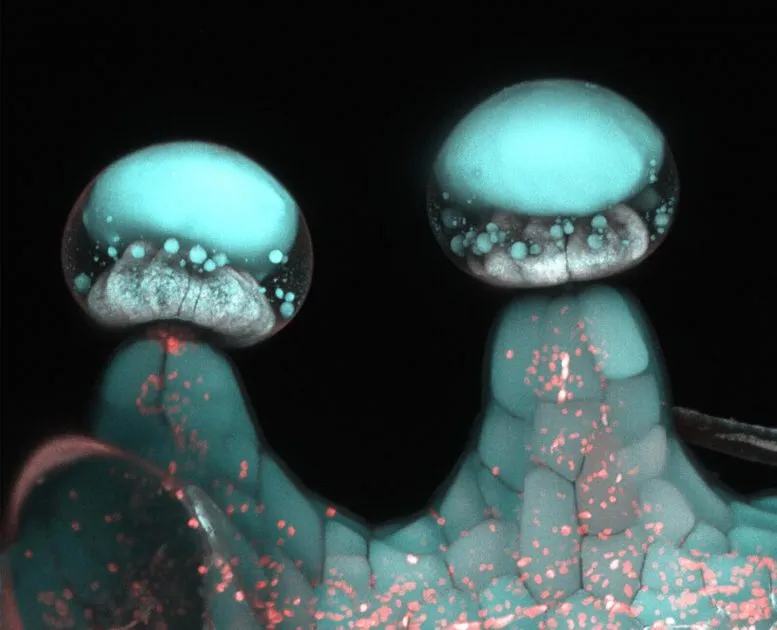
There have been over 100 different terpenes discovered so far and it seems every strain has a unique composition of them. Terpenes are produced inside structures called glandular trichomes, which also produce cannabinoids. These compounds are found in almost every plant and are responsible for the pleasant aromas that can be found in cannabis. The different terpene compositions in each strain are what give unique flavors, aromas, and colors to the cannabis plant. Environmental conditions such as the climate, fertilizer used, soil type, and the age of the plant can play a huge role in terpene development. For example, prior to aging, terpenes are mostly found in high concentrations in unfertilized female plants.
What are Terpenes?
There have been over 100 different terpenes discovered so far and it seems every strain has a unique composition of them. Terpenes are produced inside structures called glandular trichomes, which also produce cannabinoids. These compounds are found in almost every plant and are responsible for the pleasant aromas that can be found in cannabis. The different terpene compositions in each strain are what give unique flavors, aromas, and colors to the cannabis plant. Environmental conditions such as the climate, fertilizer used, soil type, and the age of the plant can play a huge role in terpene development. For example, prior to aging, terpenes are mostly found in high concentrations in unfertilized female plants.
One interesting fact regarding the differences in smells between strains is that a particular strain will always smell a little like its descendants.
Entourage effect: This term was first used in a text published in 1998 by a group of scientists known as the “father of cannabis research” and Dr. Raphael Mechoulam. This term has been mainly used to describe the interaction of cannabinoids with terpenes in cannabis research.
The theory suggests that all the compounds in cannabis work together to produce a better effect than when taken alone.
Playing the devil’s advocate, this theory may not be all that true. Sure, taking THC with a combination of terpenes might promote efficacy, but it is also important to note, that it could also have antagonistic interactions. If the theory was 100% true, then taking CBD and THC together would have an elevated/additive effect – but this is not necessarily true. However, this theory can still be a fishbone to many future studies. In biochemistry, there are chemicals that behave better together than when alone. It is just a matter of finding the chemicals that behave synergistically in cannabis.
Breakdown of Terpene Analysis
There are five benefits to terpene analysis:
- The concentration of Terpenes and the type can be determined in a particular strain
- A strain’s pharmacological benefits can be optimized
- More information on Terpene can help identify the correct strain to give a patient with particular symptoms.
- According to boiling points the proper method of delivery could be identified
- For consumer safety and medicinal efficiency, the analysis of terpenes can contribute to the standardization of compositions.
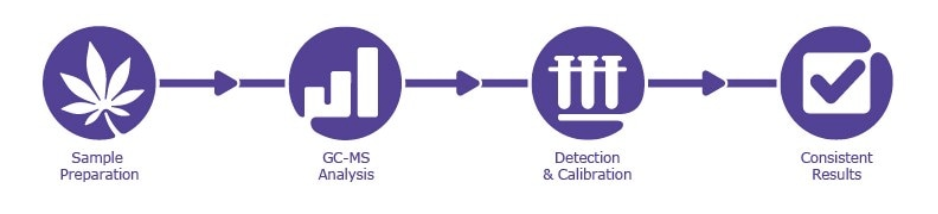
Most to all cannabis testing labs perform Terpene testing using an analytical technology called Gas Chromatography, or GC. Long story short, it is an instrument that uses heat and particle interaction to both evaporate and separate gases (terpenes in this case) which can then be used to quantify terpenes in a cannabis sample. Alongside preparing the samples in hand, it is also highly encouraged and also performed by most analysts/scientists to include Terpene Standard Mixes with every run. Running Terpene Standard Mixtures routinely alongside your samples for the day is extremely crucial for two big reasons:
- it acts as an internal control in which you can compare your samples of interest in reference to the standardized mix and
- it works as quality control to make sure your instrument is behaving consistently from one day to the next.
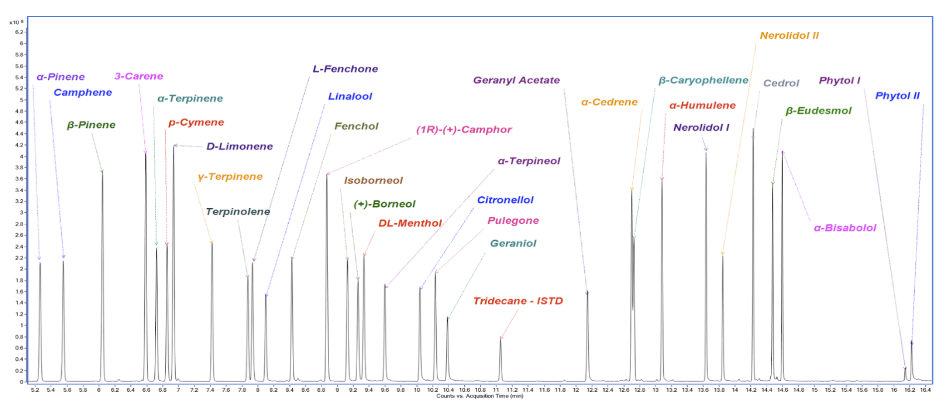
Below is an example of a chromatogram of a terpene Standard Mix that is used as a reference marker to compare and transpose with the raw sample data that the instrument spits out to screen for and identify terpenes.
The Technology: GC-FID / GC-MS
The volatility of Terpenes makes Gas Chromatography a better method to use for the analysis. Unlike for cannabinoids, where both HPLC and GC can be used, for Terpenes, all testing labs are using GC for cannabis terpene testing. The proficiency to rapidly and precisely characterize terpene compounds with a single instrument allows the industry to become more legitimate due to the stringent and controlled standardized testing practices.
A traditional method that has been constantly used for terpene analysis is gas chromatography with a flame ionization detector (GC- FID). The first step involves preparing a solvent-based extraction where the cannabis sample is immersed in a particular solvent (often times it’s either Methanol or Ethanol) to extract a particular compound. Following the extraction step, the next step is to inject this liquid into the GC sample apparatus. The GC then performs the separation step. The separated compounds then exit the separation-column and enter the flame ionization detector (FID), where the samples are “burned out” to produce the ions. Electrodes then detect and measure the current from the ions (or the time it takes for the compound to leave the column and be detected). The retention time of the compound is the unit of measure used to identify and also quantify the terpenes. GC-FID does not require a mass spectrometer.
On the other hand, a GC-MS is a newer and more sensitive technology. With mass spectrometry, the compounds enter the mass spectrometer instead of FID. A mass spectrometer ionizes the compounds leaving the GC, followed by a series of processes as it goes through the system to give a mass to charge ratio as the output.
In summary, GC-FID identifies compounds based on retention time (Retention time is the time that a solute spends in the column) compared to a GC-MS where the mass spectral information for each peak is also provided. Depending on the reason for testing, one method can outperform the other. For measuring levels of drugs and metabolites in biological fluids, for example, the sensitivity and specificity provided by the mass spectrometer would be a more suitable tool for testing.
FAQ
Frequently asked
- Why do cannabis labs use GC instead of HPLC for terpenes?
- The volatility of terpenes makes gas chromatography the better method for their analysis. Unlike cannabinoids, where both HPLC and GC can be used, all testing labs use GC for cannabis terpene testing.
- What is the difference between GC-FID and GC-MS for terpene analysis?
- GC-FID identifies compounds based on retention time and does not require a mass spectrometer; compounds exiting the separation column are burned in the flame ionization detector to produce ions, and electrodes detect and measure the current. GC-MS is a newer and more sensitive technology in which compounds are ionized and reported as a mass-to-charge ratio, so mass spectral information is provided for each peak as well. Depending on the reason for testing, one method can outperform the other.
- Why run a terpene standard mix with every batch?
- Running terpene standard mixtures alongside the day's samples serves two purposes: it acts as an internal control against which samples of interest can be compared, and it works as quality control to confirm the instrument is behaving consistently from one day to the next. The chromatogram from the standard mix is used as a reference marker to compare against the raw sample data in order to screen for and identify terpenes.
- What affects terpene levels in a cannabis plant?
- Environmental conditions including the climate, the fertilizer used, the soil type and the age of the plant can all play a large role in terpene development. Prior to aging, terpenes are mostly found in high concentrations in unfertilized female plants. Terpenes are produced inside structures called glandular trichomes, which also produce cannabinoids.
- Is the entourage effect proven?
- The entourage effect is a theory suggesting that all the compounds in cannabis work together to produce a better effect than when taken alone, and the term was first used in a text published in 1998. It is not settled science — taking THC with a combination of terpenes might promote efficacy, but interactions could also be antagonistic, and if the theory were entirely true then CBD and THC taken together would always have an elevated or additive effect, which is not necessarily the case.
Do you prepare terpene samples alone or use the potency extractant?
Related guides
All guides- 01
Maximizing the Quality and Safety of Your Cannabis: A Guide to Pesticide Testing
Similar to other plants, cannabis plants are prone to diseases, pests, fungi, and bacterial infections. In order to maximize the cultivation yield of cannabis, today cannabis growers are using many techniques to repel and/or kill unwanted pests, which normally involve the application of different pesticides.
Need this tested?
Compare labs that run these assays and get quotes in one go — no account, no fee.