· 12 min read
Maximizing the Quality and Safety of Your Cannabis: A Guide to Pesticide Testing
Similar to other plants, cannabis plants are prone to diseases, pests, fungi, and bacterial infections. In order to maximize the cultivation yield of cannabis, today cannabis growers are using many techniques to repel and/or kill unwanted pests, which normally involve the application of different pesticides.
- pesticides
- cannabis plants
- cultivation
- regulatory authorities
- testing
- pesticide residues
- analytical methods
- insecticides
- herbicides
- fungicides
- rodenticides
- acaricides
- molluscicides
- nematocides

Similar to other plants, cannabis plants are prone to diseases, pests, fungi, and bacterial infections. In order to maximize the cultivation yield of cannabis, today cannabis growers are using many techniques to repel and/or kill unwanted pests, which normally involve the application of different pesticides. Based on the field of use, pesticides are classed into seven major groups: insecticides, herbicides, fungicides, rodenticides, acaricides, molluscicides, and nematocides. By chemical classes, pesticides are divided into organophosphorus compounds (OP), carbamates, chlorinated hydrocarbons, pyrethroids, and heterocyclic compounds. Within indoor cannabis plants, the most commonly present pests are aphids, spider mites, and thrips. When using indoor lighting systems, fungal diseases can also be a potential concern to growers. It is believed that indoor plants are at higher risk of pesticide contamination, compared to plants that are grown outdoors. Knowing this, the most commonly used pesticides in cannabis plantations are insecticides, acaricides, and fungicides. [5]
Chemicals used for increasing or decreasing the rate of growth and maturation of cannabis plants called plant growth regulators (PGRs), such as Daminozide are banned in the US since the 80’s due to concerns that long-term exposure can contribute to increased risk of cancer.[2]
Pesticides are typically sprayed throughout the growth and processing stages of cannabis plants. In the processing stages, most of the pesticides can either stay or be enriched by different processing factors. Since numerous pesticides have shown carcinogenic and mutagenic effects in humans, consumer exposure to residual pesticides has become a concern for both the public and regulative authorities. Due to the diverse routes of exposure, cannabis product consumers may be especially vulnerable to adverse health effects emerging from pesticide residues. Numerous studies report that pesticide residues are rapidly delivered to smokers upon inhalation and additionally, burning plant tissues can pyrolyze these chemicals and form newly formed toxic compounds. Since cannabis is still illegal in most parts of the world, this issue is widely overlooked. [1]
The principal problem is hidden behind the uncontrolled and unregulated use of pesticides that rise a potential risk for public health and the environment. Despite the agricultural benefits, many issues arise with the use of these chemicals, in particular, impact on the ecological system by contamination of the soil, water, and air. Chlorpyrifos for example is an organophosphorus pesticide that is known to be a highly toxic chemical that affects the nervous system. Dichlorodiphenyltrichloroethane is a pesticide that has been banned in numerous countries, because of its known disruptive properties on the endocrine system, at the same time affecting the human reproductive, cardiovascular, and metabolic systems. [2]
Pesticides in cannabis plants and cannabis-based products are ranked high on the list of safety concerns to public health. Depending on the jurisdiction where cannabis-based products are being sold, regulatory authorities require typical analytical protocols including identification and quantification of certain cannabinoids by liquid chromatography (LC) and terpenes by gas chromatography (GC), determination of solvent residuals by GC, identification, and quantification of pesticide residues by LC- mass spectrometry (LC/MS) or gas chromatography-mass spectrometry (GC/MS), heavy metals testing by inductively coupled plasma (ICP), identification of microorganisms such as bacteria, yeasts, and molds by culture or polymerase chain reaction, moisture content analysis and determination of mycotoxins by LC/MS. [4]
Analytical techniques that are presented by the regulations and mostly employed in the determination of pesticide residues in cannabis and cannabis-based products are liquid chromatography (LC) coupled with mass spectrometry (MS), but gas chromatography (GC) coupled with MS is also used for the analysis of non-polar compounds using triple quadrupole (QqQ) as a mass analyzer. GC with electron capture detection (ECD) is a highly sensitive and selective technique for compounds containing electronegative functionality such as halogen atoms. New advanced techniques such as high-resolution mass spectrometry (HRMS) are also being discussed, for performing both targeted and untargeted analyses. The choice of analytical technique generally is dictated by the chemical nature and physicochemical properties of the pesticides. The complexity of the sample matrix brings different possibilities for sample preparation. [2]
Legislation for cannabis pesticide testing
Many countries and states which have legalized cannabis use, have already established certain regulation limits for pesticide residues in cannabis-based products. Due to its pharmacological potential today cannabis is gaining increased attention for the development of versatile and time and cost-effective analytical methods. Analysis of contaminants such as pesticides in cannabis and cannabis-based products is mandatory for ensuring consumer safety. State regulatory agencies are usually aiming at designs for testing regulations that mirror a routine testing program applied to food and pharmaceutical products. When it comes to the safety of cannabis-based products such as oil concentrates, in order to achieve the desired medical properties of the product, raw material is previously concentrated. With this procedure, the concentration of pesticides may also increase. The European Commission has directed maximum residue limits for over 516 pesticides in cannabis, ranging from 5 ng/gram for fipronil and triazoxide to 30 000 ng/gram for copper derivate products. In the United States, the Environmental Protection Agency (EPA) has approved the use of 59 pesticides in Cannabis Sativa. In Oregon (USA), 491 compounds (comprising chlorinated hydrocarbons, organophosphates, carbamates, and pyrethroids) are being controlled with the regulation OAR 333-008 with maximum residue limits of 100 ng/gram. [2]
Pesticide testing requirements and limits also vary between the United States and Canada. In Canada, 96 pesticide residues have been mandated to be tested with limits of quantification (LOQ), depending on the form of the cannabis product (dried flowers: 0.02-3.0 µg/g; oils: 0.01-2.5 µg/g; fresh plant: 0.01-1.5 µg/g). In the United States, there is no federal guidance available with regard to tolerances for pesticide residues in cannabis and regulatory requirements are established individually for each state. For example, in California testing for a total of 66 pesticides is required, while in Oregon, a total of 59 pesticides are mandated. [1]
In 2013, the American Herbal Pharmacopoeia (AHP stated its concerns that a group of pesticides, including acaricides, insecticides, fungicides, and plant growth regulators are potentially being used at cannabis plantations. The first draft list of approved pesticides for use in cannabis cultivation was published by the Colorado State Department of Agriculture in July 2015. [3]
Sample preparation when testing for pesticides in cannabis:
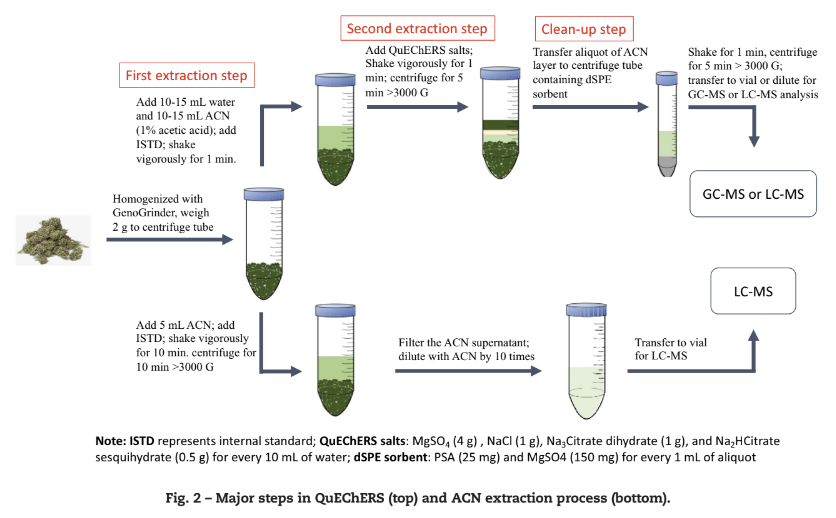
Sample treatment is a very important part of the sample preparation process where as many as possible compounds are needed to be efficiently extracted. In cannabis-based products, this process is rather complex, because of all of the components present in the matrix that can negatively affect the extraction of the pesticides. The most commonly used methods that are developed for the extraction of harmful residues and contaminants are QuEChERS (quick, easy, cheap, effective, rugged, and safe) and SLE (solid-liquid extraction). Very often in SLE, Acetonitrile is used as an extraction solvent to simultaneously extract pesticides and mycotoxins in the cannabis plant. In some cases, Methanol is also used as an extraction solvent for pesticides. Generally, the QuEChERS method is considered to be the most efficient method for extraction of pesticides in the cannabis plant, based on its versatility, easy handling, time effectiveness, and being environment friendly. Because of the complexity of these matrices, an additional step for removing pigments and other interferences is also required in order to additionally eliminated potential interferences with pesticides at trace concentrations. [2]
Separation and detection of pesticides
In order to meet regulatory and quality control standards, cannabis, and cannabis-based products should be tested for residues of both authorized and unauthorized pesticides. Separation of pesticide contaminants is generally carried out by gas chromatography or liquid chromatography techniques, but due to its versatility and capacity to analyze semi-polar and polar pesticides used in cannabis plantations, liquid chromatography is a technique that is being used to a greater extent. C18 is the most commonly used stationary phase in LC and is also employed in the analysis of pesticides in cannabis. Usually, non-buffered mobile phases such as 0,1% formic acid in combination with acetonitrile are used for extraction in the analysis of pesticides in the cannabis plant. In order to detect concentration levels at nanograms/gram or picograms/gram, pesticide contaminants in cannabis and cannabis-based products are usually identified and quantified using high-sensitivity techniques using low-resolution mass spectrometry (LRMS) analyzers such as triple quadruple (Qqq) or triple quadrupole linear ion trap (QTrap). [2]
Separation and detection methods in cannabis pesticide testing
For a wide-range analysis of pesticides, it is a common practice to use both of the most commonly used techniques for pesticide residues, GC and LC. When it comes to pesticide analysis with tandem mass spectroscopy, depending on the cannabis strain, one of the most common challenges is always the high and varying levels of cannabinoids and terpenes in the sample (complex matrix), compared to the low levels of pesticides in traces that may be present. Co-extracting all these components in the final sample brings a high matrix load to the LC-MS/MS system, which can call for more frequent system maintenance, increased downtime during cleaning, decreased column lifetime and/or performance, and dirty valves, build-up of material on spray shields, etc. With these types of samples, GC instrumentation usually encounters similar issues such as dirty inlets and liners, contaminated sources, and clogged syringes. High dilution of samples can reduce the matrix effect, but on the other end, the instrument needs sufficient sensitivity to meet action levels mandated by the regulatory authorities. When dilution of samples is not enough for reducing the matrix effect, thorough sample clean-up is required when preparing the sample for pesticide residues analysis. [4]
Using LC-MS/MS in multiresidue pesticide analysis with electrospray ionization (ESI) is a well-established practice over the last years. The disadvantage of the ESI mode is that it won’t detect every eluting analyte from an LC. GC-MS/MS with electron impact (EI) ionization is generally applied for non-ionizable pesticides that are non-detectable with ESI. Using this kind of separate analysis approach brings complexity to everyday laboratory routine, making it time and labor-intensive. Additionally, some of the tested pesticides are heat liable and can degrade in the GC injection port. An additional approach to this thermal problem can be conducting LC-MS/MS with ESI analysis and then switching the probe to atmospheric pressure chemical ionization (APCI) to analyze pesticides that can not be analyzed in ESI. With this approach, the laboratory is not obligated to have a GC instrument, but the drawbacks include significant instrument downtime that results from changing the ionization sources and probe, as well as the requirement of breaking the mass spectroscopy vacuum. [4]
Preparation of samples for testing pesticides in cannabis
When analyzing biological or environmental samples with complex matrices, analytical method development can be quite challenging. Establishing sufficient sensitivity, precision, accuracy, and specificity in such matrices are critical in the process of method development. This applies to all cannabis-based products, because of the variability in the chemical composition of the cannabis plant. The biggest challenge when developing an analytical method for pesticide residues is the high matrix effect and variability in matrices.
Because of this, samples should be rigorously prepared and the process can be divided into four steps:
- Homogenization of cannabis plants in order to improve extraction efficacy.
- Sample clean-up protocol, followed by a suitable extraction process to reduce the matrix interferences during the analysis
- Pre-concentrating the sample to improve sensitivity, accuracy, and precision
- Stabilizing the sample by reconstitution in a suitable inert solvent.
Different sample clean-up methods
This process is considered to be the classical sample preparation method for many different analytical procedures when analyzing biological or environmental samples. The disadvantages of these types of methods are the use of large quantities of potentially carcinogenic and toxic organic solvents, followed by low extraction properties. These activities are often labor-intensive, time-consuming, and difficult to automate. The extraction of the components of interest mostly depends on their partition coefficients and in the case of solid samples, they all require mechanical pre-treatment like pulverization, grinding, pressing, sonification, etc.
Solid-phase extraction
This process is considered to be the classical sample preparation method for many different analytical procedures when analyzing biological or environmental samples. The disadvantages of these types of methods are the use of large quantities of potentially carcinogenic and toxic organic solvents, followed by low extraction properties. These activities are often labor-intensive, time-consuming, and difficult to automate. The extraction of the components of interest mostly depends on their partition coefficients and in the case of solid samples, they all require mechanical pre-treatment like pulverization, grinding, pressing, sonification, etc.
Solid-phase microextraction
This technique is described as one of the most popular techniques, being simple, sensitive, and easy to automate at relatively low costs. Solid-phase microextraction methods are often considered sample preparation techniques with great potential in pesticide residues analysis and profiling of cannabinoids and terpenes in cannabis plants.
Quick, easy, cheap, effective, rugged, and safe (QuEChERS) method
This approach was first mentioned in 2003 for the determination of pesticide residues in fruit and vegetables and since then has been widely used in the preparation of biological and environmental samples for analysis. In QueChERS-based methods, the water content present in the test samples should be greater than 25% in order to achieve the ideal partitioning of the analytes. When analyzing cannabis matrices, the addition of water is required for further hydration of the matrix, since the raw cannabis flower contains 10-15% water. Using these methods for the preparation of samples desire special caution when mixing salts, for example, MgSO4 mixed with water generates heat due to an exothermic reaction, where temperature labile analytes could degrade. This problem can be easily resolved by adding freezing cold water (< 4°C) or by pre-freezing the samples for analysis before extraction. When using these samples of salt mixtures in GC methods, salts easily deposit in the instrument, especially in the inlet liner. This requires additional attention in the maintenance of the instrument. Due to the complexity of the cannabis sample matrices, any pH alterations in the samples by using salts and water can potentially cause degradation of unstable analytes. Maybe the biggest drawback when using QuEChERS-based methods in cannabis-based products is the fact that when organic solvents are used for extraction, along with pesticide residues other interfering hydrophobic compounds such as cannabinoids and terpenes will also be extracted. [4]
Conclusion
Over the last few years, pesticides that were introduced to cannabis plants either during cultivation or storage are of significant concern to the public and the cannabis industry. Regulatory authorities from different states and countries are also implementing regulations regarding the testing of pesticide residues in cannabis plants and cannabis-based products. Due to the varying complex nature of cannabis samples for testing pesticide residues, many laboratories for cannabis testing are showing interest in the challenging process of developing suitable analytical methods for pesticide analysis in their cannabis-based products. In countries where medical and recreational use of cannabis is legalized, suitable standardized testing protocols for pesticide testing should be available, in order to ensure the quality, efficacy, and safety of all cannabis-based products that are available on the market.

References
- Craven, C. B., Wawryk, N., Jiang, P., Liu, Z., & Li, X. F. (2019). Pesticides and trace elements in cannabis: Analytical and environmental challenges and opportunities. Journal of environmental sciences (China), 85, 82–93. DOI: https://doi.org/10.1016/j.jes.2019.04.028
- López‐Ruiz, R., Marín‐Sáez, J., Garrido Frenich, A. and Romero‐González, R. (2021). Recent applications of chromatography for analysis of contaminants in cannabis products: a review. Pest Management Science, 78(1), pp.19–29. DOI: https://doi.org/10.1002/ps.6599
- Pérez-Parada, A., Alonso, B., Rodríguez, C. et al. Evaluation of Three Multiresidue Methods for the Determination of Pesticides in Marijuana (Cannabis sativa L.) with Liquid Chromatography-Tandem Mass Spectrometry. Chromatographia 79, 1069–1083 (2016). DOI: https://doi.org/10.1007/s10337-016-3029-9
- Sanka N. Atapattu, Kevin R.D. Johnson, Pesticide analysis in cannabis products, Journal of Chromatography A (2019), DOI: https://doi.org/10.1016/j.chroma.2019.460656
- Taylor, A, Birkett, JW. Pesticides in cannabis: A review of analytical and toxicological considerations. Drug Test Anal. 2020; 12: 180– 190. DOI: https://doi.org/10.1002/dta.2747
FAQ
Frequently asked
- Why is QuEChERS the most common prep method for cannabis pesticide testing?
- QuEChERS — quick, easy, cheap, effective, rugged and safe — is generally considered the most efficient method for extracting pesticides from the cannabis plant because of its versatility, easy handling, time effectiveness and environmental friendliness. It was first described in 2003 for determining pesticide residues in fruit and vegetables. Its biggest drawback with cannabis is that when organic solvents are used, interfering hydrophobic compounds such as cannabinoids and terpenes are extracted alongside the pesticide residues.
- Why do you need to add water to a cannabis sample when running QuEChERS?
- QuEChERS-based methods require the water content of the test sample to be greater than 25% to achieve ideal partitioning of the analytes, and raw cannabis flower contains only 10 to 15% water, so water must be added to hydrate the matrix. Care is needed when mixing salts, because magnesium sulfate mixed with water generates heat through an exothermic reaction that can degrade temperature-labile analytes. This is resolved by adding freezing cold water below 4 degrees Celsius or pre-freezing samples before extraction.
- Why does the cannabis matrix cause so many problems in LC-MS/MS pesticide analysis?
- Samples carry high and varying levels of cannabinoids and terpenes compared with the trace levels of pesticides that may be present, and co-extracting all those components produces a high matrix load on the LC-MS/MS system. That leads to more frequent system maintenance, increased downtime for cleaning, and decreased column lifetime and performance; GC instrumentation suffers similar problems including dirty inlets and liners. Diluting samples reduces the matrix effect, but where dilution is not enough, thorough sample clean-up is required.
- Do you need both LC and GC to cover a full pesticide panel?
- For wide-range pesticide analysis it is common practice to use both techniques. LC-MS/MS with electrospray ionization is well established for multiresidue analysis, but electrospray will not detect every analyte eluting from the LC, so GC-MS/MS with electron impact ionization is generally applied for non-ionizable pesticides. An alternative that avoids buying a GC is to switch the probe to atmospheric pressure chemical ionization, though this brings significant instrument downtime and requires breaking the mass spectrometer vacuum.
- Why are pesticide residues in smoked cannabis a particular concern?
- Pesticide residues are rapidly delivered to the smoker on inhalation, and burning plant tissue can pyrolyze the chemicals into new toxic compounds. Because cannabis is frequently grown indoors, the most-used products are insecticides, acaricides and fungicides, aimed at common indoor pests such as aphids, spider mites and thrips.
Related guides
All guides- 01
Cannabis Terpene Testing - The Simple Explanation
There have been over 100 different terpenes discovered so far and it seems every strain has a unique composition of them. Terpenes are produced inside structures called glandular trichomes, which also produce cannabinoids. These compounds are found in almost every plant and are responsible for the pleasant aromas that can be found in cannabis. The different terpene compositions in each strain are what give unique flavors, aromas, and colors to the cannabis plant. Environmental conditions such as the climate, fertilizer used, soil type, and the age of the plant can play a huge role in terpene development. For example, prior to aging, terpenes are mostly found in high concentrations in unfertilized female plants.
Need this tested?
Compare labs that run these assays and get quotes in one go — no account, no fee.