· 9 min read
How much does cannabis testing cost per sample?
Cannabis testing cost per sample is about $322 at large labs and $750 at small ones. What edibles and potency testing cost, and why the price swings.

Any cannabis products sold to customers within the states and countries where cannabis is legal for medicinal AND recreational use is highly regulated either federally or provincially. This regulation emphasizes that every batch of cannabis products must be first tested by a licensed laboratory to ensure that potency and contaminant levels pass the required threshold for it to be safely sold to customers.
Photo credit:
Fabian Blank @blankerwahnsinn
Most to all cannabis testing laboratories have the appropriate equipment to test the following tests:
- Potency
- Mycotoxin
- Pesticide
- Heavy Metal
- Residual solvents
- Terpenes
- Moisture Content
- Water Activity
- pH levels
- Microbial testing: E Coli, Salmonella, Yeast and Mold, Total Aerobic Count, and Viral
It is important to emphasize why the final cost of the cannabis product on retail shelves is what it is and the reason for it. Each cannabis product goes through 1) a series of regulated steps during cultivation and manufacturing even before it reaches the laboratory for testing, and then 2) the laboratory performs a series of tests mentioned above, each involving advanced scientific technology (making sure all levels are compliant with the government regulations) further adding to the cost. Then, 3) once the lab gives a go-ahead, the products are then packaged, distributed, and finally put on shelves for purchase.
Cost to Test Cannabis by Lab-Scale
Cost per Batch of Cannabis
In North America, recreational cannabis is now legal in Canada and in 20 states: Colorado, Washington, Alaska, Oregon, Washington DC, Maine, Massachusetts, Nevada, Michigan, Vermont, Guam, Illinois, Arizona, Montana, New Jersey, New York, Virginia, New Mexico, Connecticut, and California.
Each state and also Canada has their own set of rules and regulations and it is extremely important to first research the laws and regulations of a specific geographic location before building any Cannabis based business. For simplicity, we will only focus on California and discuss the overall cost of building and maintaining a cannabis testing lab.
Firstly, in California, recreational cannabis is legal for an adult aged over 21 to either possess, purchase or distribute one ounce of cannabis and as little as 8 grams of concentrated cannabis. An adult also has permission to grow up to 6 cannabis plants in their home.
All products must be tested by a licensed laboratory before it goes on the shelf for customers to buy. Alongside, all cannabis products must be manufactured and held by a licensed distributor. When trying to find the costs of these licensed testing laboratories – it is, unfortunately, not as readily available – since most labs do not publish them online. Each lab (depending on if it’s a startup or a larger company) has its set of prices based on labor, testing materials and equipment, the type of sample and the number of samples to be tested. Some testing labs can give a package deal for a large sample number vs. testing one sample. Regardless, this arrangement is made by a contractual agreement by the distributor and licensed testing laboratory.
A research group in California has conducted thorough research on what it takes to run a licensed testing laboratory and gives detailed data on estimates of the capital required including the fixed and variable costs. They ensured that all costs were included in their estimates such as the costs of equipment (e.g. supplies, instruments, chemical reagents), facilities, maintenance, supplies, technical and managerial labor, taxes, and buffering costs (when laboratory costs are higher than budget at times). To make sure that the cost estimates were a good representation of the entire state of California, the data was gathered from established cannabis testing labs, new cannabis testing labs (startups), labs that test other products alongside cannabis products, and other industry sources such as advisors and retailers. The cost of transportation of the cannabis products to and from manufacturing and test facilities was also taken into account across the state.
When it comes to testing cannabis samples in a lab, it is extremely important to keep in mind that some cannabis samples will fail after testing. In this study, they considered the California Department of Pesticide Regulation data and notes based on experience shared by labs to tackle the budget leeway if inventory is lost due to a failed test. They did this simply by accounting for samples that were remediated following the first fail. Wholesale prices and a survey of retail cannabis were also used to better incorporate the opportunity costs of failed samples (This specific unpublished research was performed by the University of California Agricultural Issues Center).
Three different lab sizes were kept in mind when developing a fixed cost per unit of cannabis being testing by each lab to understand the overall distribution cost within the industry. An assumption was made regardless of the size of the laboratory. This was that they all used the same inputs/metrics but in different proportions. The assumption was also made that the economies of scale provide larger labs with a competitive advantage over smaller ones because the larger the business, the lower its per-unit costs.
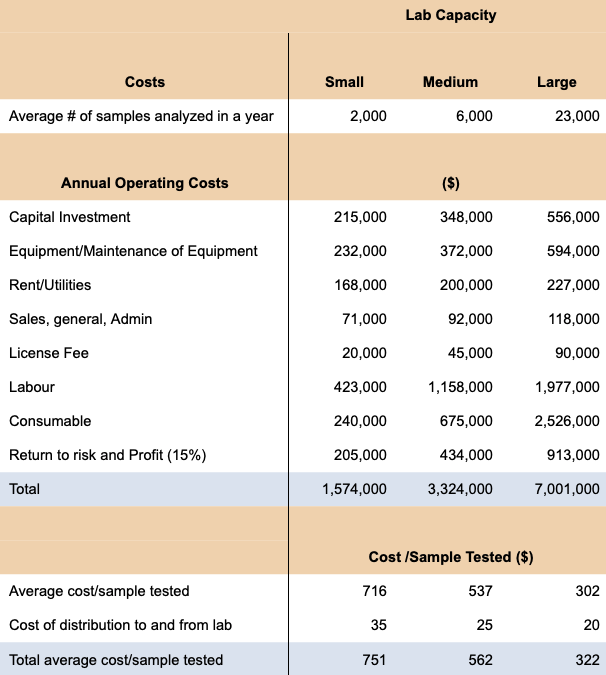
NOTE: The cost values in this table are simplified and general estimates and not a determined fixed value. For the purpose of this article, this table is only meant to give a simplified overview and is a more simplified representation of the study referenced above.
Based on discussions within the cannabis industry, the general number of samples analyzed annually were estimated depending on the size of the laboratory – whether small, medium, or large. The largest costs across all the laboratories came from equipment and equipment maintenance, other general laboratory expenses such as consumables, and labor cost. In the grand scheme of things, the costs as a whole are less than proportional to the number of samples tested and therefore contribute to economies of scale. The return to risk and profit was simply 15% of the sum of the foregoing expenses. Interestingly, in the cannabis industry, since there are so many uncertainties, the risk-return tradeoff is very common. The idea is as follows, the higher the risk, the higher the reward. So in total, they estimated that for a small lab the total cost would be around $1.6million, for a medium-sized lab about $3.3 million, and for a large lab around $7.0 million.
Now, let’s look back at why the study’s assumption of economies of scale suggests that larger labs hold a competitive advantage over smaller labs. This is reflected in the testing cost per sample. On average within the lab (taking into account more than one test is being performed on a sample), large labs commonly charge around $322 whereas a small lab charges around $750 per sample. These costs mentioned above represent an average cost per sample, for more than one test - oftentimes is a combination of potency and microbial testing. Overall, a large testing lab has more labor and equipment advantages versus a small lab – a large lab can process as much as 10 times the number of samples – and the annual operating costs are only about five times higher.
Importance of Contaminant and Potency Testing in Cannabis
There are many different types of cannabis products currently available in the cannabis market, which can make testing for some types extremely complex. These types include dried flowers (pre-rolled or consumer-ready form), edibles (e.g. cookies, brownies, gummies, and beverages), vape-pen cartridges with cannabis oil, tinctures, and topicals (a.k.a creams, and lotions). Depending on the cannabis product the cannabis tests can vary. For example, edibles, potency, and microbial tests are usually the basic types of testing requested by distributors. For pre-rolled flowers, pesticide and mycotoxin testing are often requested, and not potency for these products, so on and so forth.
Contaminant and potency testing is extremely important for any cannabis product to be considered legal in the market. A study has shown and summarized a list of mandatory testing per batch type and criteria used to pass tests. The summary includes the substances measured in each test (for example, cannabinoids or pesticides), provides a description of the type of test to be performed for the substance, and the criteria for passing the test.
Oftentimes, tests such as potency, foreign matter testing, heavy metals, mycotoxins, microbial contamination testing, and terpenes are requested for all batches of cannabis. Moisture Content tests are often just applied to flowers and solids (e.g. brownies). So like mentioned before, the specifics and regulated limits of each test are dependent on which cannabis product type is being tested. All licensed testing laboratories are responsible for only receiving samples for testing from licensed distributors. Following performing each test, it is the laboratories responsibility to establish/create a certificate of analysis (CoA) showing the results (either a pass or fail) and analysis of each test. The batch of samples must pass before those can be put on retail shelves for selling.
Among all tests, the strictest limit is on pesticide residues.
Firstly, let’s define what Tolerance Levels are, in any food science research. A Tolerance Level is defined as the maximum allowable amount of chemical residue, legally allowed in food. Interestingly, compared to other agricultural products in California, the maximum allowed tolerance level set on cannabis products is very tight. In cannabis, the maximum residual level is ZERO for most of the pesticide types – suggesting that very sensitive and rigorous testing is required. For pesticides with a more flexible limit – even if the tolerance level can be above ZERO, it is still very low and specifically for inhalable products. More so, this tolerance level for inhalable products can also be said to have very low levels compared to other agricultural products.
Cannabis Testing and its Laboratory Challenges
Cannabis can pose many challenges in a laboratory setting due to its numerous forms – whether it’s edibles, distillates, flowers, beverages, topicals, etc. To add to these challenges, cannabis consists of hundreds of different compounds that are both known and unknown; some compounds happen to be psychoactive whereas others are not, and they can be consumed in many ways, be it via inhalation, ingestion, topical absorption, etc.
For potency testing, for example, most labs have already adapted to common effective methods, but there is still ongoing work happening trying to identify faster and more accurate methods to effectively identify these compounds. The most common method for potency testing is undoubtedly High-Performance Liquid Chromatography (HPLC) utilizing an ultraviolet-visible spectrum detector (UV-VIS). Although a mass spectrometer is a valid and powerful detector with greater sensitivity, the cost of use versus UV-VIS detection makes it infeasible. As more and more cannabis testing labs are entering the market, instrument manufacturers are working to provide separation methods to be used with their products and this is helping push HPLC UV-VIS as the industry standard for potency analysis.
Terpene testing on the other hand utilizes gas chromatography since the terpenes are volatile compounds. With over 100 possible terpenoids, the cannabis plant can produce a plethora of unique combinations that end-users find interesting. Labs can choose between GC-GC, GC-MS, and GC-Headspace methodologies but since terpene detection accuracy is not of utmost importance, most go with GC-GC due to the minimal cost, and appropriate accuracies, and efficiency.
Testing for mycotoxins, heavy metals, microbes, residual solvents, and pesticides are the most important tests when it comes to consumer safety though. These contaminant tests protect the end-user from ingesting dangerous compounds, toxins, and bacteria.Interestingly, because the cannabis plant is a phytoremediation plant, it makes these tests so much more crucial for consumer safety. What does phytoremediation mean? Phytoremediation plants can readily and actively absorb many chemicals present in the soil, water, and air.
One of the biggest challenges in Cannabis testing over other agricultural products is that method and validation protocols are continuously ongoing, as well as the law surrounding cannabis is evolving. There are no standardized analytical testing methodologies within the industry thus far. So when it comes to research in Cannabis, there is versatility and in return we get variability. Yes, the cannabis plant is complex, but since the research field in this industry is still fairly new and the laws and regulations are constantly changing, the time and cost of testing from seed to sale will be constantly varying throughout the years to come.
FAQ
Frequently asked
- How much does cannabis testing cost per sample?
- Roughly $322 per sample at a large lab and about $750 at a small lab, based on the PLOS ONE cost model for California labs. That average covers more than one assay, typically potency plus microbial, so single-assay prices are lower and a full compliance panel is higher.
- Why do small labs charge more per sample than large labs?
- Economies of scale. The same study found a large lab can process about ten times the samples of a small lab while its annual operating costs are only about five times higher, so the fixed cost of instruments and staff is spread over far more samples.
- What does it cost to run a cannabis testing lab per year?
- The California cost model estimates about $1.6 million a year for a small lab, $3.3 million for a medium lab, and $7.0 million for a large lab, with equipment, maintenance, consumables, and labor as the largest line items.
- Which tests are included in a cannabis compliance panel?
- Most licensed labs run potency, mycotoxins, pesticides, heavy metals, residual solvents, terpenes, moisture content, water activity, pH, and microbial testing (E. coli, Salmonella, yeast and mold, total aerobic count). Which of these are mandatory depends on the state.
- How much does edibles testing cost compared with flower?
- Edibles usually cost more per sample than flower because the infused matrix needs extra sample preparation and, in many states, a homogeneity test across the batch. Ask the lab for its edibles price list rather than assuming the flower rate.
Related guides
All guides- 01
Cannabis Testing Lab Certification: How to Prepare Cannabis Testing Labs for ISO 17025 Audits
In 1973 Oregon was the first U.S. member state that decriminalized cannabis. California, in 1996 became the first state to legalize the medical use of cannabis. In 2012 Colorado and Washington became the first states to legalize the recreational use of cannabis. As of 2019, thirty-three states, four of the permanently inhabited U.S. territories, and the District of Columbia have legalized medical cannabis. Globally, cannabis is legalized in forty-four countries, with four countries legalizing recreational use of cannabis.
Need this tested?
Compare labs that run these assays and get quotes in one go — no account, no fee.