· 11 min read
Cannabis Lab 101: Cannabis Testing Lab Software — LIMS Options Compared for Small Labs
I spent four years on the bench watching labs drown in spreadsheets and manual Metrc entry. This guide compares the LIMS platforms actually used in cannabis testing labs — named vendors, published pricing where available, Metrc integration depth, and what ISO/IEC 17025:2017 actually requires from your records software.
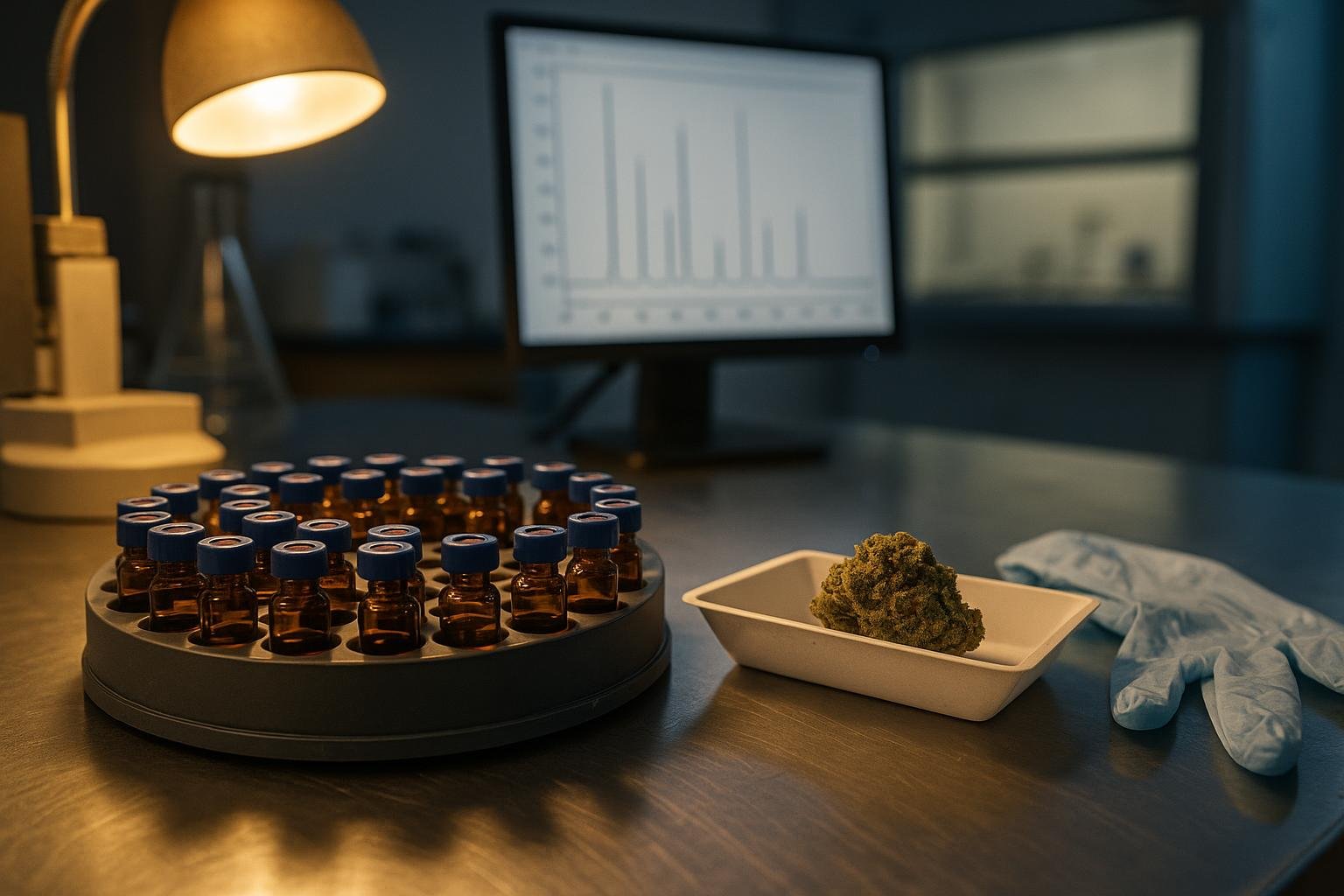
Picking the wrong LIMS is the most expensive mistake a small cannabis testing lab can make — more expensive than a bad centrifuge, more disruptive than a failed proficiency test. I spent four years on the bench watching labs drown in spreadsheets and manual Metrc entry, and the pattern is always the same: the lab buys software that looked good in a demo but was never actually designed for cannabis compliance workflows. This guide names the platforms, compares what is publicly known about pricing, and tells you exactly what to look for before you sign anything.
Whether you are a lab director evaluating your first LIMS purchase, a bench tech who has been manually typing results into Metrc for six months and is ready to make the case to management for automation, or a startup lab trying to understand what software you actually need on day one — this article is for you. Investors, dispensary shoppers, and consumers will find nothing useful here.
This article covers a lot of ground. Here is what is coming:
- What ISO/IEC 17025:2017 actually requires from your records software (and what it does not)
- What a cannabis LIMS must do for Metrc compliance
- How to evaluate vendors — named platforms, published pricing where it exists
- How to migrate from one LIMS to another without losing your accreditation
Step 1: Understand What ISO/IEC 17025:2017 Actually Requires from Your Software
Before you evaluate a single vendor, you need to know what the standard actually says — because vendors will tell you their software is “ISO 17025 compliant” and that phrase means almost nothing without context.
ISO/IEC 17025:2017 clause 7.5.1 requires that technical records contain sufficient information to allow a test to be repeated under conditions as close as possible to the original, including the date and the identity of personnel responsible for each laboratory activity and for checking data and results. That is the baseline: dated, attributed records.
Clause 7.5.2 goes further for amendments: any change to a technical record must be traceable to the previous version or original observation, must include the date of alteration, must indicate what was changed, and must identify the person responsible. Critically — and this is where vendor marketing gets sloppy — the standard does not mandate a specific “timestamp field” or “user ID field” by name. It requires traceability to a person and a date. The UNIDO guide to ISO/IEC 17025:2017 puts it plainly: original observations, calculations, and derived data should be dated and traceable to the person responsible. CALA’s P07:2017 application guidance adds that both the original and amended records must be retained — not just the final version.
What this means in practice: your LIMS must produce a locked, human-readable audit trail showing who changed what record and on what date, and it must retain the original value alongside the amended one. A spreadsheet where someone overwrites a cell fails this requirement immediately. Any LIMS worth evaluating will have this audit trail built in — ask to see it in the demo, not just hear about it.
Clause 8.4 covers general record control — identifiability, retrievability, security, and protection from destruction — but the per-change traceability rules live in clause 7.5.2. Keep that distinction clear when you are reading vendor compliance checklists.
For a deeper look at preparing for an ISO 17025 audit, see our guide on cannabis lab certification and ISO 17025 audit preparation.
Step 2: Map Your Metrc Integration Requirements Before Talking to Any Vendor
Metrc is the seed-to-sale tracking system used by a number of U.S. cannabis states. If your state uses Metrc, your LIMS either talks to it or your staff does — and manual entry at scale is where transcription errors and compliance failures live.
Metrc’s Open API is the mechanism: a testing facility using a LIMS can, after proper integration and testing, upload information automatically into Metrc’s database rather than entering it by hand. Metrc does not charge third-party software providers API access fees, which CloudLIMS confirmed in its coverage of New York’s BioTrack-to-Metrc transition — removing one financial barrier for LIMS vendors building integrations.
Before you talk to a single vendor, build a one-page mapping document that answers:
- Which Metrc state license(s) does your lab operate under?
- What sample types do you receive — flower, concentrate, edible, topical?
- Do you issue resamples, and how does your state require those to be recorded in Metrc?
- What result fields does your state’s Metrc configuration require at upload?
Confident LIMS puts the typical Metrc integration timeline at 2–6 weeks when license numbers, sample-type mappings, and resample logic are defined upfront — delays almost always come from incomplete mapping, not from the API itself. Hand that document to every vendor you evaluate and ask them to show you, in a live environment, how their system handles your specific sample types.
Note that Metrc is not the only seed-to-sale system in use across U.S. cannabis states. BioTrack operates in some jurisdictions. If your state uses a different system, verify that your candidate LIMS has a verified integration for that specific system, not just Metrc.
Note: Hemp testing labs operating under federal oversight rather than a state cannabis program may not be subject to Metrc at all. Verify your specific state’s requirements directly with your state regulator before assuming Metrc integration is mandatory.
Step 3: Evaluate the Named Platforms — Features, Metrc Depth, and Pricing
Here is what is publicly known about the platforms that appear most frequently in cannabis testing lab conversations. I am not endorsing any of them — I am telling you what the vendors say and where the pricing is actually published.
CloudLIMS
CloudLIMS is a SaaS platform that describes itself as SOC 2 compliant and ISO 9001:2015 certified. It has announced Metrc integration in Ohio and Michigan, with the integration allowing labs to automatically import sample data — including Metrc package tag IDs and strain information — and upload test results back to Metrc. The vendor describes its SaaS model as carrying zero upfront cost.
CloudLIMS is the only named cannabis LIMS vendor with publicly accessible pricing tiers. G2’s CloudLIMS pricing page (last updated August 6, 2026) shows pricing ranging from roughly $42 to $310 per month depending on the plan. A 3-user annual plan at $310 per month unlocks full customization, instrument integrations, CoA generation, client portals, Metrc and QuickBooks connectivity, and compliance features. A 4-user plan runs $270 per user per month billed annually; a 5-user plan runs $285 per user per month billed annually. These are third-party-reported figures — verify current pricing directly with CloudLIMS before budgeting.
LabWare GROW
LabWare markets LabWare GROW as a SaaS LIMS designed specifically for CBD/THC testing, pre-built for seed-to-sale tracking. The GROW product page emphasizes that subscribers always receive the current version without costly upgrade projects — a real advantage for small labs that cannot staff an IT department. LabWare has published guidance on integrating LIMS with Metrc for cannabis compliance. Pricing is not published; LabWare GROW is quote-only.
ATL Sample Master
Accelerated Technology Laboratories (ATL) states that Sample Master LIMS is Metrc-verified in eight states: California, Colorado, Maryland, Michigan, Nevada, Ohio, Oregon, and Massachusetts. Metrc-verified means the integration has been tested against Metrc’s API in that state’s specific configuration — a meaningful distinction from a vendor who simply claims Metrc compatibility. Pricing is quote-only.
Confident LIMS
Confident LIMS announced full Metrc integration in Illinois, noting that all licensed labs were required to be fully operational in Metrc as of July 1, 2025. The platform publishes useful technical detail on its integration approach, including the 2–6 week timeline noted above. Pricing is not publicly listed.
What I suggest labs ask every vendor during the demo: Show me the audit trail for a result that was amended after initial entry. Show me a Metrc upload for a failed sample with a resample. Show me how a CoA is generated and what happens if a result is out of specification. If the demo is scripted around happy-path workflows only, that is a red flag.
Note: Matrix Gemini (Autoscribe) appears in cannabis LIMS discussions but does not publish verifiable cannabis-specific pricing on its official site. Treat any third-party price figures for Matrix Gemini as unconfirmed until you get a direct quote.
For context on what testing actually costs per sample — which affects how you think about LIMS ROI — see our breakdown at the cost of testing cannabis for small, medium, and large labs.
Step 4: Plan Your Migration Without Losing Accreditation
Switching LIMS mid-accreditation cycle is genuinely risky if you do not plan it properly. The single biggest migration mistake is treating the data transfer as an IT project rather than a quality event.
Here is the sequence I suggest:
Before you sign the new contract:
- Export a full data dump from your current system in a readable format (CSV or XML, not a proprietary binary). Confirm the new vendor can ingest it.
- Identify every instrument integration your current LIMS handles and confirm the new platform supports the same instrument communication protocols.
- Map every report template — CoAs, QC summary reports, proficiency test records — and confirm the new system can reproduce them.
During the transition period:
- Run both systems in parallel for at least two to four weeks. Every result entered in the new system should be cross-checked against the old one.
- Document the parallel-run as a validation activity. Your accreditation body will ask for evidence that the new system produces equivalent output.
- Confirm that your Metrc integration is tested and verified before you decommission the old system. Confident LIMS’s Illinois announcement is a useful example of what a go-live looks like when the state sets a hard deadline.
After go-live:
- Archive the old system’s data in a retrievable format for the duration your accreditation body requires records to be kept.
- Update your quality manual to reference the new system, including the new audit trail procedure.
- Notify your accreditation body if the LIMS change constitutes a significant change to your quality management system — most bodies require this.
The records requirement that trips up migrations most often is clause 7.5.2’s retention of original observations. If your old system holds raw instrument data that your new system cannot import, you need a documented procedure for how auditors access those historical records. “We deleted the old server” is not a procedure.
For context on method validation requirements that intersect with LIMS configuration, see our Cannabis Lab 101 validation guide.
Quick answers
How much does cannabis LIMS software cost per month? CloudLIMS publishes tiers on G2 ranging from roughly $42 to $310 per month depending on the plan selected, with a 3-user annual plan at $310 per month unlocking Metrc connectivity, CoA generation, and instrument integrations. LabWare GROW and ATL Sample Master are quote-only, so you will need to contact those vendors directly for pricing. Budget for implementation time on top of any subscription fee — Metrc integration alone typically takes 2–6 weeks according to Confident LIMS.
Does my cannabis LIMS need to integrate with Metrc? If your state uses Metrc as its seed-to-sale tracking system, yes — your LIMS either integrates with Metrc or your staff enters results manually, which is slow and error-prone. Metrc’s Open API allows third-party systems like a LIMS to upload test results and import sample data electronically rather than via manual entry. ATL Sample Master is Metrc-verified in eight states; CloudLIMS has announced verified integrations in Ohio and Michigan, among others.
What does ISO/IEC 17025:2017 actually require from LIMS record-keeping? Clause 7.5.1 requires that technical records contain the date and identity of personnel responsible for each laboratory activity, and clause 7.5.2 requires that any amendment to a technical record be traceable to the previous version, include the date of alteration, indicate what was changed, and identify the person responsible — but the standard does not mandate a specific timestamp field or user-ID field by name. In practice, a LIMS audit trail that captures who changed what and when satisfies the intent of both clauses. See the UNIDO guide to ISO/IEC 17025:2017 for a plain-language walkthrough.
Can I use a spreadsheet instead of a LIMS for cannabis compliance testing? Technically nothing in ISO/IEC 17025:2017 forbids spreadsheets, but clause 7.5.2’s amendment-traceability requirement is extremely difficult to satisfy reliably in Excel — a cell can be overwritten with no record of the original value. Most accreditation bodies will flag an uncontrolled spreadsheet system as a nonconformity during audit. A purpose-built LIMS with a locked audit trail is the practical answer for any lab running more than a handful of samples per day.
How long does Metrc integration take when switching LIMS vendors? 2–6 weeks is the typical timeline according to Confident LIMS, when license numbers, sample-type mappings, and resample logic are defined upfront before the integration work begins. Delays almost always come from incomplete mapping of your sample types to Metrc’s required fields, not from the API itself. Build that mapping document before you sign a contract with any new vendor.
What is the difference between a cannabis-specific LIMS and a generic laboratory LIMS? A cannabis-specific LIMS ships with pre-built Metrc connectors, certificate-of-analysis templates formatted for state reporting, and sample intake workflows designed around flower, concentrate, and edible matrix types. A generic LIMS can be configured to do the same things but requires significantly more implementation work and ongoing maintenance to stay current as state regulations change. For a small lab with limited IT resources, a cannabis-specific platform almost always reaches compliance faster.
Sources
- ISO/IEC 17025:2017 clauses 7.5.1 and 7.5.2 — UPM/CQA summary document
- UNIDO Guide to ISO/IEC 17025:2017 (June 2020)
- CALA P07:2017 — Application of Requirements in ISO/IEC 17025:2017
- Metrc Open API page (June 5, 2024)
- CloudLIMS — Metrc integration announcement, Ohio (August 14, 2024)
- CloudLIMS — Metrc integration announcement, Michigan (July 16, 2024)
- CloudLIMS — LIMS interface to Metrc for regulatory reporting (March 14, 2024)
- CloudLIMS — BioTrack to Metrc transition, New York (June 16, 2026)
- G2 — CloudLIMS pricing page (last updated August 6, 2026)
- LabWare — CBD/THC industry page
- LabWare GROW — SaaS LIMS product page (December 31, 2025)
- LabWare — Cannabis LIMS compliance and Metrc interface blog post (September 28, 2023)
- ATL Sample Master — Cannabis LIMS page (August 14, 2023)
- Confident LIMS — Metrc and BioTrack integration overview (April 24, 2026)
- Confident LIMS — Metrc integration in Illinois (August 5, 2025)
FAQ
Frequently asked
- How much does cannabis LIMS software cost per month?
- CloudLIMS publishes tiers on G2 ranging from roughly $42 to $310 per month depending on the plan selected, with a 3-user annual plan at $310 per month unlocking Metrc connectivity, CoA generation, and instrument integrations. LabWare GROW and ATL Sample Master are quote-only, so you will need to contact those vendors directly for pricing. Budget for implementation time on top of any subscription fee — Metrc integration alone typically takes 2–6 weeks according to Confident LIMS.
- Does my cannabis LIMS need to integrate with Metrc?
- If your state uses Metrc as its seed-to-sale tracking system, yes — your LIMS either integrates with Metrc or your staff enters results manually, which is slow and error-prone. Metrc's Open API allows third-party systems like a LIMS to upload test results and import sample data electronically rather than via manual entry. ATL Sample Master is Metrc-verified in eight states; CloudLIMS has announced verified integrations in Ohio and Michigan, among others.
- What does ISO/IEC 17025:2017 actually require from LIMS record-keeping?
- Clause 7.5.1 requires that technical records contain the date and identity of personnel responsible for each laboratory activity, and clause 7.5.2 requires that any amendment to a technical record be traceable to the previous version, include the date of alteration, indicate what was changed, and identify the person responsible — but the standard does not mandate a specific timestamp field or user-ID field by name. In practice, a LIMS audit trail that captures who changed what and when satisfies the intent of both clauses. See the UNIDO guide to ISO/IEC 17025:2017 for a plain-language walkthrough.
- Can I use a spreadsheet instead of a LIMS for cannabis compliance testing?
- Technically nothing in ISO/IEC 17025:2017 forbids spreadsheets, but clause 7.5.2's amendment-traceability requirement is extremely difficult to satisfy reliably in Excel — a cell can be overwritten with no record of the original value. Most accreditation bodies will flag an uncontrolled spreadsheet system as a nonconformity during audit. A purpose-built LIMS with a locked audit trail is the practical answer for any lab running more than a handful of samples per day.
- How long does Metrc integration take when switching LIMS vendors?
- Confident LIMS puts the typical timeline at 2–6 weeks when license numbers, sample-type mappings, and resample logic are defined upfront before the integration work begins. Delays almost always come from incomplete mapping of your sample types to Metrc's required fields, not from the API itself. Build that mapping document before you sign a contract with any new vendor.
- What is the difference between a cannabis-specific LIMS and a generic laboratory LIMS?
- A cannabis-specific LIMS ships with pre-built Metrc connectors, certificate-of-analysis templates formatted for state reporting, and sample intake workflows designed around flower, concentrate, and edible matrix types. A generic LIMS can be configured to do the same things but requires significantly more implementation work and ongoing maintenance to stay current as state regulations change. For a small lab with limited IT resources, a cannabis-specific platform almost always reaches compliance faster.
Need this tested?
Compare labs that run these assays and get quotes in one go — no account, no fee.