· 12 min read
Cannabis Lab 101: Cannabis Beverage Testing — Emulsions, Homogeneity, and Shelf Stability
I've run potency on flower all day, but the first time a cannabis beverage came through the door I realized the matrix changes almost everything — extraction, homogeneity sampling, particle size, pH, and stability all need rethinking. Here's what the bench actually looks like for infused beverages.
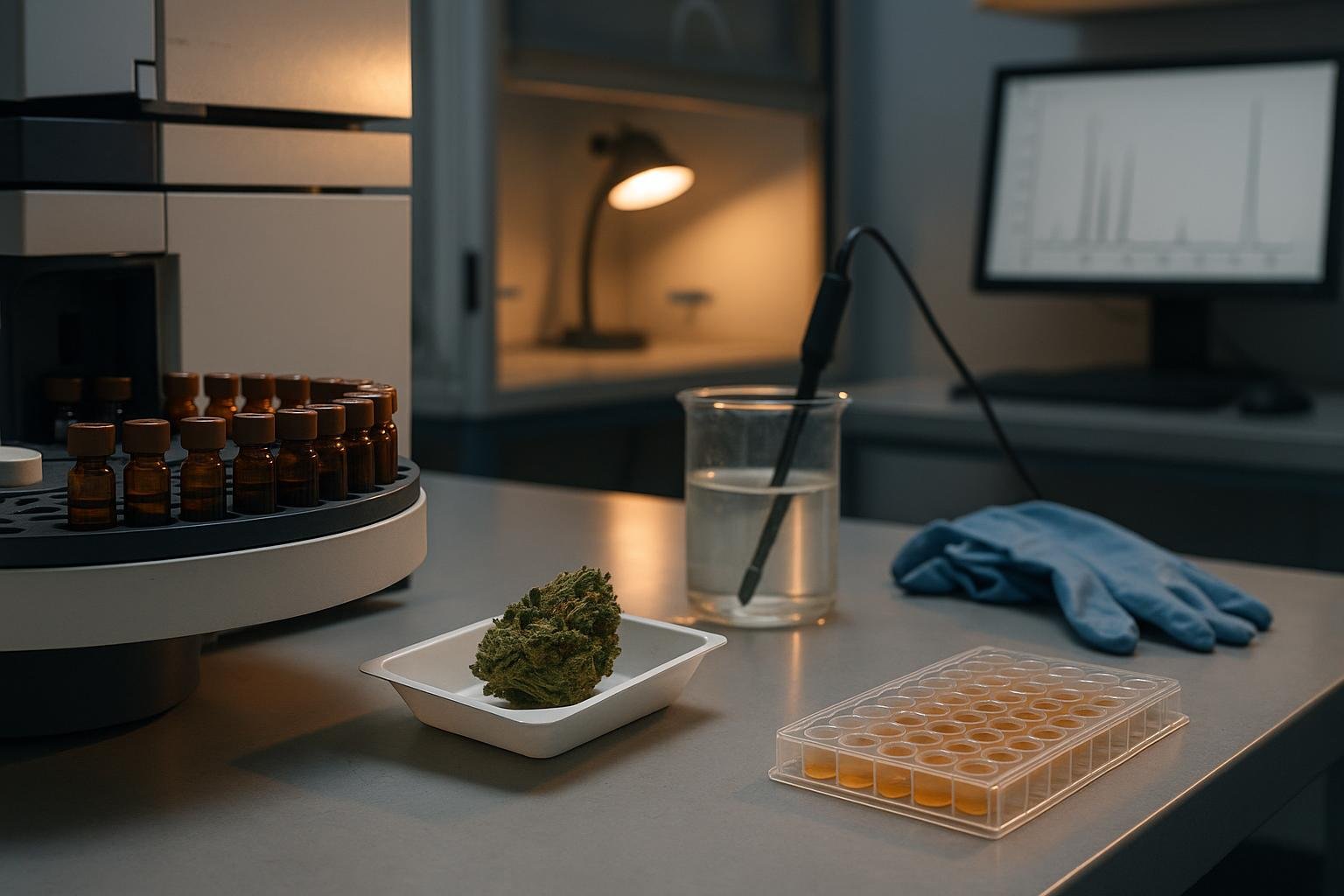
Cannabis beverages are the matrix that humbles bench chemists who think they have seen everything. The sample is aqueous, often carbonated, sometimes acidic enough to degrade cannabinoids on contact with the wrong container, and built around an emulsion whose droplet size determines both bioavailability and analytical recovery. Potency, homogeneity, particle characterization, pH, and shelf stability all land on the lab’s plate — and the regulatory frameworks are still catching up to the chemistry.
Whether you are a lab technician preparing your first beverage submission, a lab director writing a validation protocol for a new matrix, or a beverage manufacturer trying to understand why your compliance results look different from your in-house QC numbers — this article is for you. Consumer dispensary questions and investment analysis are out of scope.
This article covers a lot of ground, so here is what is coming:
- Why the emulsion matrix breaks standard extraction workflows and what to do instead
- How homogeneity sampling actually works — and what the regulations require
- Particle size characterization: which instrument classes do what
- pH as a stability and regulatory endpoint
- Shelf stability testing: what the science says and what states require
- What compliance testing costs for beverages
Step 1: Understand Why the Emulsion Matrix Changes Everything
Flower and concentrate extractions are relatively forgiving. You weigh the sample, add solvent, sonicate (agitation via sound energy), filter, and inject. The matrix is mostly lipid or plant material and it behaves predictably in organic solvents.
A cannabis beverage is different in almost every respect. The continuous phase is water. The cannabinoids — which are highly lipophilic (fat-loving, poorly water-soluble) — are suspended as an oil-in-water emulsion, typically stabilized by an emulsifier such as lecithin or a polysorbate. In a nanoemulsion (an emulsion with droplet diameters typically below 200 nm), the droplets are small enough to appear optically clear, which is why some products are marketed as water-soluble.
The analytical problem is that your extraction solvent has to break the emulsion cleanly and pull the cannabinoids into a phase you can inject onto the column. If the emulsion is not fully disrupted, you get low and variable recovery. If you over-dilute with an incompatible solvent, you can cause phase separation that traps cannabinoids in a layer you discard. Your sample preparation protocol must be validated specifically in the beverage matrix, not borrowed from a flower method.
AOAC SMPR 2022.001 sets the standard method requirements for quantitation of cannabinoids in beverages — this is the document your method validation should reference. Michigan’s technical guidance specifically requires laboratories testing marijuana-infused beverages to follow AOAC Method 945.10 and conduct analyses and validations per manufacturer specifications. If you are writing a new SOP for beverages, start with the SMPR and work backward to your instrument and solvent system. See our HPLC methods overview for the chromatographic side of potency work.
Note: Pesticide testing in cannabis beverages has its own method requirements. AOAC published SMPR 2023.001 specifically for pesticides in cannabis-containing beverages. If your state requires pesticide panels on finished beverages, confirm your method covers the beverage matrix — a method validated on flower extract is not automatically valid here. See our pesticide testing guide for background.
Step 2: Run Homogeneity Sampling Correctly
Homogeneity is where beverage testing diverges most sharply from every other cannabis matrix, and getting the sampling design wrong invalidates the entire result.
For flower, you grind and blend one unit and test it. For a beverage, the question is not just whether one bottle is at label — it is whether the cannabinoids are evenly distributed across the batch, and across the volume of a single container. An emulsion that has partially creamed (where oil droplets migrate upward, concentrating near the top of the container) will give you a high result from the top of the bottle and a low result from the bottom. That is a homogeneity failure, and it is a manufacturing problem, not a lab problem — but the lab has to catch it.
State requirements give you the sampling framework:
- Mississippi requires three randomized units from a batch and considers the product homogeneous only if all three are within ±15% of the labeled THC/CBD per serving. Testing is required every six months and after any manufacturing-process or ingredient change.
- New Jersey requires homogeneity testing on the first three lots produced under a new or updated master formulation record, using four separate increment samples per lot, with an RSD between increments that may not exceed 15%.
- Minnesota requires testing for potency and homogeneity for cannabis products as part of its technical authority framework.
The 15% RSD threshold is the most commonly cited acceptance criterion across state frameworks, and it is the number to design your sampling protocol around. If your state has not published an explicit criterion, 15% RSD is the defensible benchmark to use while you wait for guidance — document your rationale.
Practically: mix or invert each container before sampling according to the manufacturer’s handling instructions, then pull your aliquot. If the product is carbonated, you need a degassing step before extraction or you will have foam in your vial and irreproducible injections. I suggest labs take it a step further and document the container orientation during storage before sampling — top-heavy creaming is a real failure mode and your SOP should address it explicitly.
For cost context: published lab price lists show homogeneity testing at $80 (Nova Analytic Labs) to $180 (Sunrise Cannabis Lab), reflecting the multiple cannabinoid profiles run across sampled units in a single submission. See our cost-per-sample breakdown for how these line items add up.
Step 3: Characterize Droplet Size — and Know Which Instrument Does What
Droplet size is not a compliance requirement in most state frameworks right now, but it is the single most predictive physical measurement for whether your beverage will stay homogeneous over its shelf life. A manufacturer who cannot tell you their emulsion’s droplet size distribution has not finished their formulation work.
Two instrument classes dominate this measurement:
Dynamic light scattering (DLS) measures how fast particles diffuse in solution and back-calculates a hydrodynamic diameter (the diameter of a sphere that would diffuse at the same rate). It is fast, requires minimal sample preparation, and works well for monodisperse (single, narrow size distribution) nanoemulsions. Brookhaven Instruments’ NanoBrook 90Plus and 90Plus PALS cover a size range of roughly 1–2 nm to 6 µm depending on configuration, with precision typically ±1%, conforming to ISO 13321 and ISO 22412. The Verder Scientific Microtrac NANOTRAC family covers 0.3 nm to 10 µm by the same technique.
Laser diffraction covers a much wider size range and handles polydisperse (broad size distribution) samples better. Shimadzu’s SALD-2300 measures 17 nm to 2500 µm, with aqueous emulsions analyzed via the SALD-MS23 flow cell accessory.
Use DLS for nanoemulsions; use laser diffraction when your formulation contains a wider range of droplet sizes or when you need to detect the onset of creaming as larger droplets form. For stability studies, run droplet size at each time point alongside potency — a growing mean droplet diameter is an early warning sign before you see visible phase separation.
Note: Neither DLS nor laser diffraction is currently mandated by most state cannabis regulations for compliance submissions. These measurements belong in your internal QC and stability program, and in the data package you give a manufacturer when they ask why their batch failed homogeneity.
Step 4: Measure pH — It Is Both a Regulatory and a Stability Endpoint
Michigan’s technical guidance explicitly requires pH as a quantitative measure of acidity or basicity for marijuana-infused beverages. That is not a surprise — pH affects cannabinoid stability, emulsifier performance, and microbial risk all at once.
Cannabinoids are more stable at lower pH. THCA decarboxylates (loses its carboxyl group, converting to THC) more readily at elevated temperatures, but pH also influences the rate of cannabinoid degradation over time. An acidic beverage — a sparkling water at pH 3.5, for example — creates a different stability environment than a near-neutral tea at pH 6.5. If you are running stability studies, pH must be a measured endpoint at every time point, not just at release.
Practically, pH measurement on a beverage is straightforward: calibrate your pH meter with at least two buffer standards bracketing the expected sample range, degas carbonated samples before measurement, and record the temperature alongside the reading because pH is temperature-dependent. The measurement itself is not the hard part — the hard part is understanding what a pH drift between time points is telling you about emulsion chemistry.
A 2022 peer-reviewed study of oral cannabis emulsions identified pH, uniformity of content, and phase separation as the core storage stability endpoints — exactly the triad a lab should be tracking across a shelf-life study.
Step 5: Design a Shelf Stability Program That Actually Generates Useful Data
Stability testing is where the beverage category is most underserved by current regulatory guidance — and where manufacturers most often come to the lab with a vague request and no protocol.
Minnesota requires stability testing to determine the expiration date for each product. New Jersey requires testing laboratories to conduct stability testing on retention samples to support the labeled expiration date. Most other states have not yet codified beverage-specific stability requirements, but the absence of a rule does not mean the manufacturer can skip the work — it means they have no regulatory backstop if a product degrades before its printed date.
ASTM D8309-21 is the Standard Guide for Stability Testing of Cannabis-Based Products and is the framework I recommend labs and manufacturers use when designing a study.
The peer-reviewed literature gives you realistic expectations — but not universal rules, because stability is formulation-specific:
- A 2021 study found a cannabis nanoemulsion remained stable for 6 weeks with only minor creaming, and that pasteurization-style flash heating and a single freeze-thaw cycle at −20°C had minimal impact on nanoemulsion parameters except for a slight increase in droplet size.
- A 2022 study found no significant droplet-size change after 28 days at room temperature for several formulations — but one formulation had phase-separated by day 28, making a homogeneous sample impossible to obtain.
- A Microtrac application note on THC-infused beverages reports long-term monitoring over nearly 200 days, describing stability in terms of volume fraction and creaming changes — TSI (a dimensionless index where lower values indicate greater physical stability) is a useful accelerated-stability metric for this type of study.
A stability program for a cannabis beverage should track potency, pH, droplet size, and visual appearance at minimum — at multiple time points across the claimed shelf life, stored under the conditions stated on the label.
I suggest labs push manufacturers to define storage conditions before the study starts, not after. “Room temperature” is not a condition — 20°C in a climate-controlled warehouse is a condition. The data you generate is only as useful as the conditions you document.
Note: The can-liner cannabinoid loss question comes up constantly in beverage formulation discussions. A reliable, peer-reviewed or regulator-published source quantifying cannabinoid loss specifically from aluminum can liners was not found in the primary literature at time of writing. The concern is chemically plausible — lipophilic molecules can adsorb to polymer coatings — but labs should not report a specific loss percentage without data from their own spike-and-recovery experiments in the actual container. If a manufacturer asks you about this, the honest answer is: run a container compatibility study.
Quick answers
How much does homogeneity testing cost for a cannabis beverage? Published lab price lists show homogeneity testing ranging from $80 to $180 per submission — Nova Analytic Labs lists it at $80 and Sunrise Cannabis Lab at $180. Those prices typically cover multiple cannabinoid profiles run across sampled units in a single submission, so the cost reflects the labor of running several potency analyses and calculating the RSD.
What RSD is acceptable for cannabis beverage homogeneity? New Jersey requires that the RSD between increment samples not exceed 15%, and Mississippi uses the same ±15% window around the labeled THC/CBD per serving. That 15% RSD threshold appears in multiple state frameworks and is the de facto benchmark even where a state has not codified an exact number.
Can I use a standard flower extraction protocol to test a cannabis beverage? No — the aqueous, emulsified matrix of a beverage requires a different sample-preparation approach than a solvent extraction designed for plant material. You need to validate recovery specifically in the beverage matrix; AOAC SMPR 2022.001 sets the standard method requirements for cannabinoids in beverages and is the document your validation should reference.
How long are cannabis nanoemulsions stable? Stability is formulation-specific, not universal. A 2021 peer-reviewed study found a cannabis nanoemulsion remained stable for 6 weeks with only minor creaming, while a 2022 study found one oral emulsion formulation had phase-separated by day 28. ASTM D8309-21 provides the standard guide for cannabis product stability testing that labs and manufacturers can use to generate their own expiration-date data.
What particle size instruments do labs use for nanoemulsion characterization? Dynamic light scattering (DLS) is the most common technique for nanoemulsion droplet sizing, with instruments in this class measuring roughly 1 nm to 6 µm or wider depending on the model. Laser diffraction covers a broader size range and is useful when a formulation contains larger droplets or a wide size distribution. Neither technique is currently mandated by most state cannabis regulations, but droplet size is a critical quality attribute for demonstrating emulsion stability over shelf life.
Does every state require stability testing for cannabis beverages? No — requirements vary significantly by state. Minnesota requires stability testing to establish an expiration date for each product, and New Jersey requires testing laboratories to conduct stability testing on retention samples to support the labeled expiration date. Other states have not yet codified stability testing requirements for beverages specifically, so check your state’s current technical guidance directly.
Sources
- Michigan CRA — Sampling and Testing Technical Guidance for Marijuana Products
- Michigan CRA — Marijuana-Infused Beverages Testing Requirements
- Minnesota OCM — Sampling and Testing Technical Standards
- Minnesota OCM — Cannabis Technical Authority v1.2
- Mississippi MMCP — Cannabis Testing Regulation Implementation Bulletin (2024-07-15)
- New Jersey CRC — Testing Guidance (2025-02-19)
- New Jersey — N.J.A.C. 17:30-19.5 (stability testing)
- AOAC SMPR 2022.001 — Quantitation of Cannabinoids in Beverages
- AOAC SMPR 2023.001 — Pesticides in Cannabis-Containing Beverages
- ASTM D8309-21 — Standard Guide for Stability Testing of Cannabis-Based Products
- PMC8461879 — Cannabis nanoemulsion stability study (2021)
- PMC8954602 — Oral cannabis emulsion stability study (2022)
- Microtrac — THC-Infused Beverages Stability Testing (application note)
- Brookhaven Instruments — Measurement of Cannabinoid Nanoemulsion Droplet Size by DLS
- Shimadzu — SALD-2300 Particle Size Analyzer
- Shimadzu — Hemp Testing Brochure (SALD-MS23 flow cell)
- Verder Scientific — Cannabis Applications (Microtrac NANOTRAC)
- Sunrise Cannabis Lab — Price List (2025-02)
- Nova Analytic Labs — Testing Menu and Adult Use Guide (2023-09)
FAQ
Frequently asked
- How much does homogeneity testing cost for a cannabis beverage?
- Published lab price lists show homogeneity testing ranging from $80 to $180 per submission — Nova Analytic Labs lists it at $80 and Sunrise Cannabis Lab at $180. Those prices typically cover a multi-unit potency panel used to calculate the RSD across sampled units, so the cost reflects multiple cannabinoid profiles run in a single submission.
- What RSD is acceptable for cannabis beverage homogeneity?
- New Jersey's Cannabis Regulatory Commission requires that the relative standard deviation between increment samples not exceed 15%, and Mississippi uses the same ±15% window around the labeled THC/CBD per serving. That 15% RSD threshold appears in multiple state frameworks and is the de facto industry benchmark even where a state has not codified an exact number.
- Can I use a standard flower extraction protocol to test a cannabis beverage?
- No — the aqueous, emulsified matrix of a beverage requires a different sample-preparation approach than a solvent extraction designed for plant material. You need to account for the emulsion breaking cleanly, avoid phase separation during dilution, and validate recovery in the beverage matrix specifically; AOAC SMPR 2022.001 sets the standard method requirements for cannabinoids in beverages.
- How long are cannabis nanoemulsions stable?
- Stability is formulation-specific, not universal. A 2021 peer-reviewed study found a cannabis nanoemulsion remained stable for 6 weeks with only minor creaming, while a 2022 study found one oral emulsion formulation had phase-separated by day 28. ASTM D8309-21 provides a standard guide for cannabis product stability testing that labs and manufacturers can follow to generate their own expiration-date data.
- What particle size instruments do labs use for nanoemulsion characterization?
- Dynamic light scattering (DLS) is the most common technique for nanoemulsion droplet sizing; instruments in this class measure roughly 1 nm to 6 µm or wider depending on the model. Laser diffraction covers a broader range and is useful when a formulation contains larger droplets. Neither technique is currently mandated by most state cannabis regulations, but droplet size is a critical quality attribute for demonstrating emulsion stability over shelf life.
- Does every state require stability testing for cannabis beverages?
- No — requirements vary significantly by state. Minnesota's Office of Cannabis Management requires stability testing to establish an expiration date for each product, and New Jersey requires testing laboratories to conduct stability testing on retention samples to support the labeled expiration date. Other states have not yet codified stability testing requirements for beverages specifically, so you must check your state's current technical guidance directly.
Need this tested?
Compare labs that run these assays and get quotes in one go — no account, no fee.