· 11 min read
Cannabis Lab 101: Total Cost of Ownership for a Cannabis Lab HPLC or GC-MS, Beyond the Purchase Price
I break down every cost a cannabis testing lab actually carries on an HPLC or GC-MS system over five years: instrument qualification, service contracts, columns, solvents, gases, reference standards, software licensing, and the staff hours nobody budgets for until it is too late.
- hplc-cost-cannabis-lab
- gc-ms-cost-cannabis-testing
- cannabis-lab-equipment-budget
- total-cost-of-ownership
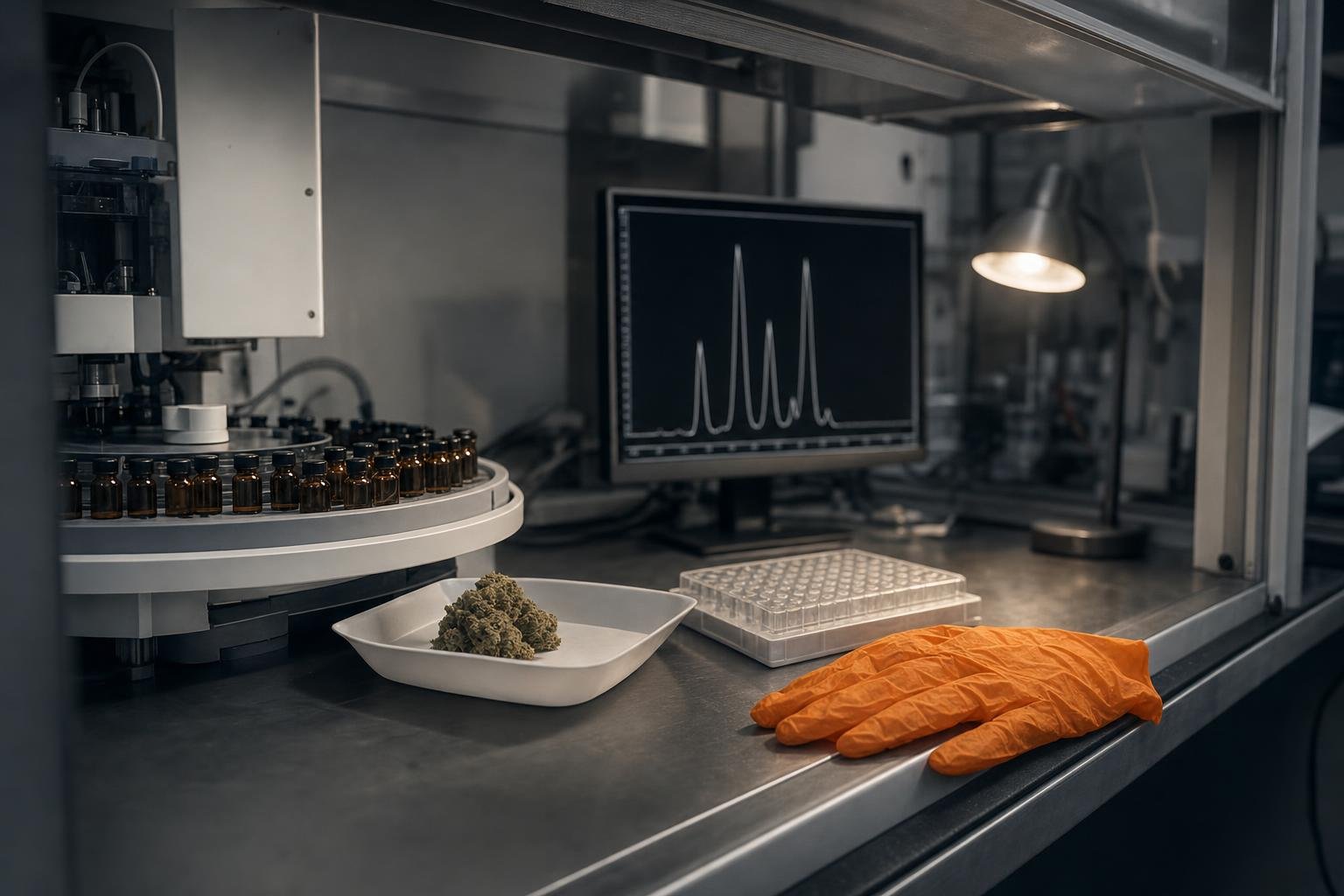
What a cannabis testing lab actually spends on an HPLC or GC-MS system over five years is almost always larger than the number on the purchase order, and the gap between those two figures is where lab budgets quietly collapse. This article itemizes every cost category you need to model before you buy, from instrument qualification through annual service, columns, solvents, gases, reference standards, software, and the staff hours that nobody puts in the spreadsheet until the instrument is already on the bench.
Whether you are a lab director writing a capital request, a startup founder building a pro-forma, or a grower trying to understand why your testing invoice is what it is, this article gives you the framework to build or interrogate a five-year instrument cost model. You will not find a single national price list here, because no authoritative one exists for this market. What you will find is every line item you need to go get quotes for, and the questions to ask when you do.
This article covers:
- The instrument purchase and configuration decisions that set your cost baseline
- Installation, IQ/OQ/PQ qualification, and what ISO 17025 actually requires
- Service contracts and what you are and are not buying
- Columns, solvents, gases, vials, and other consumables
- Reference standards and certified reference materials
- Software licensing and data-system costs
- Staff time: the hidden line item
- How requalification events add to the five-year total
Step 1: Anchor the Model to Your Instrument Configuration, Not Just the Base Price
The number on the vendor quote sheet is for the base instrument. By the time you configure an HPLC or GC-MS for cannabis compliance work, the final capital cost is meaningfully higher, and the configuration choices you make here ripple through every subsequent operating cost.
For HPLC, the core decisions are pump type (quaternary versus binary), autosampler capacity and throughput, column oven, and detector. A UV detector is the minimum for cannabinoid potency; a diode-array detector (DAD, a detector that captures a full UV-visible spectrum at every point in the chromatogram) gives you spectral confirmation and is worth the additional cost for a compliance lab. If you are running pesticides or mycotoxins by LC, you will need a mass spectrometer detector rather than UV, which is a different instrument class and a different cost tier entirely. See the HPLC methods overview for the method context behind these choices.
For GC-MS, the key decisions are the mass analyzer type (single quadrupole for screening, triple quadrupole for quantitative trace work), inlet configuration, and whether you need a headspace autosampler for residual solvents. A headspace autosampler (a device that volatilizes sample components into the gas phase before injection, keeping the column clean of non-volatile matrix) is essentially required for residual-solvent work and adds to both the capital cost and the annual service cost.
Get an itemized quote that separates every module, because each module has its own service and consumable cost profile. Vendors will bundle aggressively; unbundle the quote yourself so you can model each line.
Step 2: Budget for Installation, IQ/OQ/PQ, and the Accreditation Requirement Behind Them
Installation is not just plugging in a power cord. A qualified instrument installation includes utility verification, leak checks, system suitability testing, and documentation. IQ/OQ/PQ (installation qualification, operational qualification, and performance qualification) is the formal documented process that confirms the instrument was installed correctly, operates within specification, and performs correctly for your specific assays.
This qualification documentation is not optional if you need ISO/IEC 17025 accreditation, and ISO/IEC 17025 accreditation is not optional in any licensed cannabis testing state I am aware of. California requires it for type-8 testing laboratory licenses. New York Part 130 §130.7(a) requires it. Virginia 3VAC10-60-20 requires it. Nevada Regulation 11 requires it within one year of licensure. Utah requires it. Minnesota 342.37 permits pre-accreditation licensing but requires a contract with an accreditation body and a scheduled audit.
IQ/OQ/PQ can be performed by the vendor, by a third-party qualification provider, or by qualified in-house staff with documented procedures. Vendor-performed qualification is convenient but carries a premium. Third-party providers are often less expensive. In-house qualification is cheapest in cash terms but requires staff competency and takes time away from sample throughput.
Budget for requalification events as well. Any time you move the instrument, replace a major module, or make a significant software change, your accreditation body will expect documented requalification. New York conducts regulatory audits every two years and reviews your ISO 17025 records, so gaps in qualification documentation surface at the worst possible moment.
Note: If you are pursuing ISO/IEC 17025 accreditation for the first time, budget for the initial accreditation assessment itself, which is a separate cost from instrument qualification. See the ISO 17025 audit preparation guide for what assessors actually look at.
Step 3: Model the Annual Service Contract Honestly
An annual service contract (ASC) from the instrument vendor or an authorized third-party provider typically covers scheduled preventive maintenance visits, parts for covered failures, and priority response time. What it usually does not cover: consumables (columns, septa, liners, vials), damage from misuse, and software upgrades beyond a defined version.
The commonly cited rule of thumb that service contracts run a percentage of purchase price is exactly that, a rule of thumb. The actual rate depends on instrument age, configuration complexity, your geographic location relative to a service engineer, and whether you negotiate. Get the service contract quote in writing at the same time as the instrument quote, and read the exclusions list before you sign either document.
Alternatives to a full vendor ASC include time-and-materials service (you pay per visit), third-party service providers (often less expensive, variable quality), and in-house service engineers (viable at scale, requires investment in training and spare-parts inventory). Each alternative shifts cost from a predictable annual line item to a variable one, which makes budgeting harder but may lower total spend.
I suggest labs take it a step further and ask the vendor for mean-time-between-failure data on the specific modules you are buying. A pump head that fails every two years on a time-and-materials contract is more expensive than it looks in year one.
Note: As instruments age past their manufacturer support window, parts availability becomes a constraint. Build an instrument replacement cycle into your five-year model rather than assuming the instrument runs indefinitely.
Step 4: Account for Consumables, the Cost That Compounds Quietly
Consumables are the category that surprises new lab directors most, because each individual item seems inexpensive and the aggregate is not.
For HPLC, the recurring consumable stack includes:
- Analytical columns and guard columns. Column lifetime is driven by sample load and matrix cleanliness. Cannabis extracts are lipid-rich and pigment-heavy; without rigorous sample preparation, columns foul faster than in a pharmaceutical lab running clean standards. Guard columns are not optional in this matrix.
- Mobile-phase solvents. Reversed-phase cannabinoid methods typically run acetonitrile or methanol gradients with aqueous buffers. Solvent purity grade matters for UV detection; HPLC-grade or LC-MS-grade solvents cost more than ACS-grade. Waste solvent disposal is a real cost that is easy to forget.
- Vials, caps, and filters. A high-throughput lab burns through these at volume.
- Septa, tubing, and fittings. These fail on a schedule; keep spares.
For GC-MS, the recurring consumable stack includes:
- Carrier gas (helium is the standard for GC-MS; helium supply has been periodically constrained and pricing fluctuates). Some labs have moved to hydrogen carrier gas for certain applications, which requires a generator and different safety infrastructure.
- Inlet liners and septa. These are replaced on a regular injection-count schedule.
- Columns. GC columns are generally more durable than HPLC columns in cannabis matrices when sample preparation is adequate, but they are not indefinite.
- Tune standards and calibration gases.
For both platforms, certified reference standards and certified reference materials (CRMs, reference materials with a certificate of analysis traceable to a national metrology institute or equivalent) are a recurring cost. Cannabis potency methods require cannabinoid reference standards; pesticide methods require multi-analyte mixes. Standards have expiration dates, and ISO/IEC 17025 requires laboratories to ensure the suitability of reference materials and maintain relevant documentation, including validity periods where applicable. Budget for regular repurchase on a schedule that keeps you within your documented suitability window.
See the cost-per-sample breakdown for how consumable costs translate into per-test economics.
Step 5: Price the Software Stack and Do Not Forget Data Integrity
Chromatography data systems (CDS, software that controls the instrument, acquires raw data, processes chromatograms, and generates audit-trailed reports) are not a one-time purchase in most modern configurations. Vendors sell an initial license and then charge annual maintenance fees for updates, support, and continued compliance with data-integrity expectations.
ISO/IEC 17025 clause 7.11 requires that laboratory information-management systems be protected from unauthorized access, safeguarded against tampering and loss, and supported by controls for record identification, storage, protection, backup, archiving, retrieval, retention, and disposal. The standard also requires amendments to technical records to be traceable to prior versions or original observations. Regulatory bodies in cannabis have increasingly scrutinized data integrity; California’s testing laboratory requirements include a quality-assurance program that covers data handling.
Get the full multi-year software licensing schedule in writing before you commit to an instrument platform, because switching CDS later is expensive and disruptive.
Additional software costs to model: laboratory information management system (LIMS, software that tracks samples, chains of custody, results, and reports) integration or licensing, electronic laboratory notebook (ELN) licensing if applicable, and any state-specific reporting portal integration that your regulator requires.
Step 6: Put Staff Time in the Spreadsheet
This is the line item that disappears from vendor-prepared cost models and reappears as overtime, missed sample deadlines, and analyst burnout.
Every instrument requires staff time for:
- Daily system suitability checks before sample runs
- Preventive maintenance tasks that are not covered by the service contract (or that happen between contract visits)
- Troubleshooting when something goes wrong mid-batch
- Column equilibration and mobile-phase preparation
- Standard preparation and calibration curve verification
- Requalification after any significant instrument event
- Method verification when you add a new matrix or analyte
- Documentation for ISO 17025 and state regulatory audits
I have seen labs staff for sample throughput and then discover that a single instrument qualification event consumes two analyst-days that were not in the schedule. At a fully-loaded labor cost (salary plus benefits plus overhead), those days are not free.
The honest way to model this is to estimate the hours per week the instrument demands in non-sample-processing time, multiply by your fully-loaded hourly rate, and add it as a recurring annual operating cost. That number will be uncomfortable. It should be.
Note: Method validation (as distinct from instrument qualification) is a separate time and cost sink when you are bringing up a new assay. See the method validation overview for what that process actually involves.
Quick answers
What costs beyond the purchase price should I budget for an HPLC in a cannabis lab? Beyond the capital purchase you need to budget for installation and IQ/OQ/PQ qualification, an annual service contract, HPLC columns (which wear out on a schedule tied to sample load), mobile-phase solvents and consumables such as vials and filters, data-system software licensing, certified reference standards, and the staff hours spent on preventive maintenance and periodic requalification. These recurring costs can rival or exceed the original purchase price over a five-year horizon, so building a line-item operating budget before you sign the purchase order is essential.
What is IQ/OQ/PQ and do cannabis labs have to do it? IQ is installation qualification (confirming the instrument was installed correctly), OQ is operational qualification (confirming it performs within vendor specifications), and PQ is performance qualification (confirming it performs correctly for your specific methods and matrices). ISO/IEC 17025 accreditation, which is required for licensed cannabis testing in states including California, New York, Nevada, Virginia, Utah, and Minnesota, demands documented evidence that your equipment is fit for purpose, and IQ/OQ/PQ is the standard mechanism for providing that evidence.
How often does an HPLC column need to be replaced in a cannabis testing lab? Column lifetime depends on sample load, matrix cleanliness, and how well your sample preparation removes lipids and pigments from cannabis extracts, so no universal replacement interval applies. In practice, a busy potency lab running dozens of injections per day will cycle through columns far faster than a low-volume lab, and guard columns are the standard way to extend analytical column life. Budget for guard column replacement as a routine consumable and track analytical column performance by monitoring retention-time drift and peak shape rather than by a fixed injection count.
Does a cannabis lab need a separate GC-MS and HPLC, or can one instrument cover everything? No single instrument covers all required cannabis assays. HPLC with UV or diode-array detection is the dominant platform for cannabinoid potency because it measures cannabinoids in their native acid forms without heat-induced decarboxylation, while GC-MS is the standard platform for residual solvents and is widely used for terpenes and pesticide screening. Pesticide confirmation at trace levels typically requires LC-MS/MS or GC-MS/MS; see the pesticide testing guide for the method detail.
Is a service contract on a lab instrument required for ISO 17025 accreditation? ISO/IEC 17025 does not mandate a vendor service contract by name, but it does require laboratories to maintain equipment in a condition that ensures valid results, which means documented preventive maintenance, calibration, and repair records. A service contract is one way to satisfy that requirement; a qualified in-house engineer with documented procedures is another. States such as New York conduct regulatory audits every two years and review ISO 17025 accreditation records, so whatever maintenance approach you choose must be fully documented.
What does cannabis lab software licensing actually cover and why does it recur annually? Chromatography data systems are the software layer that controls the instrument, captures raw data, processes peaks, and generates the audit-trailed reports that ISO 17025 and state regulators require. Vendors typically sell an initial license and then charge annual maintenance fees for software updates, technical support, and continued compliance with evolving data-integrity expectations. Get the full multi-year licensing schedule in writing before you commit to a platform, because the total software cost over five years is a meaningful fraction of the instrument capital cost.
Sources
- New York Part 130 Cannabis Laboratory Regulations (October 2022)
- New York Part 130 Cannabis Laboratory Regulations (March 2023 update)
- California DCC: Testing Laboratory License Types
- California DCC: Testing Laboratories Guidance
- Virginia 3VAC10-60-20 Laboratory Requirements
- Nevada Cannabis Compliance Board Regulation 11
- Utah Independent Cannabis Testing Laboratory Rule
- Minnesota Statute 342.37 Cannabis Testing Facility Licensing
- ISO/IEC 17025:2017 Requirements
FAQ
Frequently asked
- What costs beyond the purchase price should I budget for an HPLC in a cannabis lab?
- Beyond the capital purchase you need to budget for installation and IQ/OQ/PQ qualification, an annual service contract, HPLC columns (which wear out on a schedule tied to sample load), mobile-phase solvents and consumables such as vials and filters, data-system software licensing, certified reference standards, and the staff hours spent on preventive maintenance and periodic requalification. These recurring costs can rival or exceed the original purchase price over a five-year horizon, so building a line-item operating budget before you sign the purchase order is essential.
- What is IQ/OQ/PQ and do cannabis labs have to do it?
- IQ is installation qualification (confirming the instrument was installed correctly), OQ is operational qualification (confirming it performs within vendor specifications), and PQ is performance qualification (confirming it performs correctly for your specific methods and matrices). ISO/IEC 17025 accreditation, which is required for licensed cannabis testing in states including California, New York, Nevada, Virginia, Utah, and Minnesota, demands documented evidence that your equipment is fit for purpose, and IQ/OQ/PQ is the standard mechanism for providing that evidence.
- How often does an HPLC column need to be replaced in a cannabis testing lab?
- Column lifetime depends on sample load, matrix cleanliness, and how well your sample preparation removes lipids and pigments from cannabis extracts, so no universal replacement interval applies. In practice, a busy potency lab running dozens of injections per day will cycle through columns far faster than a low-volume lab, and guard columns (short protective columns placed before the analytical column) are the standard way to extend analytical column life. Budget for guard column replacement as a routine consumable and track analytical column performance by monitoring retention-time drift and peak shape rather than by a fixed injection count.
- Does a cannabis lab need a separate GC-MS and HPLC, or can one instrument cover everything?
- No single instrument covers all required cannabis assays. HPLC with UV or diode-array detection is the dominant platform for cannabinoid potency because it measures cannabinoids in their native acid forms without heat-induced decarboxylation, while GC-MS is the standard platform for residual solvents and is widely used for terpenes and pesticide screening. Pesticide confirmation at trace levels typically requires LC-MS/MS or GC-MS/MS. A compliance lab building out for a full test menu will need multiple chromatography platforms, each carrying its own five-year cost structure.
- Is a service contract on a lab instrument required for ISO 17025 accreditation?
- ISO/IEC 17025 does not mandate a vendor service contract by name, but it does require laboratories to maintain equipment in a condition that ensures valid results, which means documented preventive maintenance, calibration, and repair records. A service contract is one way to satisfy that requirement; a qualified in-house engineer with documented procedures is another. States such as New York conduct regulatory audits every two years and review ISO 17025 accreditation records, so whatever maintenance approach you choose must be fully documented.
- What does cannabis lab software licensing actually cover and why does it recur annually?
- Chromatography data systems (CDS) are the software layer that controls the instrument, captures raw data, processes peaks, and generates the audit-trailed reports that ISO 17025 and state regulators require. Vendors typically sell an initial license and then charge annual maintenance fees for software updates, technical support, and continued compliance with evolving data-integrity expectations. Some vendors have moved to subscription models entirely, so the distinction between a capital software cost and an operating cost has blurred; get the full multi-year licensing schedule in writing before you commit to a platform.
Need this tested?
Compare labs that run these assays and get quotes in one go — no account, no fee.