· 11 min read
Cannabis Lab 101: Cannabis Laboratory Sciences Training — Courses, Certificates, and What Employers Actually Check
I've watched talented bench chemists get passed over because their résumé listed a cannabis badge but zero instrument hours. This guide maps every major university certificate, industry short course, and standards-aligned e-learning option — with real costs and lengths — so you can build a training path that actually gets you hired.
- cannabis-laboratory-sciences-training
- cannabis-lab-certification-course
- cannabis-science-degree
- lab-careers
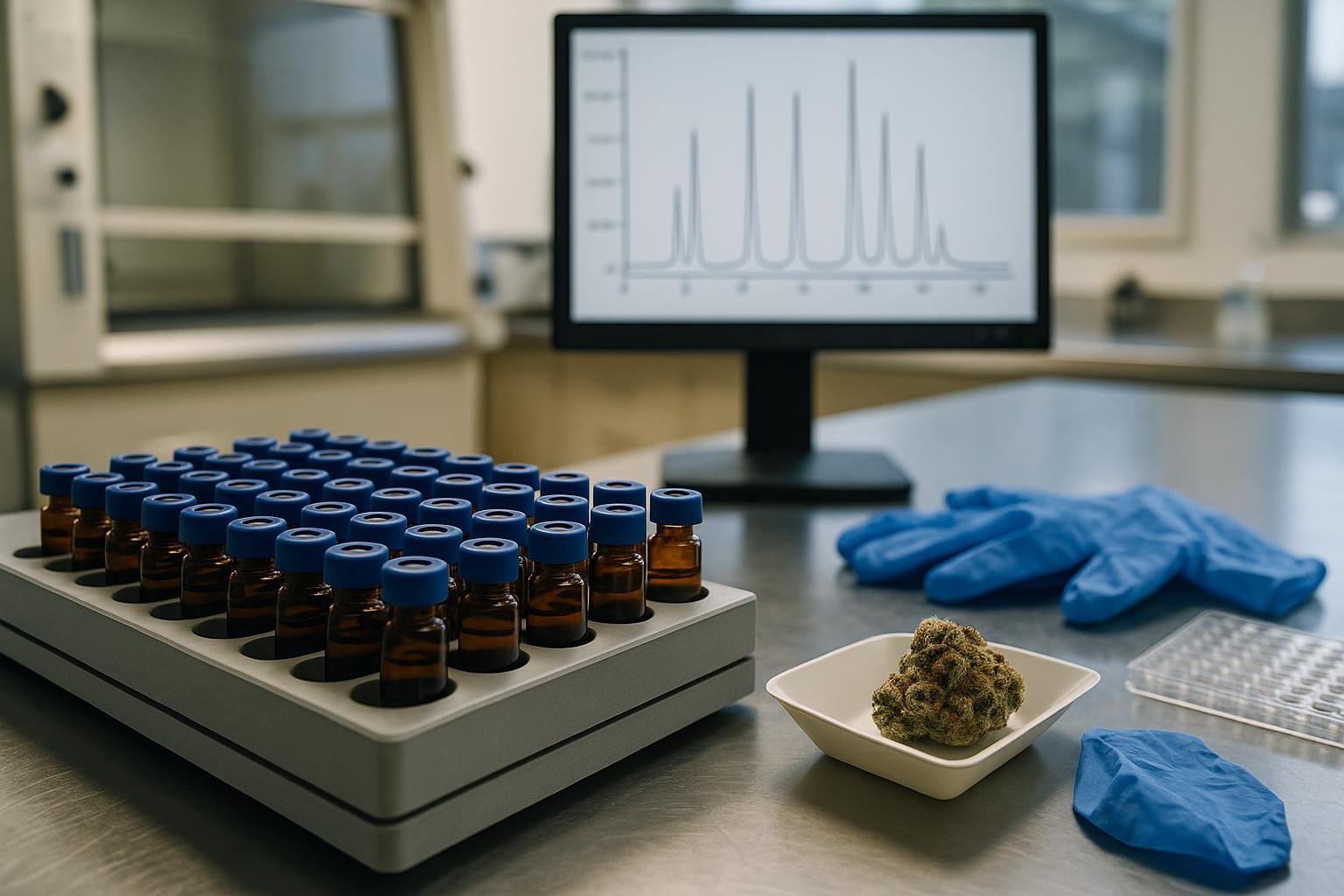
Cannabis laboratory sciences training today is a mix of formal university certificates and degrees, industry short courses, and regulatory- and standards-focused e-learning — and employers typically care more about hands-on instrument experience and quality systems literacy than about any one “cannabis” badge.
Whether you are a recent chemistry graduate trying to break into a licensed testing lab, a working technician looking to formalize your skills, or a lab director building a training matrix for new hires, this article gives you the actual program names, current costs, program lengths, and the competency signals that accreditation-oriented hiring actually rewards. This is not a ranking; it is a map.
Here is what this article covers:
- University certificate and degree programs: costs, lengths, and what each emphasizes
- Industry short courses and e-learning: where they fit and what they are worth
- Instrument-specific training: vendor courses and conference short courses
- Standards-aligned training: ASTM and ANAB as the accreditation bridge
- What the curriculum signals tell us about what employers actually check
Step 1: Understand the training landscape before you spend a dollar
The first thing I tell anyone asking about cannabis lab training is this: the phrase “cannabis laboratory sciences training” covers a spectrum so wide that a $17 micro-course and a $23,940 graduate certificate both technically qualify. Treating them as equivalent is how people waste money — or undersell themselves.
At one end you have micro-courses: Green CulturED’s Cannabis Certificate of Analysis (CoA) course costs USD $27 and takes 31–60 minutes. Their Cannabis Product Analysis & Testing course is USD $17 and runs 15–30 minutes. Both give you one year of access. These are orientation tools — useful for a dispensary manager or a new hire who needs vocabulary before their first shift, not a credential that moves a résumé.
At the other end, Northeastern University’s Graduate Certificate in Cannabis Science carries an estimated total tuition of USD $23,940 for Academic Year 2026–2027, takes as few as nine months full-time, and is a graduate-level credential from an R1 university. That is a different instrument entirely.
In between sits the bulk of the market: university certificates in the USD $4,000–$16,000 range, industry diplomas running 16–24 weeks, and conference short courses priced at a few hundred to a thousand dollars per day. Your job before enrolling anywhere is to match the credential level to the job you are actually trying to get — not to the most impressive-sounding program name.
For context on what the lab side of this industry looks like day-to-day, the compliance testing overview and the how to become a cannabis lab technician guide are good orientation reads before you commit to a training path.
Step 2: Map the university programs by cost, length, and what they actually teach
University programs vary more in emphasis than in prestige. Some are science-heavy; some lean toward operations and quality management. Knowing the difference matters because labs hire for specific gaps.
Programs with a laboratory science emphasis:
- Wayne State University’s Undergraduate Certificate in Cannabis Chemistry is a 15-credit-hour curriculum that combines lecture and laboratory courses with a research laboratory experience. This is the structure I would look for if I were hiring a bench technician — it signals that the student has actually touched instruments, not just read about them.
- Beal University’s Associate of Applied Science in Cannabis Laboratory Sciences is a 20-month program culminating in an associate degree. The longer timeline reflects associate-degree depth rather than a certificate sprint.
- Thomas Jefferson University’s Cannabis Science Certificate includes courses like CSC 513 Cannabinoid Pharmacology at 3 credit hours, signaling a pharmacology and science-of-the-molecule orientation.
Programs with a production or operations emphasis:
- University of Illinois’s Cannabis Production & Management Certificate is four online courses, estimated at USD $4,796 for non-degree-seeking students, offered in spring and fall, with no prior degree required. It skews toward crop science and production management rather than analytical chemistry.
- Saint Louis University’s Cannabis Science and Operations Certificate is delivered in eight-week online terms at USD $410 per credit hour — meaning a 3-credit course runs USD $1,230 before fees. The compressed format suits working professionals.
- St. Cloud State University’s certificate programs run approximately 24 weeks (about six months), with an expected 6–8 hours per week of student time.
Graduate-level options:
- Northeastern’s nine-month online graduate certificate at USD $23,940 (AY 2026–2027) is the most expensive domestic option on this list and is positioned for students who already hold a science undergraduate degree.
- Fanshawe College’s Graduate Certificate in Cannabis Applied Science (Canada) is a one-year program with average annual tuition of CAD $16,435, designed for students with a prior science background.
The credential that moves the needle in a hiring decision is the one that demonstrates you can run an instrument or defend a quality system — not the one with “cannabis” in the title.
Note: The University of Illinois program sits in crop sciences and is best suited for cultivators or extraction operators, not analytical bench chemists. If your goal is a testing lab role, prioritize programs that include laboratory coursework over those that are entirely lecture or discussion-based.
Step 3: Use industry short courses and e-learning to fill specific gaps, not to replace fundamentals
I suggest labs take it a step further than most training matrices do: treat short courses as gap-fillers, not foundations. A technician who has never pipetted a standard will not become competent by watching a 30-minute video about CoA interpretation. But a technician who has six months of bench time and has never read an ASTM standard is genuinely underserved by their lab — and that is exactly where targeted e-learning earns its keep.
The most standards-rigorous short-course option currently available is ANAB’s Cannabis Laboratory Testing eLearning Program, priced at USD $315 for four courses that take approximately four hours total. The program is built around ASTM standards D8375, D8399, D8442, and D8469 — the four cannabis-specific ASTM standards most relevant to licensed testing labs. If your lab is working toward or maintaining ISO 17025 accreditation, this is the e-learning I would put in every technician’s onboarding record, because it speaks the same language as your accreditation auditor.
For quality management orientation, AAPS’s Cannabis – Management, Quality and Edibles program (Canada) offers a 16-week certificate track and a 24-week diploma track. The framing around management and quality — not just cannabinoid science — aligns with what ISO 17025 and GMP-oriented labs actually need from mid-level staff.
For CoA literacy and basic testing vocabulary, the Green CulturED micro-courses are fine for what they are. Just be honest about what they are: orientation, not qualification.
Note: No short course substitutes for the method validation competency that regulators and accreditation bodies actually audit. For a deep dive on what validation looks like at the bench, see the method validation guide.
Step 4: Build instrument hours through vendor training and conference short courses
This is the section most training guides skip, and it is the one that most directly answers what hiring managers actually check — because instrument hours are the one thing a certificate cannot fake.
Vendor training is underused by early-career lab scientists. Shimadzu’s FY 2025–26 Customized Training Rate Card lists two-day GC fundamentals courses and two-day GC-MS fundamentals courses as separate offerings with separate course codes, which matters: GC and GC-MS are distinct skill sets, and labs running residual solvent panels on a headspace GC need different operator competencies than labs running pesticide screens on a GC-MS/MS. The rate card is priced in INR for the Indian market, but the structure — instrument class, duration, and course code — illustrates how vendor training is organized globally. Most major vendors (Agilent, Shimadzu, Waters, and others) offer comparable in-person or virtual instrument courses; contact your local applications team for current pricing in your region.
Conference short courses are a higher-cost but higher-density option. Pittcon’s 2025 schedule included full-day courses on GC and GC-MS method development and on HPLC and UHPLC fundamentals and troubleshooting — the exact platforms cannabis labs run for potency, pesticides, and terpenes. Full-day Pittcon short courses were priced at USD $900 before the early-registration deadline and USD $1,100 after; student pricing was USD $220 with a valid student ID. Half-day courses ran USD $450 before the deadline and USD $550 after, with student pricing at USD $110.
A single full-day Pittcon short course on HPLC method development, combined with six months of bench time, will do more for your hiring prospects than most semester-long cannabis-branded courses — because it demonstrates that you understand the instrument class at a level that transfers across matrices and regulatory frameworks.
For context on what HPLC method development looks like in a cannabis-specific context, the cannabinoid separation methods guide is worth reading alongside any chromatography short course.
Note: Vendor training is typically instrument-specific and may not cover method validation, uncertainty of measurement, or quality system requirements. Pair it with standards-aligned training (ANAB, ISO 17025 prep) for a complete competency picture. See the ISO 17025 audit preparation guide for what auditors actually look at.
Step 5: Read the curriculum signals — they tell you what employers value
Because no authoritative hiring-manager survey exists for this niche, I read curriculum design as a proxy signal. Programs that include laboratory courses and research experiences — Wayne State’s cannabis chemistry certificate is the clearest example — are telling you that the competency they are building is bench-level, not conceptual. Programs built around ASTM standards (ANAB’s eLearning) are telling you that compliance and method standardization are the frame. Programs organized around management and quality (AAPS) are telling you that the target role is quality officer or operations lead, not bench technician.
Match the signal to your target role:
- Bench technician or analyst: Prioritize programs with laboratory coursework and instrument hours. Wayne State, Beal, and vendor/conference instrument training.
- Quality officer or lab manager: Prioritize quality systems literacy. ANAB’s ASTM-aligned eLearning, AAPS’s quality-framed diploma, and ISO 17025 preparation resources.
- Cultivator or extraction operator trying to understand what the lab does: The University of Illinois certificate (no degree required, USD $4,796) and the Green CulturED micro-courses are proportionate investments.
- Career-changer with a science degree: Northeastern’s graduate certificate or Fanshawe’s one-year program give you a graduate credential without requiring a second undergraduate degree.
The fastest path to a bench role is not the most expensive program — it is the program that gets you the most supervised instrument time before your first interview.
If you are already working in a lab and looking to move up, the job board lists current openings with the actual credential language employers are using right now, which is the most direct signal available about what the market is checking.
Quick answers
How much does a cannabis laboratory sciences certificate program cost? Costs range from USD $315 for ANAB’s four-course online program to USD $23,940 for Northeastern’s Graduate Certificate in Cannabis Science (AY 2026–2027 estimate). The University of Illinois’s four-course online certificate is estimated at USD $4,796 for non-degree-seeking students, making it one of the more accessible university-level options. Micro-courses from providers like Green CulturED run USD $17–$27 but are orientation tools, not professional credentials.
Do I need a science degree to enroll in a cannabis lab certificate program? Not always — the University of Illinois Cannabis Production & Management Certificate explicitly states that no prior degree is required for admission. Programs like Northeastern’s Graduate Certificate and Fanshawe College’s Cannabis Applied Science graduate certificate are designed for students who already hold a science background, so admission requirements vary significantly by program level.
What do cannabis testing lab employers actually look for when hiring? Based on what accreditation-focused programs emphasize, employers consistently value hands-on instrument experience and quality systems literacy — specifically familiarity with GLP, GMP, and ISO 17025 — over any single cannabis-specific badge. Programs that include laboratory courses and research lab experiences, like Wayne State University’s Cannabis Chemistry certificate, signal this priority directly in their curriculum design.
How long does it take to complete a cannabis laboratory sciences training program? Program lengths span from 31–60 minutes for a micro-course CoA module to 20 months for Beal University’s Associate of Applied Science in Cannabis Laboratory Sciences. Mid-range options include St. Cloud State’s approximately six-month online certificate and Northeastern’s nine-month graduate certificate, giving working professionals several realistic timelines to choose from.
What ASTM standards should a cannabis lab technician know? ANAB’s Cannabis Laboratory Testing eLearning Program — the most standards-aligned training available from a U.S. accreditation body — is built around ASTM D8375, D8399, D8442, and D8469. Familiarity with these four standards signals to an employer that you understand the method frameworks regulators and accreditation auditors actually reference during ISO 17025 assessments.
Are Pittcon short courses useful for cannabis lab training? Yes, for instrument-specific skills — Pittcon’s 2025 schedule included full-day courses on GC, GC-MS, and HPLC method development and troubleshooting, which are the chromatographic platforms cannabis labs use daily for potency, residual solvents, and pesticide analysis. Full-day courses were priced at USD $900 before the early-registration deadline (USD $220 for students), making them one of the more cost-effective ways to build platform-specific depth outside a university setting.
Sources
- Saint Louis University — Cannabis Science and Operations Certificate
- CanAm Group — Fanshawe College Graduate Certificate in Cannabis Applied Science
- Thomas Jefferson University — Cannabis Science Certificate
- Shimadzu India — FY 2025–26 Customized Training Rate Card
- University of Illinois Crop Sciences — Cannabis Production & Management Certificate
- Green CulturED — Cannabis Certificate of Analysis (CoA)
- AAPS — Cannabis Management, Quality and Laboratory
- Pittcon 2025 Short Courses PDF
- AAPS — Cannabis Management, Quality and Laboratory Certification
- Green CulturED — Cannabis Product Analysis & Testing
- Northeastern University — Graduate Certificate in Cannabis Science (Online)
- Wayne State University — Undergraduate Certificate in Cannabis Chemistry
- St. Cloud State University — Cannabis Education FAQ
- ANAB — Cannabis Laboratory Testing eLearning Program
- Beal University — Associate of Applied Science in Cannabis Laboratory Sciences
FAQ
Frequently asked
- How much does a cannabis laboratory sciences certificate program cost?
- Costs range widely: the University of Illinois Cannabis Production & Management Certificate is estimated at USD $4,796 for non-degree-seeking students, while Northeastern University's Graduate Certificate in Cannabis Science runs approximately USD $23,940 for the 2026–2027 academic year. Short industry e-learning options like ANAB's four-course cannabis laboratory testing program cost USD $315, and micro-courses from providers like Green CulturED run USD $17–$27.
- Do I need a science degree to enroll in a cannabis lab certificate program?
- Not always — the University of Illinois Cannabis Production & Management Certificate explicitly states that no prior degree is required for admission. Programs like Northeastern's Graduate Certificate and Fanshawe College's Cannabis Applied Science graduate certificate are designed for students who already hold a science background, so admission requirements vary significantly by program level.
- What do cannabis testing lab employers actually look for when hiring?
- Based on what accreditation-focused programs emphasize, employers consistently value hands-on instrument experience and quality systems literacy — specifically familiarity with GLP, GMP, and ISO 17025 — over any single cannabis-specific badge. Programs that include laboratory courses and research lab experiences, like Wayne State University's Cannabis Chemistry certificate, signal this priority directly in their curriculum design.
- How long does it take to complete a cannabis laboratory sciences training program?
- Program lengths span from roughly 31–60 minutes for a micro-course CoA module to 20 months for Beal University's Associate of Applied Science in Cannabis Laboratory Sciences. Mid-range options include St. Cloud State's six-month online certificate and Northeastern's nine-month graduate certificate, giving working professionals several realistic timelines to choose from.
- What ASTM standards should a cannabis lab technician know?
- ANAB's Cannabis Laboratory Testing eLearning Program — the most standards-aligned training available from a U.S. accreditation body — is built around ASTM D8375, D8399, D8442, and D8469. Familiarity with these four standards signals to an employer that you understand the method frameworks regulators and accreditation auditors actually reference during ISO 17025 assessments.
- Are Pittcon short courses useful for cannabis lab training?
- Yes, for instrument-specific skills — Pittcon's 2025 schedule included full-day courses on GC, GC-MS, and HPLC method development and troubleshooting, which are the chromatographic platforms cannabis labs use daily for potency, residual solvents, and pesticide analysis. Full-day courses were priced at USD $900 before the early-registration deadline (USD $220 for students), making them one of the more cost-effective ways to build platform-specific depth outside a university setting.
Need this tested?
Compare labs that run these assays and get quotes in one go — no account, no fee.