· 11 min read
Cannabis Lab 101: Proficiency Testing — How Labs Prove They Get the Right Answer
I spent years running compliance assays and watching labs treat proficiency testing as a paperwork box to check. It is not. PT is the only external proof that your numbers mean something — and regulators in every licensed state are watching the scores.
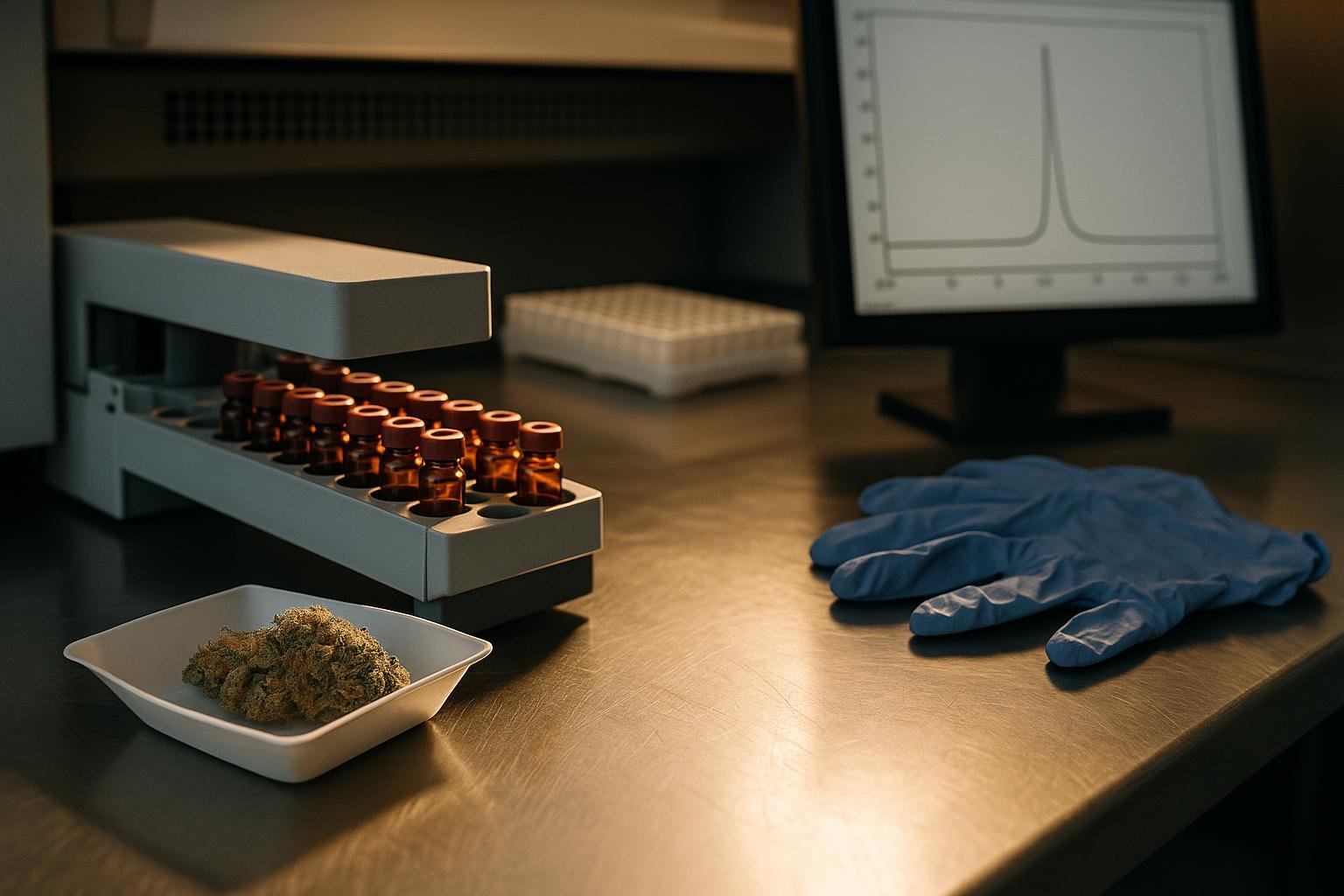
Proficiency testing is the only moment in a cannabis lab’s life when an outside party sends you a sample, already knows the right answer, and grades your work. Every other quality metric — your calibration curves, your internal standards, your method blanks — is self-reported. PT is not. That asymmetry is why regulators in every licensed state have built PT requirements into their laboratory rules, and why a failed PT round can threaten the accreditation scope that keeps your doors open.
Whether you are a bench technician trying to understand why your lab treats those brown vials differently, a lab director building a PT calendar for a new accreditation scope, or a cultivator wondering what “passed proficiency testing” actually means on a COA — this article gives you the mechanics, the scoring math, the named providers, the state-by-state frequency rules, and what happens when the score comes back wrong.
This article covers:
- What PT is and how it differs from internal QC
- Which providers are named or approved in state rules
- How z-scores work and what the acceptance windows actually are
- How often each state requires PT, by the rule text
- What a failure triggers — and what it does not
- Matrix controls and reporting requirements
Step 1: Understand what proficiency testing actually is — and what it is not
A proficiency test requires a laboratory to produce analytical results within acceptable limits for an analyte or analyte group whose identity and concentration are unknown to the laboratory but known to the PT provider. That single-blind design — you do not know the answer, they do — is what separates PT from every other check in your quality system.
Internal QC tells you whether your instrument is behaving today. A calibration curve tells you whether your standards are fresh. A matrix spike tells you whether your extraction is recovering analyte. All of those are things you designed, you ran, and you evaluated. PT is the one check where the grading is done by someone else, against a reference value your lab did not set.
Alabama’s rules describe a PT program as providing rigorously controlled and standardized samples, collecting laboratory results, and statistically evaluating those results across all participating laboratories. That cross-lab comparison is the point. Your result is not judged against your own historical data — it is judged against what other labs, running the same sample, reported.
The practical implication: treat PT samples exactly as you treat compliance samples. Michigan’s rules make this explicit — the same procedures, the same number of replicates, the same standards, the same analysts, the same equipment. Running PT on your flagship instrument while routine samples go to the backup system is the kind of thing that shows up in audit findings and, more importantly, masks real performance problems until a product failure exposes them.
For context on how PT fits into the broader accreditation picture, see our article on preparing for ISO 17025 audits.
Step 2: Know which providers are approved in your state
There is no single national list of approved cannabis PT providers. What exists is a patchwork of state-level requirements, each specifying the accreditation standard a provider must hold and, in some cases, naming providers directly.
New York’s September 2026 PT guidance names Signature Science, LLC as an ISO/IEC 17043-accredited PT provider and identifies AOAC as a partner that sells PT samples sourced from Signature Science. New York also requires that PT, when offered, be administered by an ISO/IEC 17043-approved or accredited provider — and the guidance specifies that the available matrices are hemp or hemp oil for the listed analyte groups.
Michigan’s rules require PT providers to be accredited for all relevant agency-required tests by an accreditation body recognized under the International Laboratory Accreditation Cooperation (ILAC) mutual recognition arrangement. That language matters: the provider’s ISO/IEC 17043 accreditation scope must cover the specific tests and matrices you are using it for, not just cannabis in the abstract.
Colorado requires hemp testing laboratories to successfully participate in a Colorado Department of Public Health and Environment-approved PT program as a condition of obtaining and maintaining certification.
California requires cannabis testing laboratories to maintain ISO/IEC 17025 accreditation and participate in a PT program — the Department of Cannabis Control’s licensee page is the authoritative starting point for California-specific provider approval.
The provider’s accreditation scope — which analytes, which matrices — matters as much as the ISO/IEC 17043 credential itself. A provider accredited for potency in a hemp-flower matrix is not automatically appropriate for pesticide PT in a concentrate matrix. Verify the scope certificate, not just the logo.
Note: For labs operating across state lines or seeking multi-state accreditation, you may need PT from different providers for different jurisdictions. There is no reciprocity mechanism that automatically satisfies all states simultaneously.
Step 3: Calculate and interpret your z-score
The z-score is the universal currency of PT scoring. It answers one question: how far is your result from the reference value, in units of the standard deviation used by the PT program?
The formula is straightforward:
z = (x − X) / s
Where x is your reported result, X is the assigned reference value, and s is the standard deviation used by the PT provider for that analyte and round. A z of 0 means you hit the reference exactly. A z of +2 means you reported two standard deviations above the reference. A z of −1.5 means you came in one and a half standard deviations low.
Washington’s rules use ±3 z-scores as the fallback passing boundary when the PT provider does not supply individual analyte acceptance criteria — for fields other than residual-solvent testing. For residual solvents, Washington uses a ±30% recovery criterion from the reference value when the provider does not supply analyte-specific criteria.
Those are fallback rules, not universal ones. Your PT provider’s scoring report may use tighter windows for specific analytes, and your state’s rule may defer entirely to the provider’s criteria. Read both documents before you assume ±3 z is your target.
Oregon defines the proficiency-testing reporting limit as equal to the required maximum laboratory limits of quantitation established in state rules — and specifies exactly how labs must report results above or below that limit, including whether to report a numeric result, “<PTRL,” or “<LOQ” depending on where the result falls relative to the lab’s own LOQ. Getting the reporting format wrong is a separate failure mode from getting the number wrong.
Note: The z-score formula above assumes the PT provider has established a robust reference value and a meaningful standard deviation. For low-participant rounds — which can happen with newer cannabis analytes or unusual matrices — the statistical power of the z-score is limited. Ask your provider how many labs contributed to the reference value for each analyte.
Step 4: Build a PT calendar that actually meets your state’s frequency rules
Frequency requirements differ enough between states that a single annual PT round will leave most labs out of compliance somewhere. Here is what the primary sources actually say:
- Michigan: at least one successful PT sample set covering all required analytes annually, unless the agency requests additional testing.
- Alabama: at least once every 12 months, covering all analytes required by applicable law and chapter.
- Oregon: two successful studies out of the three most recent attempts for each accredited field, with consecutive study closing dates no more than seven months apart. That seven-month gap rule effectively forces labs to run PT at least twice per year per field to maintain a valid rolling window.
- New York: satisfactory performance in at least two of three consecutive PTs within an 18-month period to maintain approval for an analyte or analyte group. To obtain initial approval for a new analyte, two consecutive satisfactory performances are required.
Build your PT calendar backwards from the rolling-window rules, not forwards from the minimum frequency. A lab that runs PT once in January and once in December technically meets an annual requirement but may violate a seven-month gap rule or leave itself with no buffer if one round fails.
I suggest labs maintain a PT tracking spreadsheet with columns for: analyte/field, provider, submission date, closing date, result, z-score or recovery, pass/fail, and the next required submission date calculated from the state’s rolling rule. It takes an afternoon to build and saves a compliance crisis.
Step 5: Know what a failure actually triggers — and what it does not
A failed PT round is not automatically a license revocation. The consequences are field-specific, rolling, and — in most states — designed to give a lab a structured path to remediation before accreditation scope is affected.
In New York, a single unsatisfactory result does not end the game. The lab may continue attempting PT to satisfy the two-out-of-three rolling requirement within the 18-month window. The pressure is real — you cannot report results for an analyte you are not approved for — but the structure allows for one miss.
In Oregon, repeated failures in a given field — specifically, failing two of your three most recent studies — jeopardize your accreditation for that field specifically, not your entire laboratory license. The field-specific framing matters: a pesticide PT failure does not automatically pull your potency accreditation.
In Washington, a failed parameter affects the corresponding accreditation scope rather than triggering a blanket result across all tests. Labs must achieve a passing score for each field-of-testing parameter for which they are or will be accredited.
In Alabama, continued satisfactory PT performance is required for continued registration. The scientific director must review and evaluate PT results, and analysts who participated must sign attestation statements — creating a documented chain of accountability that regulators can audit.
The practical response to a failed PT is a root-cause investigation, documented in your corrective action system, before you attempt the next round. Submitting a second PT sample without understanding why the first one failed is how labs end up failing two out of three and losing a field. Common root causes include calibration standard degradation, extraction recovery problems specific to the PT matrix, and — more often than anyone admits — analyst technique differences that only surface when the blind is lifted.
For method-level troubleshooting context, see our method validation article.
Note: Oregon requires usable-marijuana matrix PT samples for pesticide, mycotoxin, and certain potency analyses. A usable-hemp matrix is only permitted in writing if a usable-marijuana matrix is unavailable from the provider. Matrix substitution without that written permission is itself a compliance failure, separate from the analytical result.
Quick answers
How often do cannabis labs have to do proficiency testing? Frequency varies by state. Michigan requires at least one successful PT sample set covering all required analytes annually. Oregon requires two successful studies out of the three most recent attempts, with no more than seven months between consecutive study closing dates. New York requires satisfactory performance in at least two of three consecutive PTs within an 18-month period — so the practical cadence in most states lands somewhere between twice and four times per year per field of accreditation.
What is a z-score in cannabis proficiency testing? A z-score measures how far your reported result sits from the assigned reference value, expressed in units of the relevant standard deviation — so a z-score of zero means you hit the reference exactly. Washington’s rules use ±3 z-scores as the fallback passing boundary when a PT provider does not supply analyte-specific acceptance criteria. Other jurisdictions may use provider-defined or analyte-specific windows, so always check your state’s rule and your provider’s scoring sheet.
Which companies provide accredited cannabis PT samples? There is no single national list. New York’s September 2026 PT guidance names Signature Science, LLC as an ISO/IEC 17043-accredited provider and notes that AOAC sells PT samples sourced from Signature Science. Michigan requires providers to be accredited by an ILAC-recognized accreditation body for all relevant required tests. Your state regulator’s approved-provider list is the authoritative starting point — not a vendor’s marketing page.
What happens if a cannabis lab fails a proficiency test? Consequences are field-specific and rolling, not an instant license pull. In Oregon, failing two of your three most recent studies for a given field jeopardizes your accreditation for that field specifically. In New York, a single unsatisfactory result does not automatically disqualify a lab — the lab may continue attempting PT to satisfy the two-out-of-three rolling requirement. Alabama requires the scientific director to review every PT result and analysts to sign attestation statements, and continued registration depends on sustained satisfactory performance.
Does ISO/IEC 17043 accreditation mean a PT provider is approved for my state? ISO/IEC 17043 accreditation is a necessary condition in most states but not always sufficient on its own. New York requires PT providers to be ISO/IEC 17043-approved or accredited, but its guidance also specifies which matrices those providers must cover. Michigan ties provider eligibility to accreditation for all agency-required tests specifically. Check your state’s approved-provider language — the matrix and analyte scope of the provider’s accreditation matters as much as the accreditation itself.
Can a lab use a different procedure for PT samples than for real product testing? No — and this is one of the most commonly cited findings in PT audits. Michigan’s rules explicitly require labs to use the same procedures, number of replicates, standards, analysts, and equipment for PT samples as for routine marihuana-product testing. Alabama’s rules carry the same requirement. Running PT on your best instrument with your most experienced analyst while routine samples go elsewhere is exactly the behavior the rule is designed to prevent.
Sources
- New York Part 130 Laboratory Regulations
- New York OCM Proficiency Testing Guidance, September 2026
- New York Part 130 Cannabis Laboratories Adopted Rules
- Michigan Cannabis Regulatory Agency — Marihuana Sampling and Testing Rules
- Oregon Administrative Rules Chapter 333, Division 64
- Washington Administrative Code Chapter 16-310
- Alabama Administrative Code Chapter 538-X-10
- Alabama Administrative Code Rule 538-X-10-.06
- Colorado CDPHE Hemp Testing Laboratory Certification
- California Department of Cannabis Control — Testing Laboratories
- ILAC — International Laboratory Accreditation Cooperation
FAQ
Frequently asked
- How often do cannabis labs have to do proficiency testing?
- Frequency varies by state. Michigan requires at least one successful PT sample set covering all required analytes annually. Oregon requires two successful studies out of the three most recent attempts, with no more than seven months between consecutive study closing dates. New York requires satisfactory performance in at least two of three consecutive PTs within an 18-month period — so the practical cadence in most states lands somewhere between twice and four times per year per field of accreditation.
- What is a z-score in cannabis proficiency testing?
- A z-score measures how far your reported result sits from the assigned reference value, expressed in units of the relevant standard deviation — so a z-score of zero means you hit the reference exactly. Washington's rules use ±3 z-scores as the fallback passing boundary when a PT provider does not supply analyte-specific acceptance criteria. Other jurisdictions may use provider-defined or analyte-specific windows, so always check your state's rule and your provider's scoring sheet.
- Which companies provide accredited cannabis PT samples?
- There is no single national list. New York's September 2026 PT guidance names Signature Science, LLC as an ISO/IEC 17043-accredited provider and notes that AOAC sells PT samples sourced from Signature Science. Michigan requires providers to be accredited by an ILAC-recognized accreditation body for all relevant required tests. Your state regulator's approved-provider list is the authoritative starting point — not a vendor's marketing page.
- What happens if a cannabis lab fails a proficiency test?
- Consequences are field-specific and rolling, not an instant license pull. In Oregon, failing two of your three most recent studies for a given field jeopardizes your accreditation for that field specifically. In New York, a single unsatisfactory result does not automatically disqualify a lab — the lab may continue attempting PT to satisfy the two-out-of-three rolling requirement. Alabama requires the scientific director to review every PT result and analysts to sign attestation statements, and continued registration depends on sustained satisfactory performance.
- Does ISO/IEC 17043 accreditation mean a PT provider is approved for my state?
- ISO/IEC 17043 accreditation is a necessary condition in most states but not always sufficient on its own. New York requires PT providers to be ISO/IEC 17043-approved or accredited, but its guidance also specifies which matrices those providers must cover. Michigan ties provider eligibility to accreditation for all agency-required tests specifically. Check your state's approved-provider language — the matrix and analyte scope of the provider's accreditation matters as much as the accreditation itself.
- Can a lab use a different procedure for PT samples than for real product testing?
- No — and this is one of the most commonly cited findings in PT audits. Michigan's rules explicitly require labs to use the same procedures, number of replicates, standards, analysts, and equipment for PT samples as for routine marihuana-product testing. Alabama's rules carry the same requirement. Running PT on your best instrument with your most experienced analyst while routine samples go elsewhere is exactly the behavior the rule is designed to prevent.
Related guides
All guides- 01
Cannabis Lab 101: Cannabis Edibles Testing Cost — Why Infused Products Cost More to Test
I spent four years running potency assays on everything from flower to fudge, and infused products always took longer and cost more. Here is exactly why — matrix effects, homogeneity requirements, and the extra sample prep no one explains — plus real prices from published lab menus.
- 02
Cannabis Lab 101: Cannabis Lab Technician Salary by State and Role
I pulled every sourced number I could find from ZipRecruiter, Indeed, and Salary.com to build a real salary table by role — from sample-prep tech to lab manager. Here is what the data actually says, what drives the spread, and how to negotiate your next offer.
- 03
Cannabis Lab 101: Cannabis Testing Cost Per Sample — 2026 Price Ranges by Assay
I pulled published price lists from licensed labs in New Jersey, Minnesota, and Oregon, plus Utah's state fee schedule, to show you exactly what each assay costs in 2026 — and why the same test can cost twice as much in one state as another.
Need this tested?
Compare labs that run these assays and get quotes in one go — no account, no fee.