· 11 min read
Cannabis Lab 101: Cannabis Testing Cost Per Sample — 2026 Price Ranges by Assay
I pulled published price lists from licensed labs in New Jersey, Minnesota, and Oregon, plus Utah's state fee schedule, to show you exactly what each assay costs in 2026 — and why the same test can cost twice as much in one state as another.
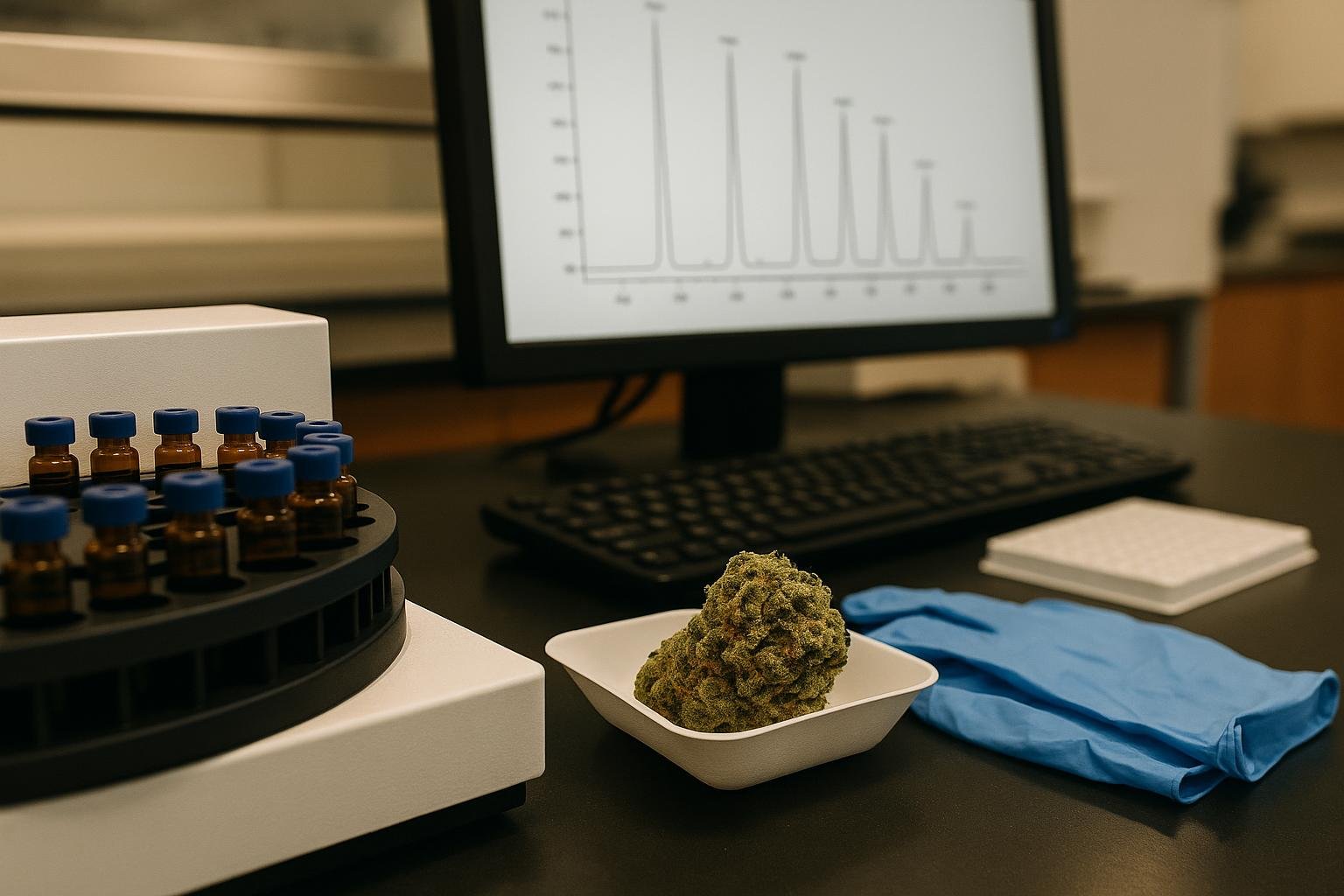
If you have ever looked at a lab invoice and wondered why pesticide testing costs twice what potency testing does, or why the same compliance panel runs $500 in one state and $1,350 in another, this article is for you. I pulled published price lists from licensed labs in New Jersey, Minnesota, and Oregon, plus Utah’s publicly available state fee schedule, to give you real 2026 numbers by assay — and the analytical reasons behind the gaps.
Whether you are a grower trying to budget your compliance costs before harvest, a lab director benchmarking your pricing against the market, or a technician who wants to understand why the pesticide run takes four hours when potency takes forty minutes — this article gives you the actual numbers and the actual reasons behind them.
Here is what we cover:
- Potency (cannabinoid profile)
- Terpenes
- Residual solvents
- Pesticides
- Heavy metals
- Microbial contaminants
- Mycotoxins
- Full compliance panels — flower, concentrate, and edible
- Why prices differ by state
Step 1: Understand what you are actually paying for before you look at the price
Every line on a lab invoice maps to a specific instrument run, a specific reference standard, and a specific amount of analyst time. The price is not arbitrary — it is a function of how long the instrument takes, how many analytes the method covers, how expensive the certified reference standards are, and how much sample prep the matrix demands.
Potency is the cheapest individual assay at most labs because HPLC-UV or HPLC-DAD (high-performance liquid chromatography with ultraviolet or diode-array detection) is fast, the column chemistry is well-established, and a single run covers the eight to twelve cannabinoids most states require. You can read more about the underlying method in the cannabinoid separation methods overview.
Pesticides are expensive because LC-MS/MS (liquid chromatography coupled to tandem mass spectrometry) or GC-MS/MS (gas chromatography coupled to tandem mass spectrometry) instrument time is long, the method must detect analytes at parts-per-billion concentrations across a list that can run to nearly 100 compounds, and certified reference standard mixes for cannabis pesticide panels are not cheap. Colorado mandated testing for 99 pesticides beginning July 1, 2024, and that list length is a direct cost driver.
Heavy metals require ICP-MS (inductively coupled plasma mass spectrometry), a separate instrument class from everything else in the lab, with its own plasma gas consumption, tuning standards, and matrix-matched calibration requirements. If you want the analytical rationale, the heavy metals testing overview covers it.
The single most important thing to understand about cannabis testing prices is that you are not paying for a number — you are paying for instrument time, consumables, and analyst expertise, and those costs are real regardless of whether your sample passes or fails.
Step 2: Read the per-assay price ranges from published lab price lists
The table below draws from three published private-lab price lists and one state fee schedule, all from 2025–2026. These are the only sources I am using — there is no reliable national average for cannabis testing costs, and I am not going to invent one.
Potency (cannabinoid profile)
- Sunrise Cannabis Lab, NJ (Feb 2025): $70
- AIT Lab Group, MN (May 2026): $125
- Utah state fee schedule: not listed as a standalone (included in panels)
Terpenes
- Sunrise Cannabis Lab, NJ: $50
- AIT Lab Group, MN: $130
- Utah UDAF fee schedule (2025): $121
Residual solvents
- Sunrise Cannabis Lab, NJ: $100
- AIT Lab Group, MN: $100
- Cannabiz Labs: $75
- Utah UDAF fee schedule: $121
Pesticides
- Sunrise Cannabis Lab, NJ: $160
- AIT Lab Group, MN: $220
- Utah UDAF fee schedule: $176
Heavy metals
- AIT Lab Group, MN: $125
Microbial contaminants
- Cannabiz Labs — basic: $75
- Cannabiz Labs — expanded: $125
- AIT Lab Group, MN: $175
- Utah UDAF — with PCR: $132 / without PCR: $99
Mycotoxins
- Sunrise Cannabis Lab, NJ: $60
- Cannabiz Labs: $75
- AIT Lab Group, MN: $150
- Utah UDAF fee schedule: $143
The spread within a single assay category — $60 to $150 for mycotoxins, $160 to $220 for pesticides — tells you that method scope, analyte count, and instrument configuration vary meaningfully between labs even when the assay name is the same.
For mycotoxins specifically, Cannabiz Labs notes that their panel covers ochratoxin A and aflatoxins B1, B2, G1, and G2 — five analytes — with a 2.0 g sample requirement. A lab covering a shorter list can price lower; a lab covering a longer list or using a more sensitive platform will price higher. Colorado’s rules require testing for aflatoxins and ochratoxin A, each with an actionable limit of 20 ppb, which is a relatively compact mycotoxin scope.
Note: Mycotoxin pricing for hemp versus marijuana can differ if the state applies different required analyte lists. Always confirm which analytes are covered before comparing quotes.
Step 3: Compare full compliance panel prices — and understand what is inside them
A compliance panel is not just the sum of individual assay prices. Labs bundle instrument runs, share sample prep steps across assays, and price panels to incentivize full-panel submissions. That is why panels are almost always cheaper than buying each assay individually.
Flower panels
- Sunrise Cannabis Lab, NJ — Flower Compliance Panel: $600 (cannabinoids, terpenes, microbials, mycotoxins, water activity, heavy metals, pesticides, moisture, foreign matter)
- Utah UDAF — Flower & Pre-Pack Flower Testing Panel: $694
- Pinnacle Analytics, OR — OLCC Flower Compliance Package: $550 (potency, pesticides, mycotoxins, heavy metals, microbials, moisture content and water activity)
Concentrate and extract panels
- Sunrise Cannabis Lab, NJ — Concentrate Compliance Panel: $580
- AIT Lab Group, MN — Cannabis/Hemp Resin Compliance Panel: $820
- AIT Lab Group, MN — Rosin Compliance Panel: $725
- Pinnacle Analytics, OR — OLCC Solventless Concentrate Compliance Package: $1,200 (includes field duplicate)
- Pinnacle Analytics, OR — OLCC Extracts/Concentrates Compliance Package: $1,350
Edible panels
- Sunrise Cannabis Lab, NJ — Infused Edible Compliance Panel: $500 (potency, microbials, mycotoxins, water activity, heavy metals, pesticides, foreign matter)
Multi-assay bundles
Note: Oregon’s OLCC compliance packages include a field duplicate requirement for certain product types — meaning the lab must receive and process two samples per lot, which is baked into the panel price. If you are comparing Oregon pricing to New Jersey pricing, you are not comparing apples to apples on sample count.
The most expensive compliance panels in this dataset reflect genuine regulatory scope differences — analyte list length, field duplicate requirements, and product-type-specific method demands — not just margin differences between labs.
For a deeper look at what compliance testing involves analytically, see the introduction to cannabis compliance testing.
Step 4: Identify the regulatory drivers that explain why prices differ by state
The single biggest lever on per-panel price is how many analytes the state requires, and how demanding the method must be to detect them.
Pesticide list length. Colorado requires testing for 99 pesticides as of July 1, 2024. A longer required list means more reference standards, longer instrument runs, and more analyst review time. ASTM has published ASTM D8399, a cannabis-specific LC-MS/MS pesticide method, which gives labs a validated starting point — but adapting it to a 99-compound state list is more work than adapting it to a 50-compound list. See the detailed guide on cannabis pesticide testing for the method-level detail.
Heavy metals action levels. Colorado’s actionable limits for elemental impurities vary by product category and route of administration — for example, 1 CCR 212-3-4-115 sets different limits for inhaled products versus other delivery forms. Tighter limits require lower instrument detection limits, which can mean longer integration times or more rigorous matrix-matched calibration — both of which add cost.
Required analyte categories. New York’s Office of Cannabis Management requires testing for microorganisms, foreign material, metals, microbial impurities, moisture content and water activity, mycotoxins, pesticides, residual solvents, and terpenoids as a minimum panel. Maryland’s Technical Authority Rev 6 (effective February 2024) similarly mandates residual solvents and microbiological impurities as required categories, with specific analyte names and concentration limits for compounds including benzene and propane.
Method requirements (PCR vs. culture). Utah’s fee schedule illustrates this directly: PCR-based (polymerase chain reaction — a molecular method that detects microbial DNA) microbial testing costs $132 per sample versus $99 per sample for non-PCR methods. When a state mandates PCR for specific pathogens, labs cannot substitute the cheaper culture method and must price accordingly.
Hemp versus marijuana. Under 7 U.S.C. 1639o(1) as amended by P.L. 119-37, hemp is defined by total THC concentration — including THCA — not exceeding 0.3 percent on a dry weight basis. The pre-amendment framing that referenced only delta-9 THC is superseded. Some states apply different required panels to hemp versus marijuana, which affects what you pay.
Note: If you are submitting hemp for compliance testing, confirm with the lab which state’s required analyte list they are running against — the answer affects both the price and the pass/fail criteria.
I suggest labs take it a step further and publish their analyte lists alongside their prices, not just the assay name. A “pesticides” line item that covers 50 analytes and one that covers 99 are not the same product, and growers deserve to know the difference before they sign a service agreement.
Tip 5: Use these numbers to budget your compliance costs before you submit
Here is how to use the price ranges above practically.
If you are a flower producer in a state with a mid-complexity required panel, budget $600–$700 per lot for a full compliance submission based on the New Jersey and Utah data points above. If you are in Oregon under OLCC rules, the published flower compliance package runs $550, while solventless concentrate and extract packages run $1,200 and $1,350 respectively — and factor in that field duplicate requirements for certain product types mean pulling two samples per lot from your inventory.
If you are a concentrate or extract producer, the panel price varies more by product type than almost any other variable — rosin (a solventless extract) typically skips residual solvents testing, which is why AIT’s Rosin Compliance Panel at $725 is priced below their Resin Compliance Panel at $820.
If you are a lab director benchmarking your pricing, the data above gives you a defensible market range. Potency at $70–$125, pesticides at $160–$220, and full flower panels at $486–$694 from the labs surveyed here are all real published numbers from 2025–2026. The wide variation in concentrate and extract panel pricing reflects genuine regulatory scope differences, not just margin differences.
The most expensive compliance panels in this dataset are not pricing anomalies — they reflect what it actually costs to run multi-category compliance submissions under demanding state regulatory frameworks.
For more context on how lab costs scale with volume and lab size, see the cost of testing cannabis for small, medium, and large labs.
Quick answers
How much does cannabis potency testing cost per sample? Potency testing ranges from $70 per sample at Sunrise Cannabis Lab in New Jersey to $125 per sample at AIT Lab Group in Minnesota, based on published 2025–2026 price lists. The spread reflects differences in the number of cannabinoids reported, instrument platform costs, and state-mandated method requirements — not necessarily quality differences between labs.
How much does a full cannabis compliance panel cost? Published compliance panel prices range from $486 at Cannabiz Labs to $1,350 for an OLCC-compliant extracts package at Pinnacle Analytics in Oregon, based on 2025–2026 lab price lists. The wide range is driven by how many analyte categories a state mandates — Oregon’s OLCC rules require a field duplicate and cover potency, pesticides, mycotoxins, heavy metals, microbials, and residual solvents all in one submission.
Why does pesticide testing cost so much more than potency testing? Pesticide panels require LC-MS/MS or GC-MS/MS instrumentation capable of detecting dozens to nearly 100 analytes at parts-per-billion concentrations, and instrument time, solvent costs, and reference standard procurement all scale with analyte count. Colorado, for example, mandated testing for 99 pesticides as of July 1, 2024, which directly raises the per-sample cost compared to states with shorter required lists.
Can a grower or manufacturer negotiate cannabis testing prices? Volume discounts are common — labs typically offer reduced per-sample rates for clients submitting multiple samples per week or signing annual service agreements, though published price lists reflect single-submission rates. The best leverage is consolidating submissions and asking about panel bundling, since labs price panels below the sum of individual assay costs.
Does hemp testing cost the same as marijuana testing? Hemp and marijuana often share the same instrument platforms and methods, so per-assay costs are frequently similar, but the required panel content can differ significantly by state. Under 7 U.S.C. 1639o(1) as amended by P.L. 119-37, hemp is defined by total THC concentration — including THCA — not exceeding 0.3 percent on a dry weight basis, and some states require additional compliance steps for hemp that add cost.
What is included in a cannabis microbial testing panel and what does it cost? Basic microbial testing — typically total aerobic count, total yeast and mold, and select pathogens — runs $75 per sample at Cannabiz Labs, while expanded microbial panels covering additional organisms cost $125 per sample at the same lab. Utah’s state fee schedule lists PCR-based microbial testing at $132 per sample and non-PCR microbial testing at $99 per sample, illustrating how method choice drives cost even within the same analyte category.
Sources
- Utah UDAF Medical Cannabis Testing Fees (2024)
- Utah UDAF Medical Cannabis Testing Fees (2025 update)
- Sunrise Cannabis Lab, NJ — Price List (February 2025)
- AIT Lab Group — Minnesota Cannabis & Hemp Testing Pricing (May 2026)
- Pinnacle Analytics — Pricing (April 2026)
- Cannabiz Labs — Pricing (December 2025)
- NCIA Member Post: Colorado’s Evolving Cannabis Testing Regulations (June 2024)
- New York OCM Cannabis Testing Limits (July 2024)
- Maryland Cannabis Administration Technical Authority Rev 6 (February 2024)
- Maryland Cannabis Administration Technical Authority Rev 5
- ASTM D8399-23 — Standard Test Method for Multi-residue Analysis of Pesticides in Cannabis via LC-MS/MS
- Colorado 1 CCR 212-3-4-115 — Elemental Impurities Limits
- Colorado 1 CCR 212-3-4-215 — Mycotoxin Limits
- 7 U.S.C. 1639o — Hemp Definition as Amended by P.L. 119-37
FAQ
Frequently asked
- How much does cannabis potency testing cost per sample?
- Potency testing ranges from $70 per sample at Sunrise Cannabis Lab in New Jersey to $125 per sample at AIT Lab Group in Minnesota, based on published 2025–2026 price lists. The spread reflects differences in the number of cannabinoids reported, instrument platform costs, and state-mandated method requirements — not necessarily quality differences between labs.
- How much does a full cannabis compliance panel cost?
- Published compliance panel prices range from $486 at Cannabiz Labs to $1,350 for an OLCC-compliant extracts package at Pinnacle Analytics in Oregon, based on 2025–2026 lab price lists. The wide range is driven by how many analyte categories a state mandates — Oregon's OLCC rules require a field duplicate and cover potency, pesticides, mycotoxins, heavy metals, microbials, and residual solvents all in one submission.
- Why does pesticide testing cost so much more than potency testing?
- Pesticide panels require LC-MS/MS or GC-MS/MS instrumentation capable of detecting dozens to nearly 100 analytes at parts-per-billion concentrations, and instrument time, solvent costs, and reference standard procurement all scale with analyte count. Colorado, for example, mandated testing for 99 pesticides as of July 1, 2024, which directly raises the per-sample cost compared to states with shorter required lists.
- Can a grower or manufacturer negotiate cannabis testing prices?
- Volume discounts are common — labs typically offer reduced per-sample rates for clients submitting multiple samples per week or signing annual service agreements, though published price lists reflect single-submission rates. The best leverage is consolidating submissions and asking about panel bundling, since labs price panels below the sum of individual assay costs.
- Does hemp testing cost the same as marijuana testing?
- Hemp and marijuana often share the same instrument platforms and methods, so per-assay costs are frequently similar, but the required panel content can differ significantly by state. Under 7 U.S.C. 1639o(1) as amended by P.L. 119-37, hemp is defined by total THC concentration — including THCA — not exceeding 0.3 percent on a dry weight basis, and some states require additional compliance steps for hemp that add cost.
- What is included in a cannabis microbial testing panel and what does it cost?
- Basic microbial testing — typically total aerobic count, total yeast and mold, and select pathogens — runs $75 per sample at Cannabiz Labs, while expanded microbial panels covering additional organisms cost $125 per sample at the same lab. Utah's state fee schedule lists PCR-based microbial testing at $132 per sample and non-PCR microbial testing at $99 per sample, illustrating how method choice drives cost even within the same analyte category.
Related guides
All guides- 01
Cannabis Lab 101: Cannabis Edibles Testing Cost — Why Infused Products Cost More to Test
I spent four years running potency assays on everything from flower to fudge, and infused products always took longer and cost more. Here is exactly why — matrix effects, homogeneity requirements, and the extra sample prep no one explains — plus real prices from published lab menus.
- 02
Cannabis Lab 101: Cannabis Lab Technician Salary by State and Role
I pulled every sourced number I could find from ZipRecruiter, Indeed, and Salary.com to build a real salary table by role — from sample-prep tech to lab manager. Here is what the data actually says, what drives the spread, and how to negotiate your next offer.
- 03
Cannabis Lab 101: The Cannabis Testing Market in 2026 — Who Tests What, and What It Costs
I spent four years on the bench watching growers squint at invoices and ask why a flower panel costs $600. This article breaks down who is licensed to test cannabis, what analytes every compliance panel must cover, what real labs charge per test, and why a single national market-size number is harder to find than it looks.
Need this tested?
Compare labs that run these assays and get quotes in one go — no account, no fee.