· 10 min read
Cannabis Lab 101: Cannabis Edibles Testing Cost — Why Infused Products Cost More to Test
I spent four years running potency assays on everything from flower to fudge, and infused products always took longer and cost more. Here is exactly why — matrix effects, homogeneity requirements, and the extra sample prep no one explains — plus real prices from published lab menus.
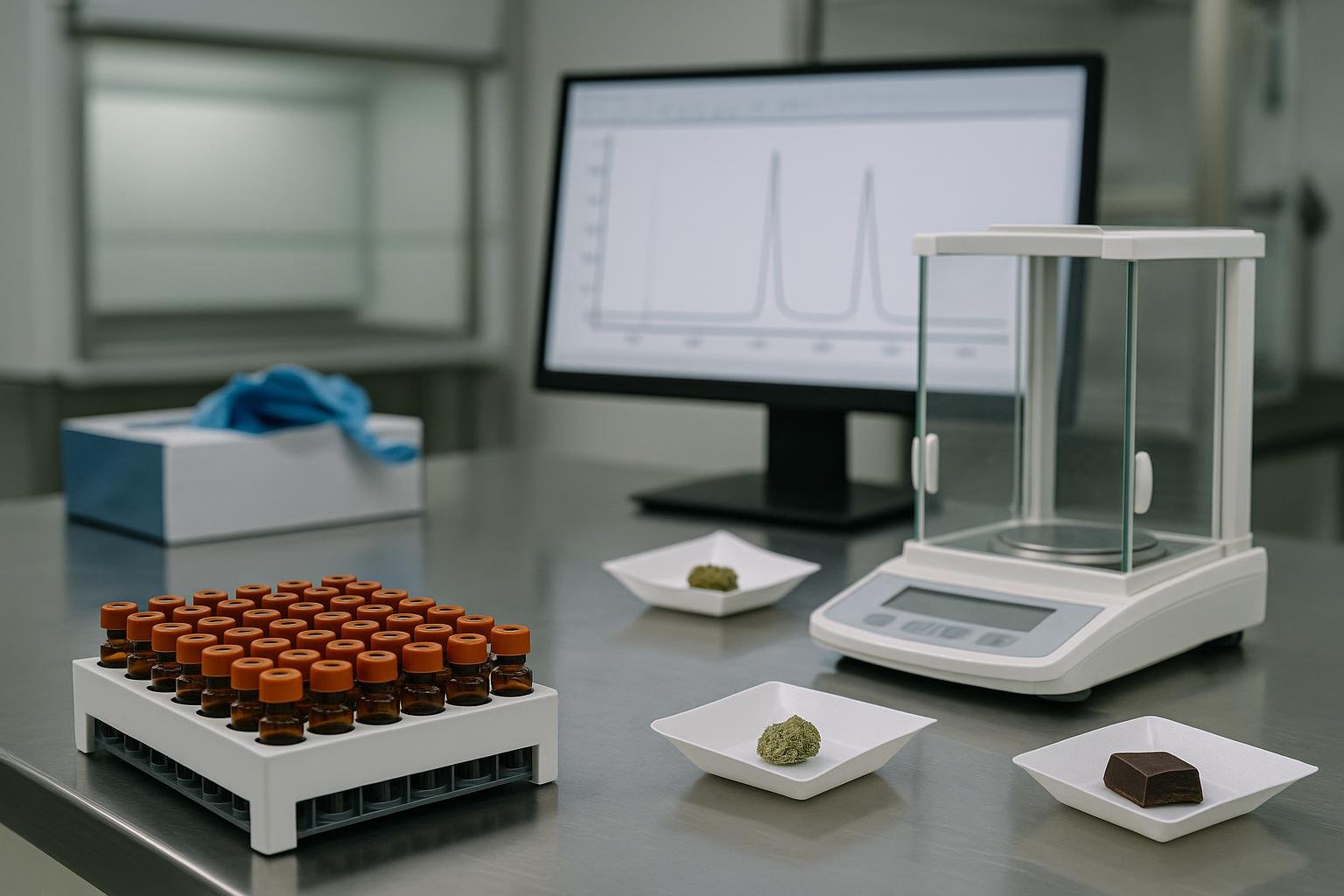
Cannabis edibles cost more to test than flower, and the price gap is not arbitrary — it reflects real differences in sample preparation, regulatory requirements, and the analytical challenges that come with testing cannabinoids inside a food matrix. If you have ever submitted a tray of gummies and winced at the invoice, this article explains exactly what you are paying for and what the lab is doing to earn it.
Whether you are a lab technician running your first edibles extraction, a lab director pricing out a new infused-product workflow, or a manufacturer trying to understand why your chocolate bar costs twice as much to test as your pre-roll — this article is for you. Consumers looking for dispensary recommendations and investors looking for market-size figures will not find what they need here.
Here is what we will cover:
- Why the food matrix creates analytical problems that flower does not
- What homogeneity testing actually involves and how Colorado’s rule defines a passing batch
- How potency variance limits apply to edibles
- What published lab price lists show about real-world edibles testing costs
- How to read a lab’s price menu so you know what you are actually buying
Step 1: Understand what the food matrix does to your cannabinoid extraction
When a lab tests ground cannabis flower for potency, the matrix is relatively forgiving. Plant material is mostly cellulose, and cannabinoids dissolve readily into common organic solvents like methanol or ethanol. A technician weighs the sample, adds solvent, sonicates (agitates the mixture using sound energy), dilutes, filters, and injects onto the HPLC (high-performance liquid chromatograph, the standard instrument class for cannabinoid potency). The whole prep can take under thirty minutes per sample.
An infused gummy, brownie, or hard candy is a different problem entirely. The food matrix — fats, sugars, starches, emulsifiers, colorants, and flavoring compounds — competes with your extraction solvent, clogs your filters, and co-elutes (elutes at the same time as the analyte of interest, obscuring the peak) with cannabinoids on the column. Chocolate is particularly brutal: cocoa butter and polyphenols both interfere. Gummies with gelatin or pectin can form gels in your extraction vial if you are not careful about solvent ratios and temperature.
The practical consequence is that every edible matrix needs its own validated extraction protocol, and validation takes time and reagents that get baked into the per-sample price. A lab that has validated its method for gummies cannot simply apply that method to a hard candy without additional development work — and cannabis-specific regulations in many jurisdictions require that validation be performed for each matrix type. If you want to understand what method validation actually involves, the Cannabis Lab 101 validation article walks through the full process.
Note: Hemp-derived edibles sold under the federal definition in 7 U.S.C. 1639o(1), as amended by P.L. 119-37, must not exceed 0.3 percent total tetrahydrocannabinols — including THCA — on a dry weight basis. The pre-amendment framing that used delta-9 THC alone is superseded. Matrix effects apply equally to hemp edibles; the analytical challenge does not change because the THC limit is lower.
Step 2: Know what homogeneity testing requires and why it is a separate line item
Potency testing tells you the average cannabinoid concentration across the sample you submitted. Homogeneity testing tells you whether every serving in the batch delivers a consistent dose — which is a completely different question and a separate analytical operation.
Colorado’s rule at 1 CCR 212-3-4-210 defines a homogeneous batch as one where a minimum of four servings drawn from two separate packaged units each show a relative standard deviation (RSD: the standard deviation expressed as a percentage of the mean, a measure of how spread out the individual results are) of less than 10 percent for each labeled cannabinoid. That means the lab must open at least two finished packages, extract at least four individual servings as discrete samples, run each one through the full potency workflow, and then calculate the RSD across those results.
That is four to six times the sample-prep workload of a single potency test, which is exactly why homogeneity appears as a separate line item on every lab menu I have seen.
Look at the published pricing: The Good Lab lists homogeneity at $150 to $250 depending on turnaround, separate from edibles potency at $100 to $150. Sunrise Cannabis Lab lists edibles potency at $160 and homogeneity at $180 as distinct line items. Nova Analytic Labs lists homogeneity at $80 with semi-solid or solid infused potency at $400 separately.
If your state requires homogeneity testing — and Colorado does for regulated marijuana products — you need to budget for both tests. Submitting only for potency and skipping homogeneity is a compliance failure, not a cost savings.
Note: Not every state has an explicit homogeneity rule written the way Colorado does. Some states require only batch potency with no formal RSD criterion. Check your state regulator’s current code; the Colorado Marijuana Enforcement Division’s rules at 1 CCR 212-3-4 are a useful model to compare against.
Step 3: Apply the potency variance rule correctly for your product
Passing potency is not just about hitting the labeled number — it is about hitting it within the allowed tolerance, and that tolerance is set by your state’s regulations.
Colorado’s rules allow a potency variance of no more than plus or minus 15 percent, a flat tolerance that applies to regulated marijuana edibles. That figure appears in Colorado regulatory guidance and is the standard your batch result is measured against.
This is the single most important number for a manufacturer to internalize before submitting an edibles batch: if your test result falls outside ±15% of the labeled potency, you have a failing batch regardless of how good your process looks.
For the lab, this rule means that low-dose products require the same or greater analytical precision as high-dose ones, because the absolute error budget is smaller at low concentrations. That is not cheaper to run — it is harder. Nova Analytic Labs’ adult-use guide states that for adult-use edibles, total THC must be no more than 10.5 mg per serving and no more than 105 mg per package — a serving-level compliance spec that the lab must verify at the individual serving level, not just the batch average.
For more on how potency is calculated and reported, see the technical overview of potency determination and the cannabinoid separation methods article.
Step 4: Read a lab price menu like a technician, not a shopper
Published lab price lists are more useful than they look if you know what the line items actually mean. Here is how to decode what you are seeing across the menus in the fact sheet.
Potency alone is not a compliance package. Desert Valley Testing lists edibles and topicals potency at $60 — the lowest figure in this set. That price almost certainly covers potency only, not homogeneity, not microbials, not pesticides. A $60 line item that leaves you non-compliant is not a bargain.
Bundle pricing reflects matrix complexity. Sunrise Cannabis Lab’s Infused Edible Panel at $500 bundles multiple analyte categories. Nova Analytic Labs’ semi-solid or solid infused testing at $400 similarly reflects the full workflow for a complex matrix. These prices are not inflated — they reflect separate sample-prep protocols for microbials, pesticides, residual solvents, mycotoxins, heavy metals, and water activity, each of which requires its own extraction and instrument class.
Turnaround time multiplies the base price. The Good Lab’s pricing page shows standard, 3-day, and 1-day turnaround tiers at $100, $125, and $150 respectively for infused edibles potency. Rush fees are real and proportional.
I suggest labs and manufacturers build a submission checklist that maps each required analyte to a specific line item on the price menu before the first batch goes out. Discovering mid-audit that you have been submitting edibles for potency only — when your state requires homogeneity — is an expensive lesson. The compliance testing overview and the cost-per-sample article are good companion reads for building that checklist.
Note: Prices on published lab menus change. The figures cited here come from menus available as of the research date for this article. Always confirm current pricing directly with the lab before submitting a batch.
Step 5: Account for the full panel, not just potency
For most regulated edibles markets, potency and homogeneity are the tests that drive the price conversation — but they are rarely the only required tests. A compliant infused product submission typically also needs microbial contaminant screening, pesticide testing, heavy metals analysis, and in some states mycotoxins and water activity.
Each of those analyte categories runs on a different instrument class and requires its own sample preparation. Microbial testing uses culture-based or qPCR (quantitative polymerase chain reaction, a molecular method for detecting microbial DNA) methods. Pesticide screening typically runs on LC-MS/MS (liquid chromatography coupled to tandem mass spectrometry) or GC-MS/MS. Heavy metals are typically analyzed by ICP-MS (inductively coupled plasma mass spectrometry) or other validated atomic spectrometry techniques such as ICP-OES, depending on the lab’s instrumentation and the jurisdiction’s accepted methods. None of these instruments care that your sample is a gummy rather than flower — but the extraction and digestion steps to get the analyte off the food matrix and into solution are more involved than for plant material.
The full compliance cost for an infused product is the sum of every required test, and that sum is almost always higher than the potency line item alone. For context on what individual contaminant panels cost and why, see the pesticide testing guide, the heavy metals article, and the mycotoxins piece.
If you are a manufacturer trying to model your testing budget before launch, I suggest pulling the full required panel from your state’s current regulations and pricing each line item separately against at least two lab menus. The variance between labs on individual line items can be significant, and the cheapest potency price does not always mean the cheapest full panel.
Quick answers
How much does cannabis edibles potency testing cost? Published lab price lists show edibles potency testing ranging from roughly $60 to $160 per sample for standard turnaround, with rush pricing pushing that higher. Homogeneity testing — required separately in states like Colorado — adds another $80 to $200 on top of potency alone. Full infused-product compliance panels that bundle potency, homogeneity, microbials, and contaminants can reach $400 to $500 per submission.
Why does edibles testing cost more than flower testing? Edibles require more sample preparation because the food matrix — fats, sugars, starches — interferes with cannabinoid extraction and chromatographic analysis in ways that ground flower does not. Homogeneity testing also requires multiple discrete servings from multiple packaged units, multiplying analyst time and consumables. The result is a higher per-sample fee that reflects real labor and reagent costs, not lab markup.
What is homogeneity testing for cannabis edibles and why is it required? Homogeneity testing confirms that cannabinoids are evenly distributed across servings within a production batch, not just present on average. In Colorado, a batch passes homogeneity when at least four servings drawn from two packaged units each show a relative standard deviation of less than 10 percent for each labeled cannabinoid, per 1 CCR 212-3-4-210. Without this check, a batch could pass average potency while individual servings deliver wildly different doses.
What is the legal potency variance allowed for cannabis edibles? Colorado’s rules allow a potency variance of no more than plus or minus 15 percent, a flat tolerance described in Colorado regulatory guidance. Other states set their own tolerances, so check your state regulator’s current code directly.
Can a lab use the same HPLC method for edibles as for flower? The instrument class — typically HPLC with UV or DAD detection — is usually the same, but the sample preparation protocol must be adapted for the food matrix. Fats and sugars require different extraction solvents, cleanup steps, and dilution factors compared with ground plant material, and cannabis-specific regulations in many jurisdictions require method validation for each matrix type. Running an unvalidated flower method on a chocolate brownie will produce inaccurate results that may not catch a failing product.
Does every edible SKU need its own compliance test, or can a lab test one product for a whole line? In Colorado, potency testing is required for each production batch of each regulated marijuana product before transfer, with limited exceptions for reduced testing allowances under 1 CCR 212-3-4. That means a manufacturer making three flavors of gummy in separate production runs needs separate batch tests for each run, not one test for the flavor family. Check your state’s specific batch definition and reduced-testing provisions, because the rules vary.
Sources
- Colorado 1 CCR 212-3-4-210 — Cornell LII
- Colorado Cannabis-Infused Products Food Safety Guidance — NEHA
- The Good Lab — Services and Pricing
- Nova Analytic Labs — Testing Menu and Adult Use Guide (PDF)
- Sunrise Cannabis Lab — Cannabis Price List (PDF)
- Desert Valley Testing — LIMSWiki vendor page
- 7 U.S.C. 1639o(1) — House.gov USC
- ISO/IEC 17025:2017 — ISO publication page (PUB100424)
FAQ
Frequently asked
- How much does cannabis edibles potency testing cost?
- Published lab price lists show edibles potency testing ranging from roughly $60 to $160 per sample for standard turnaround, with rush pricing pushing that higher. Homogeneity testing — required separately in states like Colorado — adds another $80 to $200 on top of potency alone. Full infused-product compliance panels that bundle potency, homogeneity, microbials, and contaminants can reach $400 to $500 per submission.
- Why does edibles testing cost more than flower testing?
- Edibles require more sample preparation because the food matrix — fats, sugars, starches — interferes with cannabinoid extraction and chromatographic analysis in ways that ground flower does not. Homogeneity testing also requires multiple discrete servings from multiple packaged units, multiplying analyst time and consumables. The result is a higher per-sample fee that reflects real labor and reagent costs, not lab markup.
- What is homogeneity testing for cannabis edibles and why is it required?
- Homogeneity testing confirms that cannabinoids are evenly distributed across servings within a production batch, not just present on average. In Colorado, a batch passes homogeneity when at least four servings drawn from two packaged units each show a relative standard deviation of less than 10 percent for each labeled cannabinoid, per 1 CCR 212-3-4-210. Without this check, a batch could pass average potency while individual servings deliver wildly different doses.
- What is the legal potency variance allowed for cannabis edibles?
- Colorado's rules allow a potency variance of no more than plus or minus 15 percent; that flat tolerance appears in Colorado regulatory guidance without a serving-size-based sub-threshold. Other states set their own tolerances, so check your state regulator's current code directly.
- Can a lab use the same HPLC method for edibles as for flower?
- The instrument class — typically HPLC with UV or DAD detection — is usually the same, but the sample preparation protocol must be adapted for the food matrix. Fats and sugars require different extraction solvents, cleanup steps, and dilution factors compared with ground plant material, and cannabis-specific regulations in many jurisdictions require method validation for each matrix type. Running an unvalidated flower method on a chocolate brownie will produce inaccurate results that may not catch a failing product.
- Does every edible SKU need its own compliance test, or can a lab test one product for a whole line?
- In Colorado, potency testing is required for each production batch of each regulated marijuana product before transfer, with limited exceptions for reduced testing allowances under 1 CCR 212-3-4. That means a manufacturer making three flavors of gummy in separate production runs needs separate batch tests for each run, not one test for the flavor family. Check your state's specific batch definition and reduced-testing provisions, because the rules vary.
Related guides
All guides- 01
Cannabis Lab 101: Cannabis Lab Technician Salary by State and Role
I pulled every sourced number I could find from ZipRecruiter, Indeed, and Salary.com to build a real salary table by role — from sample-prep tech to lab manager. Here is what the data actually says, what drives the spread, and how to negotiate your next offer.
- 02
Cannabis Lab 101: How to Become a Weed Tester — What the Job Actually Is
I spent four years on the bench in licensed cannabis testing labs, and the number-one question I get is whether 'weed tester' is a real job. It is — but nobody is paying you to smoke. Here is what the actual roles look like, what instruments you will run, and how to get hired.
- 03
Cannabis Lab 101: How to Start a Cannabis Testing Lab — Licensing, Accreditation, and Startup Costs
I spent four-plus years on the bench before anyone told me what opening a cannabis lab actually costs. This guide walks through state licensing requirements, ISO/IEC 17025 accreditation timelines, instrument capital expenditures by assay class, staffing minimums, and realistic runway — every number sourced.
Need this tested?
Compare labs that run these assays and get quotes in one go — no account, no fee.