· 10 min read
Cannabis Lab 101: Stability Testing, Expiry Dates, and How Labs Set a Shelf Life
I spent years running compliance panels and watched stability testing get treated as an afterthought. This article breaks down real-time vs accelerated studies, what states actually require, how THC degrades over time, and what acceptance criteria your data must hit before a regulator will approve an expiration date.
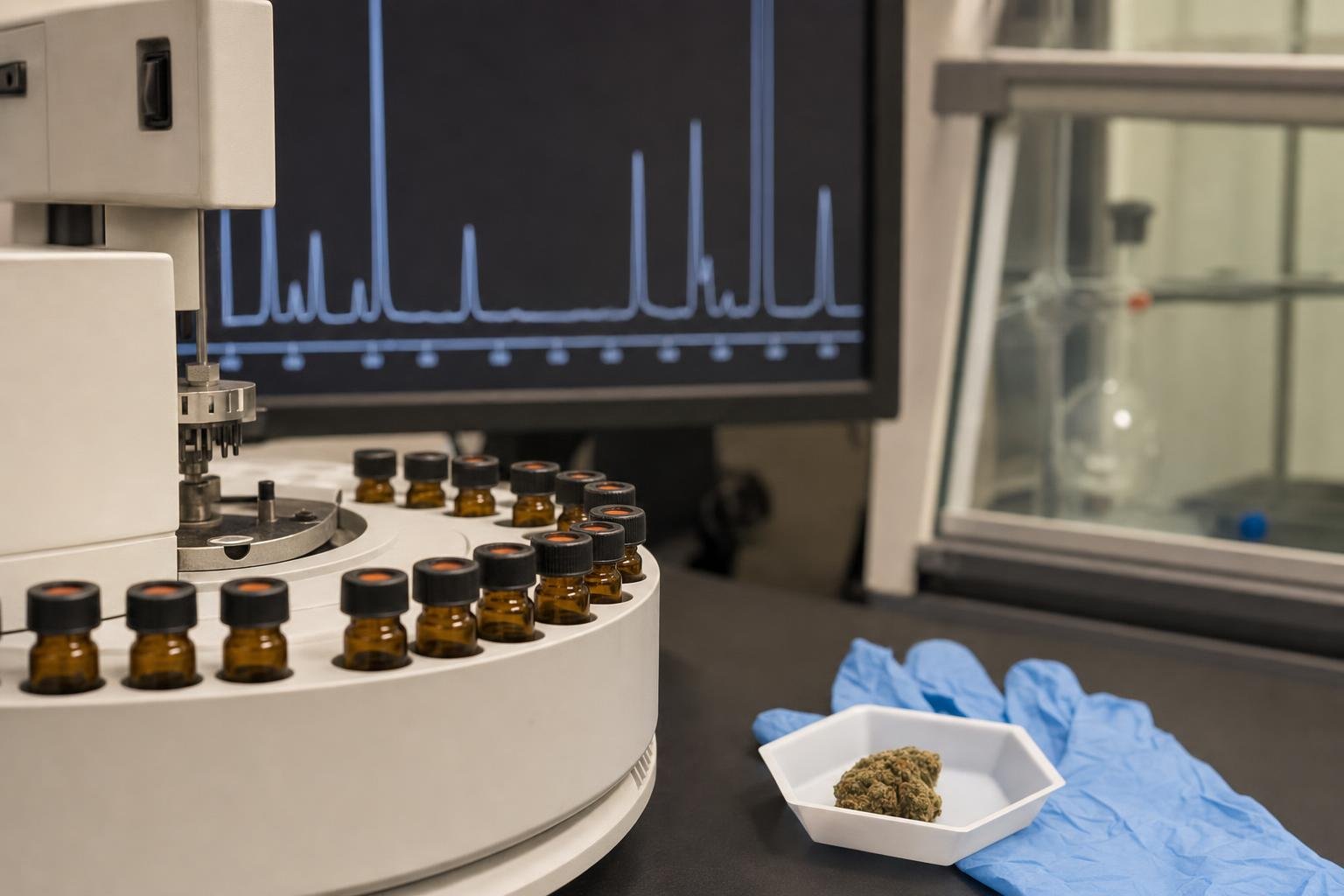
Stability testing is the discipline that turns a batch-release potency number into a claim that holds up six, nine, or twelve months later on a retail shelf. It is also one of the least standardized corners of cannabis compliance: states have written their own rules, used different default timelines, and left manufacturers to figure out the chemistry in between. This article walks through how a stability program is structured, what the regulations in several active markets actually say, and what your data must demonstrate before a regulator will approve an expiration date.
Whether you are a lab director designing a stability protocol from scratch, a manufacturer trying to understand why your lab is asking for monthly samples, or a technician who just got assigned to the stability bench, this article gives you the framework, the acceptance criteria, and the state-by-state rules you need to work with.
Here is what this article covers:
- What stability testing is and why it is not the same as a batch-release panel
- Real-time vs accelerated study design, and what state rules do and do not say about each
- THC degradation and CBN formation as the core chemical story
- State-by-state requirements: Minnesota, Colorado, New Jersey, Maryland, Virginia, and New York
- What acceptance criteria your data must hit
- How a default expiration date works and how to replace it
Step 1: Understand what stability testing actually measures
A batch-release panel tells you what is in the product on the day it leaves the facility. A stability study tells you whether that product will still meet its label claims after weeks or months of storage in its final packaging. These are different questions, and they require different experimental designs.
Stability must be evaluated in the final packaged form, not on bulk material or a reformulated sample. That requirement appears explicitly in the Minnesota Cannabis Technical Authority and reflects a basic principle: the packaging is part of the product. A nitrogen-flushed glass jar behaves differently from a polypropylene bag, and your stability data need to reflect what the consumer actually receives.
The analytes tracked at each time point typically include a full cannabinoid potency profile, microbial-contaminant counts, and, depending on the state, water activity (the amount of unbound water available to support microbial growth, expressed on a scale of 0 to 1) and contaminants that could migrate from packaging materials into the product. Minnesota’s Lab Bulletin LB-2026-01 requires analysis of microbial content, cannabinoid profile, and contaminant categories that could leach from packaging.
For a deeper look at the potency panel itself, see Cannabis Lab 101: Potency Testing and the HPLC methods overview.
Step 2: Design your study, real-time vs accelerated
A real-time stability study stores samples under the intended commercial storage conditions (for example, a cool, dark environment for a sealed edible) and pulls time-point samples on a defined schedule until the product either fails an acceptance criterion or reaches the claimed shelf life. The data you collect are directly applicable to the label claim because the conditions match what the product will actually experience.
An accelerated stability study stores samples under more stressful conditions, typically elevated temperature and humidity, to speed up the degradation reactions and generate early evidence of how the product will behave over a longer real-time period. Accelerated studies are standard practice in pharmaceutical development, where ICH guideline Q1A(R2) provides a well-established framework. For cannabis, ASTM D8309-21 is a published Standard Guide for Stability Testing of Cannabis-Based Products, though it is a voluntary guide rather than a mandated standard, and no state reviewed here has adopted it as a compliance requirement.
Note: Neither Minnesota nor Colorado has published a single required accelerated-testing temperature, humidity, duration, or mathematical conversion model. The Minnesota Cannabis Technical Authority requires stability evidence but does not specify the protocol. The Colorado Testing Rules Guidance Industry Bulletin 23-02 identifies temperature, humidity, light, packaging, potency, microbial contamination, and water activity as relevant factors without mandating a single protocol.
I suggest labs treat accelerated data as a planning tool and run concurrent real-time studies from day one, because Minnesota’s rules make clear that accelerated data alone do not automatically establish a retail expiration date. The regulator must approve the data before any date beyond the default applies.
For method validation considerations that apply to the analytical work inside a stability study, see Cannabis Lab 101: Method Validation.
Step 3: Know the chemistry, THC degradation and CBN formation
The central chemical event in cannabis potency stability is the oxidative conversion of THC (delta-9-tetrahydrocannabinol, the primary intoxicating cannabinoid) to CBN (cannabinol, a mildly psychoactive oxidation product). When THC is exposed to oxygen, light, and heat over time, the molecule loses hydrogen and aromatizes, producing CBN. A cannabinoid profile that shows declining THC alongside rising CBN is the fingerprint of an aging, improperly stored, or poorly packaged product.
The rate of that conversion is not a universal constant. It depends on the matrix (flower, oil, gummy, tincture), the oxygen headspace inside the package, light transmission through the packaging material, storage temperature, and humidity. No single peer-reviewed study provides a conversion rate that applies across all product types, and no such universal figure exists in the sourced literature. Your stability study will generate the product-specific degradation curve that actually matters for your label claim.
What regulators care about is whether the cannabinoid concentration at each time point still meets the acceptance criterion. Minnesota sets that criterion at a variance of less than 15% from the label claim (or from the time-zero measurement if no label claim exists) for the highest-concentration cannabinoid, per the Cannabis Technical Authority. If your THC is dropping faster than that threshold allows, the product’s shelf life ends at the last passing time point, not at the date you hoped to print on the label.
Note: CBN is itself a regulated cannabinoid in some state potency panels. If your product’s CBN rises above a reportable threshold during the study, that result may affect compliance independently of the THC acceptance criterion. Check your state’s potency panel requirements.
Step 4: Navigate the state-by-state rules
State requirements differ enough that a single stability protocol will not satisfy every market without review. Here is what the primary sources actually say.
Minnesota requires stability testing for all cannabis and hemp products covered by its Cannabis Technical Authority. Studies must begin within three months for new products, per Lab Bulletin LB-2026-01. Testing is required on the first batch of a new or altered process. The Office of Cannabis Management guidance notes that stability data from the first batch may be applied to later batches made with the same cultivation or manufacturing process. Explicit OCM approval is required before expiration or use-by dates can be set based on submitted stability data. Until approval is granted, the default expiration date is six months. If a product fails to demonstrate six-month stability, the regulator may assign the last demonstrated passing stability period as the expiration date.
Colorado sets a nine-month use-by date from harvest or production as the default ceiling, per Testing Rules Guidance Industry Bulletin 23-02. Stability testing can support a longer date, but potency, microbial-contaminant, and water-activity properties must all remain supported at the extended date.
New Jersey under N.J. Admin. Code § 17:30-11.8 sets a six-month maximum from manufacture or cultivation for usable cannabis and most formulations in the absence of applicable stability-testing information. Exceeding that limit requires valid scientific stability data directly applicable to the specific product.
Maryland requires growers to provide samples from each released batch to an independent testing laboratory for stability testing at six-month intervals under COMAR 14.17.10.03, and processors face the same obligation under COMAR 14.17.11.04.
Virginia under 2026 Acts of Assembly, Chapter 1051 takes a lighter-touch approach: stability testing is not required for products assigned an expiration date of 12 months or less. If you want to claim more than 12 months, you must run stability testing, and that testing is limited to microbial testing and potency testing for total THC and total CBD.
New York’s proposed Part 113 for medical cannabis, as of its March 2026 proposal, distinguishes between opened and unopened products. Unopened products require concurrent stability studies when a tentative expiration date is assigned. Opened products require testing at opening and at least again 60 days after first analysis. Both must retain consistent total THC and total CBD concentration per single serving. Note that this is proposed regulation, not final rule, and may change before adoption.
Note: This article covers only the states for which primary-source data were available at the time of writing. Your state may have requirements that differ. Go to your state cannabis regulator’s website directly rather than relying on secondary summaries.
Step 5: Build your time-point schedule and acceptance criteria
Once you know your target shelf life and your state’s requirements, you can design the time-point schedule. A typical schedule for a product targeting a six-month claim might pull samples at time zero, one month, three months, and six months. A product targeting 12 months would add a nine-month and 12-month pull. Each pull goes through the full panel required by your state, at minimum potency and microbial testing.
Document your storage conditions at every time point. Temperature and humidity logs are not optional. If a regulator asks why your month-three potency result looks anomalous, the first thing they will want is the environmental record for that storage period. A calibrated data logger inside the stability chamber is the minimum standard.
For each cannabinoid result, calculate the percent change from the time-zero value: ((time-zero result minus time-point result) divided by time-zero result) multiplied by 100. If that number exceeds 15% for the highest-concentration cannabinoid in a Minnesota-licensed product, the product has failed that time point. The shelf life claim cannot extend beyond the last passing time point.
For microbial results, apply your state’s action limits for the product category. Edibles and inhalable products typically carry different limits. See the compliance testing overview for the broader context on action limits by product type.
Note: Edibles and concentrates often degrade by different mechanisms. An edible may fail on microbial grounds before it fails on potency. A concentrate in a sealed, oxygen-free cartridge may hold potency well but fail on a packaging-leachate criterion. Design your study around the most likely failure mode for your specific matrix.
For information on what independent testing costs across different lab sizes, see The Cost of Testing Cannabis. Stability programs add ongoing testing costs beyond batch release, and manufacturers should budget for the full time-point schedule before committing to a shelf life claim.
Quick answers
What is the acceptance criterion for cannabinoid potency in a cannabis stability study? Minnesota requires the highest-concentration cannabinoid to vary by less than 15% from the label claim, or from the time-zero measurement if no label claim exists. This is one of the few published numerical criteria in state cannabis stability rules. Check your own state’s guidance, because not every program publishes an explicit tolerance.
How long is the default expiration date for a cannabis product before stability data are approved? Minnesota assigns a default six-month expiration date until a manufacturer submits evidence-based stability data and receives explicit Office of Cannabis Management approval for a different date. Colorado sets a nine-month use-by date from harvest or production as its default ceiling. Both states allow longer dates only when stability testing supports them.
Does every state require cannabis stability testing? No universal federal requirement exists, and state rules vary considerably. Virginia does not require stability testing for products assigned an expiration date of 12 months or less. Minnesota, Maryland, Colorado, and New Jersey each have explicit stability or expiration-dating requirements, but the specific obligations differ by state and product type.
What analytes are tested at each stability time point? Most state programs require at minimum a cannabinoid potency panel and a microbial-contaminant panel at each time point. Minnesota also requires testing for contaminants that could leach from packaging. Colorado adds water activity to the list of properties that must remain supported.
Can accelerated stability data alone set a retail expiration date? Not automatically, at least not in Minnesota, where the state does not allow accelerated data alone to establish a retail expiration date without explicit Office of Cannabis Management approval. Accelerated studies are a useful planning tool, but real-time data collected under intended storage conditions are what regulators use to confirm the shelf life claim.
Does THC convert to CBN as a product ages, and at what rate? THC does oxidize to CBN over time, and tracking that conversion is one reason cannabinoid profiling is included at every stability time point. No single universal conversion rate applies across all products, because the rate depends on matrix, oxygen exposure, light, temperature, humidity, and packaging. Your stability study will generate the product-specific degradation curve you actually need.
Sources
- Minnesota Cannabis Technical Authority v2.0
- Minnesota Office of Cannabis Management: Stability Testing guidance
- Minnesota OCM Lab Bulletin LB-2026-01
- Colorado MED Testing Rules Guidance Industry Bulletin 23-02
- N.J. Admin. Code § 17:30-11.8 (Cornell LII)
- New York Proposed Part 113 Medical Cannabis Regulations
- COMAR 14.17.10.03 (Maryland grower stability testing)
- COMAR 14.17.11.04 (Maryland processor stability testing)
- 2026 Virginia Acts of Assembly, Chapter 1051
- ICH Guideline Q1A(R2)
- ASTM D8309-21 Standard Guide for Stability Testing of Cannabis-Based Products
FAQ
Frequently asked
- What is the acceptance criterion for cannabinoid potency in a cannabis stability study?
- Minnesota requires the highest-concentration cannabinoid to vary by less than 15% from the label claim, or from the time-zero measurement if no label claim exists. This is one of the few published numerical criteria in state cannabis stability rules. Check your own state's guidance, because not every program publishes an explicit tolerance.
- How long is the default expiration date for a cannabis product before stability data are approved?
- Minnesota assigns a default six-month expiration date until a manufacturer submits evidence-based stability data and receives explicit Office of Cannabis Management approval for a different date. Colorado sets a nine-month use-by date from harvest or production as its default ceiling. Both states allow longer dates only when stability testing supports them.
- Does every state require cannabis stability testing?
- No universal federal requirement exists, and state rules vary considerably. Virginia, for example, does not require stability testing at all for products assigned an expiration date of 12 months or less. Minnesota, Maryland, Colorado, and New Jersey each have explicit stability or expiration-dating requirements, but the specific obligations differ by state and product type.
- What analytes are tested at each stability time point?
- Most state programs require at minimum a cannabinoid potency panel and a microbial-contaminant panel at each time point. Minnesota also requires testing for contaminants that could leach from packaging. Colorado adds water activity to the list of properties that must remain supported.
- Can accelerated stability data alone set a retail expiration date?
- Not automatically, at least not in Minnesota, where the state does not allow accelerated data alone to establish a retail expiration date without explicit Office of Cannabis Management approval. Accelerated studies are a useful planning tool, but real-time data collected under intended storage conditions are what regulators use to confirm the shelf life claim.
- Does THC convert to CBN as a product ages, and at what rate?
- THC does oxidize to CBN (cannabinol) over time, and tracking that conversion is one reason cannabinoid profiling is included at every stability time point. No single universal conversion rate applies across all products, because the rate depends on matrix, oxygen exposure, light, temperature, humidity, and packaging. Your stability study will generate the product-specific degradation curve you actually need.
Related guides
All guides- 01
Cannabis Lab 101: Cannabis Beverage Testing — Emulsions, Homogeneity, and Shelf Stability
I've run potency on flower all day, but the first time a cannabis beverage came through the door I realized the matrix changes almost everything — extraction, homogeneity sampling, particle size, pH, and stability all need rethinking. Here's what the bench actually looks like for infused beverages.
- 02
Cannabis Lab 101: Cannabis Edibles Testing Cost — Why Infused Products Cost More to Test
I spent four years running potency assays on everything from flower to fudge, and infused products always took longer and cost more. Here is exactly why — matrix effects, homogeneity requirements, and the extra sample prep no one explains — plus real prices from published lab menus.
- 03
Cannabis Lab 101: Foreign Matter and Visual Inspection, the Cheapest Test That Fails the Most Flower
I walk you through the microscopy method, the photos-in-words of what actually fails, and how pass/fail thresholds differ by state, so you can run the inspection correctly, document it defensibly, and understand why a single hair can reject a whole batch.
Need this tested?
Compare labs that run these assays and get quotes in one go — no account, no fee.