· 10 min read
Cannabis Lab 101: Foreign Matter and Visual Inspection, the Cheapest Test That Fails the Most Flower
I walk you through the microscopy method, the photos-in-words of what actually fails, and how pass/fail thresholds differ by state, so you can run the inspection correctly, document it defensibly, and understand why a single hair can reject a whole batch.
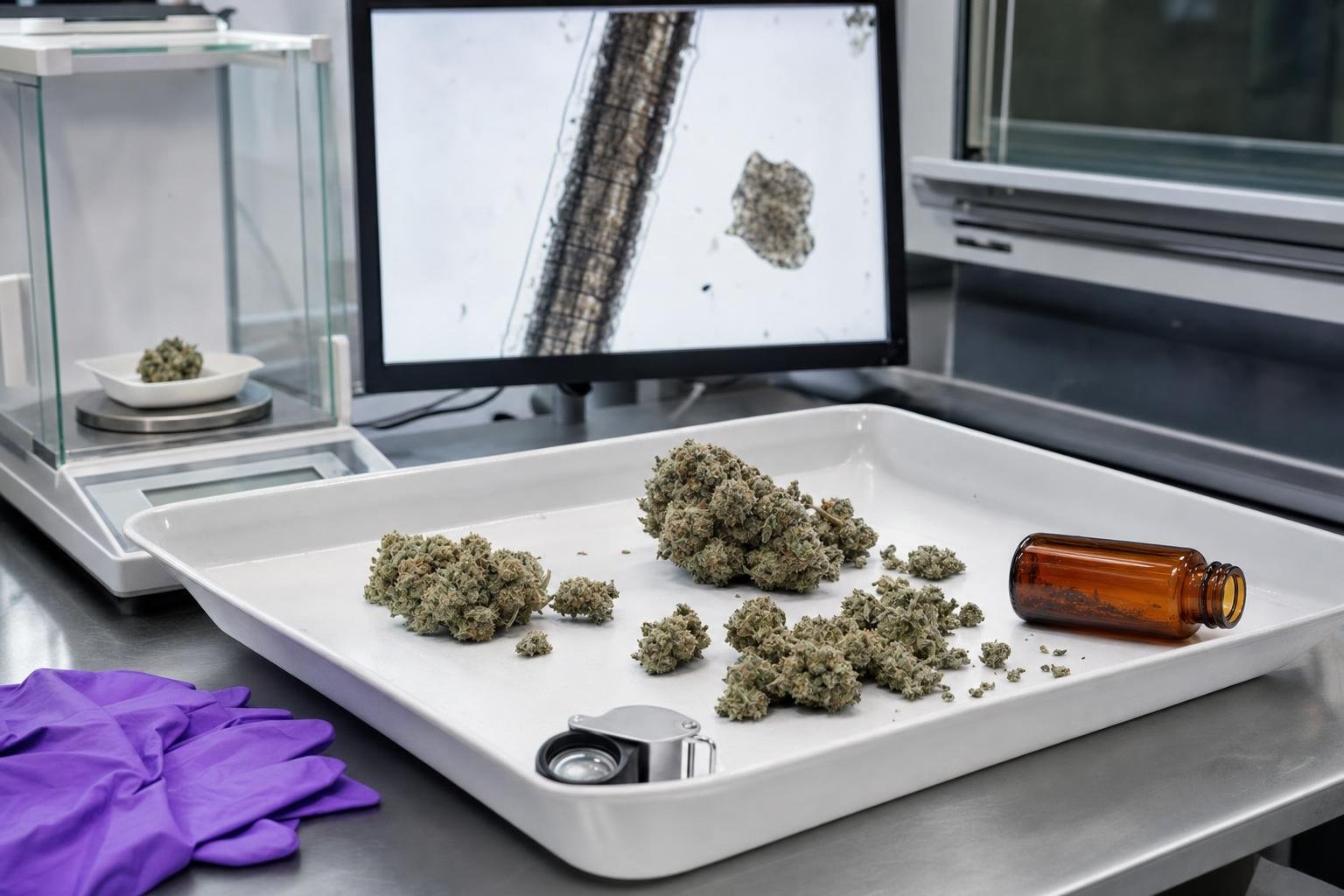
Foreign matter inspection is the test that requires the least instrumentation and still manages to reject batches that sailed through potency and pesticides. A single hair, a fragment of insect leg, or a clump of soil caught under a loupe can stop a product from reaching the shelf. This article walks you through the microscopy method, the photos-in-words of what actually fails, and how pass/fail thresholds differ by state, so you can run the inspection correctly, document it defensibly, and understand why a single hair can reject a whole batch.
Whether you are a bench technician learning the procedure for the first time, a lab director writing or auditing a standard operating procedure, or a cultivator trying to understand why your batch was rejected, this article gives you the actual regulatory thresholds, the step-by-step method, and the documentation requirements you need.
This article covers:
- What foreign matter is and why states define it differently
- How to set up and conduct the inspection before you grind anything
- What the common failure items look like in plain language
- How to document findings so they survive an audit
- Pass/fail thresholds from six state programs, side by side
Step 1: Understand what your state actually means by “foreign matter”
The single most important thing to know before you run this test is that no single national definition of cannabis foreign matter exists, and the thresholds differ enough between states that a passing result in one jurisdiction can be a failing result in another.
Here is what six programs actually say.
New Jersey’s CRC Testing Guidance requires visual inspection of unusable cannabis, usable cannabis, and cannabis products for foreign material. The inspection must cover the interior and exterior of dried flower or plant material and the exterior of any cannabis product. Failure triggers include visible sand, soil, cinders, dirt, mold, or mildew exceeding 10% of total sample area, and more than one insect fragment, one hair, or one count of mammalian excreta per 3.0 g of sample.
Nevada Cannabis Compliance Board Regulation 1, §1.100 defines foreign matter to include physical contaminants and stems at least 3 mm in diameter when they constitute more than 5% of the cannabis product. That stem threshold is worth noting: a thick woody stem is not automatically foreign matter in Nevada unless it crosses that size and proportion.
Montana Code Annotated §16-12-209 requires testing laboratories to inspect each batch for foreign matter, debris, insects, and visible mold, with the department responsible for establishing acceptable levels. If you are operating in Montana, you need to pull the current department rules rather than relying on the statute alone.
Utah Administrative Code R66-3-6 fails a sample if it contains foreign matter visible to the unaided eye, if microscopic foreign matter is harmful or estimated to exceed 3% of the representative sample’s mass, or if foreign matter appears to have been intentionally added to increase visual appeal or market value. Utah also includes a seed-count criterion: total seeds must not exceed the net weight of the sample divided by 1.75.
Note: A separate Utah rule document uses a divisor of 3.5 for the seed criterion rather than 1.75. Before you rely on either figure, verify the currently codified rule against Utah Administrative Code R68-29-6 and R66-3-6 together.
Washington Administrative Code §16-309-170 requires the result to be reported as pass or fail, and specifies that the inspection must occur in a clean, sanitary location that prevents contamination or degradation before other testing.
Minnesota’s Cannabis Technical Authority, citing Minnesota Rules part 9810.3100, sets failure for gross foreign matter above 5% by mass in the portion analyzed, and failure for sharp, hard, or puncturing material (glass, metal, plastics) above 1% by mass. Minnesota treats those two categories separately, which is a sensible distinction that other states have not always codified.
Step 2: Set up the inspection before you touch the grinder
The most common procedural error I see described in state guidance is inspecting material after it has already been homogenized. You must inspect before you grind, because grinding destroys the evidence.
Both Washington WAC §16-309-170 and Minnesota’s technical guidance specify that at least 30% of the total representative sample must be examined before homogenization. Minnesota goes further and recommends separating buds into at least 10 increments and averaging the results as total foreign-matter contamination. It also recommends dissecting nodes whenever physically possible, because insect material and soil can hide inside the bract structure of a dense flower.
For setup:
- Work in a clean, sanitary location. Washington’s rule makes this explicit; it is good practice everywhere.
- Use a white or light-colored inspection tray so that dark particulates (soil, insect fragments, hair) are visible against the background.
- Have your microscope or magnified camera ready before you open the sample container. You do not want to be adjusting equipment while the sample is exposed.
- Wear gloves. You are both protecting the sample from your own contamination and protecting yourself from whatever is on it.
- Log the sample mass before you begin. You will need it to calculate mass-based thresholds.
Note: For edibles, concentrates, and other processed products, the inspection is typically limited to the exterior of the finished product or the raw plant material before processing. Visual inspection of a finished gummy for insect fragments is a different procedure from inspecting dried flower. Check your state’s specific product-type requirements.
Step 3: Know what you are looking for, in plain language
Regulators list categories; this section translates them into what you actually see on the tray.
Soil and mineral particulates look like fine brown or gray grit that does not brush off with a dry swab the way trichome powder does. Under 10x magnification, soil particles have irregular angular edges. Sand grains are larger and more translucent. Both are named failure items in New Jersey’s guidance.
Hair is the item that surprises new technicians. A single human hair is roughly 50 to 100 micrometers in diameter and can be nearly invisible against a dense green sample until you use a light source at a low angle. Under magnification, a hair has a smooth cylindrical shaft with a visible medulla (the central canal running along the hair’s length). Minnesota’s technical guidance lists hair explicitly as gross foreign matter. New Jersey counts it: more than one hair per 3.0 g is a failure.
Insect material ranges from whole thrips (tiny, elongated, pale insects common in cannabis cultivation) to fragments of leg, wing, or exoskeleton (the hard outer shell of an insect). Under 10x magnification, insect legs show segmentation and fine hairs. Wings may be transparent with visible venation (the network of veins in an insect wing). Both Minnesota and New Jersey name insect material as a failure category.
Mold and mildew at the visible scale appear as white, gray, or black powdery or fuzzy patches on the flower surface. New Jersey’s guidance lists mold and mildew exceeding 10% of total sample area as a visual failure. Note that visual inspection for mold is not a substitute for microbiological testing; it catches gross contamination only.
Sharp, hard, or puncturing material (glass, metal, rigid plastic) is the category Minnesota treats separately with a 1% by mass threshold. These items are a physical safety hazard in a way that a hair is not, which is why the threshold is lower.
Stems are only foreign matter in some states and only above a size threshold. Nevada’s definition requires the stem to be at least 3 mm in diameter and to constitute more than 5% of the product before it counts.
Note: Plant-based adulterants (material added to increase apparent weight or visual appeal) are a separate failure category in Utah’s rules. If you see material that looks like it does not belong to the cannabis plant but also does not match soil or insect categories, document it carefully and flag it for your lab director.
Step 4: Document the inspection so it survives an audit
The photograph is not optional in Washington, and I suggest labs in every state treat it as mandatory regardless of whether their rules require it.
Washington WAC §16-309-170 requires a microscope with photographic capabilities, or a camera with sufficient magnification or resolution, to document foreign matter. When an item cannot be identified from an unmagnified photograph, magnification is required. The lab must provide a detailed written description of the observed item and a supporting photograph.
For documentation that holds up:
- Photograph the full tray before you disturb anything, then photograph each item of concern individually.
- Use a scale reference in the photograph (a ruler, a calibrated stage micrometer (a microscope slide with a precision scale engraved on it), or a coin of known size).
- Write a description that identifies the item by category (hair, insect fragment, soil), its approximate location in the sample, and whether it was found on the interior or exterior of the flower.
- Record the mass of the portion you inspected, the mass of any foreign matter separated, and the calculated percentage. This is the number that drives the pass/fail decision in mass-based states like Minnesota and Utah.
- Log the result as pass or fail, as Washington requires, but keep the supporting data in the batch record.
For method validation context, see our article on cannabis lab method validation. For how this test fits into the broader compliance picture, see an introduction to cannabis compliance testing.
Step 5: Apply the correct threshold and issue the result
This is where state differences become consequential. The same sample, inspected by the same technician using the same method, can pass in one state and fail in another.
Use this summary as a working reference, and always verify against the current primary source before you report:
- New Jersey: Soil, mold, mildew, sand, cinders, dirt exceeding 10% of sample area = fail. More than one insect fragment, one hair, or one count of mammalian excreta per 3.0 g = fail. Source: NJ-CRC Testing Guidance.
- Nevada: Stems at least 3 mm diameter exceeding 5% of product = foreign matter. Physical contaminants = foreign matter. Specific pass/fail mass threshold: verify current CCB rules. Source: Nevada CCB Regulation 1, §1.100.
- Utah: Any foreign matter visible to the unaided eye = fail. Microscopic foreign matter estimated above 3% of representative sample mass = fail. Seeds exceeding net weight divided by 1.75 = fail. Source: Utah Administrative Code R66-3-6.
- Minnesota: Gross foreign matter above 5% by mass = fail. Sharp, hard, or puncturing material above 1% by mass = fail. Source: Minnesota Cannabis Technical Authority, citing Minnesota Rules part 9810.3100.
- Washington: Report as pass or fail; photograph and describe any observed item; inspect at least 30% of sample before grinding. Source: WAC §16-309-170.
- Montana: Inspection required; acceptable levels set by the department. Source: Montana Code Annotated §16-12-209.
For method context on other contaminant tests that run alongside foreign matter, see our articles on pesticide testing and heavy metals.
Quick answers
What counts as foreign matter in cannabis testing? Foreign matter definitions vary by state, but regulators consistently name soil, sand, mold, insect fragments, hair, mammalian excreta, and physical contaminants as examples. Nevada’s rules also count stems at least 3 mm in diameter when they make up more than 5% of the product. Check your state regulator’s current rule because no single national definition exists.
How many insect fragments or hairs will fail a cannabis sample? In New Jersey, more than one insect fragment, one hair, or one count of mammalian excreta per 3.0 g of sample causes a failure. Other states set mass-based thresholds rather than count-based ones, so the answer depends entirely on which state’s rules apply to your batch.
What magnification do labs use for cannabis foreign matter inspection? Minnesota’s technical guidance recommends routine examination at up to 10x magnification, with higher magnification used where necessary. Washington’s rules require magnification whenever an item cannot be identified from an unmagnified photograph, but neither state mandates a specific instrument model or sensor specification.
Do labs have to photograph foreign matter they find? In Washington, yes: laboratories must provide a detailed written description of observed foreign matter and a supporting photograph, and must use magnification when an item cannot be identified from an unmagnified image. Other states may not specify photography explicitly, so review your state’s current administrative code.
What percentage of a cannabis sample must be inspected for foreign matter before grinding? Both Washington’s administrative code and Minnesota’s technical guidance recommend examining at least 30% of the total representative sample before homogenization or grinding. Minnesota also recommends separating buds into at least 10 increments and averaging the results.
What is the pass/fail threshold for gross foreign matter by mass? Thresholds differ by state. Minnesota sets failure at gross foreign matter above 5% by mass in the portion analyzed, and sharp or puncturing material above 1% by mass. Utah fails a sample if microscopic foreign matter is estimated to exceed 3% of the representative sample’s mass. New Jersey uses a 10% of total sample area criterion for visible soil, mold, and similar contaminants.
Sources
- NJ-CRC Testing Guidance
- Montana Code Annotated §16-12-209
- Nevada Cannabis Compliance Board Regulation 1
- Utah Administrative Code R66-3-6
- Utah Administrative Code R68-29-6
- Washington Administrative Code §16-309-170
- AOAC Official Method 945.75
- Minnesota Cannabis Technical Authority
- AOAC Official Method 960.51
FAQ
Frequently asked
- what counts as foreign matter in cannabis testing
- Foreign matter definitions vary by state, but regulators consistently name soil, sand, mold, insect fragments, hair, mammalian excreta, and physical contaminants as examples. Nevada's rules also count stems at least 3 mm in diameter when they make up more than 5% of the product. Check your state regulator's current rule because no single national definition exists.
- how many insect fragments or hairs will fail a cannabis sample
- In New Jersey, more than one insect fragment, one hair, or one count of mammalian excreta per 3.0 g of sample causes a failure. Other states set mass-based thresholds rather than count-based ones, so the answer depends entirely on which state's rules apply to your batch.
- what magnification do labs use for cannabis foreign matter inspection
- Minnesota's technical guidance recommends routine examination at up to 10x magnification, with higher magnification used where necessary. Washington's rules require magnification whenever an item cannot be identified from an unmagnified photograph, but neither state mandates a specific instrument model or sensor specification.
- do labs have to photograph foreign matter they find
- In Washington, yes: laboratories must provide a detailed written description of observed foreign matter and a supporting photograph, and must use magnification when an item cannot be identified from an unmagnified image. Other states may not specify photography explicitly, so review your state's current administrative code.
- what percentage of a cannabis sample must be inspected for foreign matter before grinding
- Both Washington's administrative code and Minnesota's technical guidance recommend examining at least 30% of the total representative sample before homogenization or grinding. Minnesota also recommends separating buds into at least 10 increments and averaging the results.
- what is the pass/fail threshold for gross foreign matter by mass
- Thresholds differ by state. Minnesota sets failure at gross foreign matter above 5% by mass in the portion analyzed, and sharp or puncturing material above 1% by mass. Utah fails a sample if microscopic foreign matter is estimated to exceed 3% of the representative sample's mass. New Jersey uses a 10% of total sample area criterion for visible soil, mold, and similar contaminants.
Related guides
All guides- 01
Cannabis Lab 101: Microbial Testing — Plating vs qPCR and Why Labs Disagree
I spent years running microbial panels on cannabis flower and concentrates, and the plating-vs-qPCR argument never gets old. This article breaks down total yeast and mold, Aspergillus species testing, AOAC SMPRs, state limits, and the dead-DNA problem that makes regulators and lab directors argue at every conference.
- 02
Cannabis Lab 101: Cannabis Testing Cost Per Sample — 2026 Price Ranges by Assay
I pulled published price lists from licensed labs in New Jersey, Minnesota, and Oregon, plus Utah's state fee schedule, to show you exactly what each assay costs in 2026 — and why the same test can cost twice as much in one state as another.
- 03
Cannabis Lab 101: The Cannabis Testing Market in 2026 — Who Tests What, and What It Costs
I spent four years on the bench watching growers squint at invoices and ask why a flower panel costs $600. This article breaks down who is licensed to test cannabis, what analytes every compliance panel must cover, what real labs charge per test, and why a single national market-size number is harder to find than it looks.
Need this tested?
Compare labs that run these assays and get quotes in one go — no account, no fee.