· 11 min read
Cannabis Lab 101: The Cannabis Testing Market in 2026 — Who Tests What, and What It Costs
I spent four years on the bench watching growers squint at invoices and ask why a flower panel costs $600. This article breaks down who is licensed to test cannabis, what analytes every compliance panel must cover, what real labs charge per test, and why a single national market-size number is harder to find than it looks.
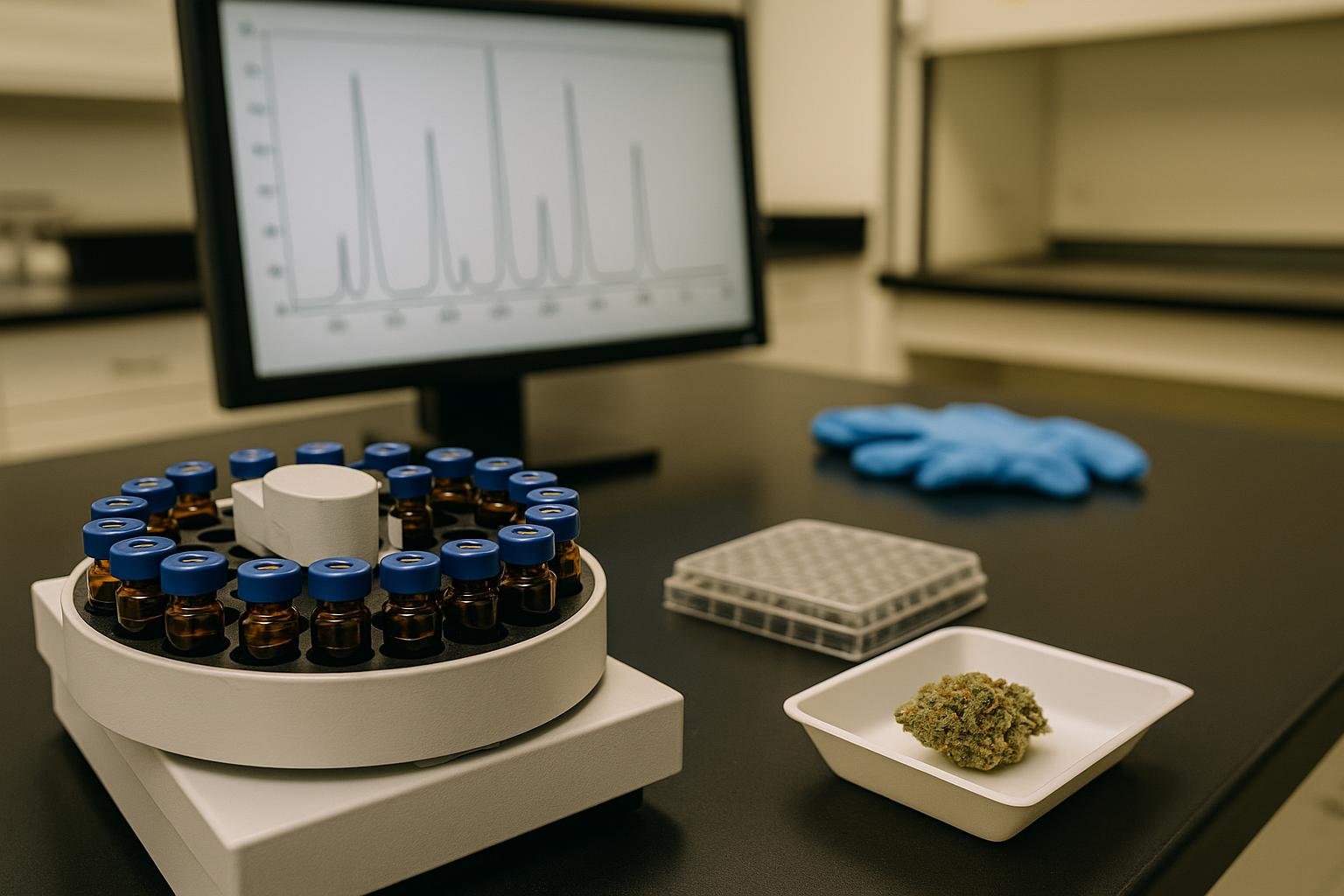
The cannabis testing market is one of the few analytical chemistry sectors where every number — market size, national lab count, compliance-versus-R&D split — is genuinely hard to pin down from primary sources. Private market research firms publish figures, but those figures are not independently verifiable from regulator pages or peer-reviewed data. What is verifiable: how many labs a given state has licensed, what analytes those labs must run, what instrument classes the published standards specify, and what real labs charge per sample. That is what this article covers.
Whether you are a bench technician trying to understand where your lab fits in the broader landscape, a lab director building a business case for a new instrument, or a cultivator staring at a $600 invoice wondering what you paid for — this article gives you the structural picture of the U.S. cannabis testing market grounded in regulator pages, ASTM standards, and a real lab’s published price list. It does not give you a market-size number, because no sourced one exists in the public record.
What is coming:
- How licensed lab counts actually work — and why there is no national total
- What analytes compliance testing covers and which ASTM standards govern each
- What instrument classes the standards specify
- What real compliance panels cost, line by line
- Why the compliance-versus-R&D split is structural, not statistical
Step 1: Understand Why There Is No Single “Market Size” Number
Every few months a press release announces that the cannabis testing services market is worth some number of billions of dollars, growing at some compound annual growth rate. I have never been able to trace those figures to a regulator page, a peer-reviewed paper, or an ASTM or AOAC document. The fact sheet behind this article confirms the same finding: no primary-source, regulator-backed, or peer-reviewed figure for a U.S. cannabis testing market size was identified in the public record as of August 2026.
The reason is structural. Cannabis remains a Schedule I controlled substance under federal law, which means there is no federal licensing body that counts labs or tracks testing volume. Market size estimates come from private research firms whose methodologies are not public. I am not saying those estimates are wrong — I am saying they cannot be verified from primary sources, and this series does not repeat unverifiable numbers.
What you can verify is the state-level picture. Each state with a legal cannabis program licenses its own testing labs and publishes — or is supposed to publish — a list of those labs. The New Jersey Cannabis Regulatory Commission (CRC) lists nine active permitted cannabis testing laboratories as of August 26, 2026: Anthea Labs, Green Analytics East, Integrated Analytical Solutions, Kaycha Labs, New Jersey Cannalytics, Smithers CTS, Sunrise Clinical Lab, Sriven Labs, and Trichome Analytical. Each holds an annual permit that must be renewed, and the CRC is the regulatory authority overseeing both licensing and compliance investigations.
New Jersey is one example. Every other state with a legal program has an equivalent page — or should. The only way to get a national lab count is to aggregate those state lists one by one. If you need your state’s list, start with your state cannabis regulator’s website; do not rely on any third-party aggregator that does not link to the primary source. Our lab directory links to licensed labs by state as a starting point.
Note: Hemp testing under the 2018 Farm Bill operates under a different regulatory framework than adult-use or medical cannabis. USDA-approved state hemp plans and tribal plans govern hemp testing labs separately, and the analyte requirements — primarily delta-9 THC at or below 0.3% on a dry-weight basis — differ from state cannabis compliance panels.
Step 2: Map the Analytes — Who Tests What
The compliance panel is not arbitrary; every analyte on it corresponds to a documented safety or labeling concern, and published ASTM standards now exist for most of them.
A typical state compliance panel for cannabis flower covers eight to ten analyte categories. Here is how the published standards map to each:
Potency (cannabinoid profile). ASTM D8375-22 specifies LC-MS/MS (liquid chromatography coupled to tandem mass spectrometry) for cannabinoid quantification in dried cannabis and hemp. ASTM D8442-22 covers cannabinoid analysis in cannabis raw materials and resin cannabis products using GC-FID (gas chromatography with flame ionization detection). See our technical overview of potency determination and cannabinoid separation methods for instrument-level detail.
Terpenes. GC is the instrument class most commonly applied to terpene quantification; see our terpene testing explainer.
Pesticides. ASTM D8399-23 specifies LC-MS/MS for multi-residue pesticide analysis in dried cannabis and hemp. The ASTM D37 Committee news release describes D8399 as helping labs establish pesticide concentration levels or confirm their absence. Our pesticide testing guide covers action limits by state.
Heavy metals. ASTM D8469 is the published test method for metals in cannabis. See our heavy metals explainer.
Microbiology. AOAC International’s validation guidance for microbiological methods in cannabis (published February 2022) provides the framework labs use to validate detection and quantification of microbial hazards.
Mycotoxins. Covered in state-specific action limit lists; see our mycotoxins guide.
Water activity. ASTM D8196 specifies determination of water activity (aw, a measure of free moisture available for microbial growth) in cannabis flower.
Residual solvents. Required for concentrates and extracts; instrument class is typically GC headspace.
Foreign matter and moisture content. Visual and gravimetric tests; typically included in flower panels.
Sampling before any of these tests matters as much as the analysis itself. ASTM D8334/D8334M-20 defines standardized sampling procedures for cannabis and hemp post-harvest batches, with the explicit note that local regulatory directives take precedence where they differ. ASTM D8493-23 covers sample preparation for analytical testing of quality attributes and notes that regulators often dictate the representative sample and final test portion mass.
Note: Concentrate and extract panels differ from flower panels. Residual solvents become mandatory; water activity may or may not be required depending on product form. Edible panels add microbiological and water activity requirements tied to food safety logic. Check your state’s specific matrix-by-matrix requirements.
Step 3: Read a Real Price List
The most useful thing I can do for a grower or a new technician is show what a real lab charges, not a range someone invented. Sunrise Clinical Lab — one of the nine NJ CRC-licensed labs — publishes a price list; the document file path indicates February 2025. Here are the individual test prices and panel prices directly from that document:
Individual tests:
- Cannabinoid Profile (Potency): $70
- Terpenes: $50
- Pesticides: $160
- Mycotoxins: $60
- Residual Solvents: $100
- Heavy Metals: $120
Compliance and specialty panels:
- Infused Edible Panel: $500 (potency, microbials, mycotoxins, water activity, heavy metals, pesticides, foreign matter)
- Infused Non-Edible Panel: $580
- Inhalable/Vape Concentrate Panel: $580 (potency, terpenes, microbials, mycotoxins, pesticides, and related tests)
- Flower Compliance Panel: $600 (potency, terpenes, microbials, mycotoxins, water activity, heavy metals, pesticides, moisture content, foreign matter)
- R&D Panel: $600
Why does the panel cost less than the sum of individual tests? Because labs batch samples, share instrument time, and price panels to encourage compliance volume. The math still works out in the lab’s favor at scale.
These are one lab’s published prices, not a national average. Prices vary by state, by lab, by matrix, and by turnaround time. For a deeper look at how lab size affects per-sample economics, see our article on the cost of testing cannabis for small, medium, and large labs.
Note: Proficiency testing (PT, the process of submitting blind samples to an external program to verify your lab’s accuracy) is a separate ongoing cost on top of routine sample fees. Proficiency Testing Canada lists participation in C70 “Potency in Cannabis” at $420 for CALA member labs and $550 for non-members, and C71 “Pesticides in Cannabis” at $620 for members and $750 for non-members (pricing page dated April 15, 2024). U.S. labs typically use domestic PT providers, but the Canadian pricing illustrates the order of magnitude.
Step 4: Understand the Compliance-Versus-R&D Split — Structurally
A common question from lab directors building a business plan is: what share of testing volume is mandatory compliance testing versus voluntary R&D testing? The honest answer is that no primary-source figure exists for this split at a national level. The fact sheet behind this article confirms it: any percentage would be speculative without an industry survey or regulator reporting.
What I can tell you is how the two categories are structured — and that matters more for business planning anyway.
Compliance testing is non-discretionary. Every batch of cannabis destined for commercial sale in a licensed market must pass a state-mandated panel before it can be released. The grower or manufacturer cannot skip it, cannot choose a cheaper subset of tests, and cannot use a lab that is not licensed in that state. This creates a volume floor that tracks directly with licensed production volume in each state.
R&D testing is discretionary. A cultivator running a new phenotype, a manufacturer developing a new edible formulation, or a brand trying to characterize a terpene profile before a product launch will order R&D panels. Sunrise Clinical Lab’s price list explicitly distinguishes compliance panels from an R&D Panel at $600 — same price as the flower compliance panel, but ordered outside the regulatory release workflow.
I suggest labs take it a step further when talking to prospective clients: explain that R&D panels are not a regulatory shortcut. They do not substitute for a compliance panel at release, and they do not carry the chain-of-custody documentation that regulators require for batch release. They are a product development tool.
For a full picture of what compliance testing entails from the lab’s side, see our introduction to cannabis compliance testing.
Step 5: Know the Standards and Accreditation Framework
The analyte map in Step 2 is only useful if the methods behind it are validated. Two frameworks govern that.
ISO/IEC 17025:2017 is the international standard for testing and calibration laboratory competence. Many state cannabis programs require or prefer ISO 17025 accreditation as a condition of licensure, though requirements vary by jurisdiction — it covers management system requirements, technical requirements, and impartiality. Our ISO 17025 audit preparation guide walks through what an accreditation body actually looks for.
ASTM D8282-19 — “Standard Practice for Laboratory Test Method Validation and Method Development” — provides a cannabis-focused framework for validating test methods. It sits alongside ISO 17025 rather than replacing it. Our method validation article covers the acceptance criteria you need to hit.
ASTM Committee D37 on Cannabis is the standards development body responsible for the analyte-specific standards listed in Step 2. Subcommittee D37.03 is specifically responsible for laboratory guidance. Additional quality system standards from D37 include D8229 for CAPA-focused quality management and D8250 for HACCP systems for extracted and infused products.
The accreditation body accredits the lab; the standard defines what the lab must do. A lab can be ISO 17025-accredited and still run a poorly validated method — accreditation is a management system check, not a method performance guarantee. The ASTM D-series standards fill that gap by specifying the chemistry.
Note: Hemp labs operating under USDA-approved state plans may face different accreditation requirements than cannabis labs. Some states accept DEA-registered labs for hemp THC testing; others require ISO 17025. Check your state hemp plan directly.
Quick answers
How many licensed cannabis testing labs are there in the United States? No federal registry publishes a national count — the number requires state-by-state aggregation from each regulator’s public list. New Jersey lists nine active permitted labs as of August 26, 2026, on the NJ CRC testing-labs page. Start with your state cannabis regulator’s website for your jurisdiction.
How much does a full compliance panel cost? $500 to $600 per sample is the range shown on Sunrise Clinical Lab’s price list, depending on product type — $500 for edibles, $600 for flower. Individual tests run $50 (terpenes) to $160 (pesticides) at the same lab.
What instruments do cannabis labs use? LC-MS/MS is specified for cannabinoid quantification (ASTM D8375-22) and for multi-residue pesticide analysis (ASTM D8399-23). GC-FID is the alternative for cannabinoids in cannabis raw materials and resin products under ASTM D8442-22.
What is the cannabis testing market size? No primary-source, regulator-backed, or peer-reviewed figure for a U.S. cannabis testing market size was identified in the public record as of August 2026. Private market research reports publish estimates, but their methodologies are not publicly verifiable. Treat any single headline number with appropriate skepticism.
What accreditation do cannabis testing labs need? ISO/IEC 17025:2017 is the standard many state programs require or prefer, though requirements vary by jurisdiction. ASTM D8282-19 provides a complementary method validation framework. See our ISO 17025 audit guide for what auditors actually check.
Sources
- New Jersey Cannabis Regulatory Commission — Testing Laboratories
- AOAC International — Validation of Microbiological Methods for Cannabis and Cannabis Products
- ASTM D8442-22 — GC-FID for Cannabinoids in Cannabis Raw Materials and Resin Products (sample PDF)
- ASTM Cannabis Standards Industry Page
- ASTM D8375-22 — LC-MS/MS for Cannabinoid Concentration (sample PDF)
- ASTM D8282-19 — Laboratory Test Method Validation and Method Development
- ASTM D8334/D8334M-20 — Sampling of Cannabis/Hemp Post-Harvest Batches
- ASTM D8399-23 — LC-MS/MS for Multi-Residue Pesticide Analysis (sample PDF)
- ASTM D8493-23 — Sample Preparation of Cannabis and Hemp Products
- Sunrise Clinical Lab — Cannabis Testing Price List (PDF)
- ASTM D8244-21a — Guide for IR/NIR Materials, D37.03 Laboratory Subcommittee (sample PDF)
- ASTM News — Cannabis Committee Approves Four New Standards
- Proficiency Testing Canada — Cannabis Laboratory Proficiency Testing Pricing
- Congressional Research Service — Hemp: Background and Issues (IF13136)
FAQ
Frequently asked
- how many licensed cannabis testing labs are there in the united states
- No single federal registry publishes a national count — the total requires state-by-state aggregation from each regulator's public list. New Jersey, for example, lists nine active permitted labs on the NJ Cannabis Regulatory Commission testing-labs page as of August 2026; your state's equivalent page is the only authoritative source for your jurisdiction.
- how much does cannabis testing cost per sample
- Individual tests range from roughly $50 for terpenes to $160 for pesticides at one publicly posted New Jersey lab price list. Full compliance panels — which bundle potency, microbials, mycotoxins, heavy metals, pesticides, water activity, and more — run $500 to $600 per sample at the same lab, depending on product type.
- what is the difference between a compliance panel and an R&D panel
- A compliance panel is the mandatory bundle of tests a state regulator requires before a batch can be sold; it is defined by rule and the lab cannot skip analytes. An R&D panel covers the same or similar analytes but is ordered voluntarily by a cultivator or manufacturer to characterize a product or formulation before it enters the compliance pipeline.
- what instruments do cannabis labs use for potency and pesticide testing
- Potency is most commonly run on HPLC-UV or, per ASTM D8375-22, LC-MS/MS; gas chromatography with flame ionization detection (GC-FID) is an alternative codified in ASTM D8442-22 for cannabinoids in cannabis raw materials and resin products. Pesticide multi-residue screening is specified as LC-MS/MS in ASTM D8399-23 because the technique's selectivity handles the large number of target compounds at trace concentrations.
- what accreditation standard do cannabis testing labs need
- ISO/IEC 17025:2017 is the international standard for testing and calibration laboratory competence, and many state cannabis programs require or prefer it as a condition of licensure, though requirements vary by jurisdiction. ASTM D8282-19, titled Standard Practice for Laboratory Test Method Validation and Method Development, provides a complementary framework specifically for validating test methods inside a cannabis laboratory quality system.
Related guides
All guides- 01
Cannabis Lab 101: Microbial Testing — Plating vs qPCR and Why Labs Disagree
I spent years running microbial panels on cannabis flower and concentrates, and the plating-vs-qPCR argument never gets old. This article breaks down total yeast and mold, Aspergillus species testing, AOAC SMPRs, state limits, and the dead-DNA problem that makes regulators and lab directors argue at every conference.
- 02
Cannabis Lab 101: Cannabis Testing Cost Per Sample — 2026 Price Ranges by Assay
I pulled published price lists from licensed labs in New Jersey, Minnesota, and Oregon, plus Utah's state fee schedule, to show you exactly what each assay costs in 2026 — and why the same test can cost twice as much in one state as another.
- 03
Cannabis Lab 101: Cannabis Testing Instruments — HPLC, GC-MS, ICP-MS, and What Each One Is For
I spent four-plus years running compliance assays on a bench, and the question I heard most from new techs was simple: which box does which test? This walkthrough covers every major instrument class in a cannabis testing lab — what it detects, why it was chosen for that assay, and the one mistake buyers keep making.
Need this tested?
Compare labs that run these assays and get quotes in one go — no account, no fee.