· 11 min read
Cannabis Lab 101: Cannabis Testing Instruments — HPLC, GC-MS, ICP-MS, and What Each One Is For
I spent four-plus years running compliance assays on a bench, and the question I heard most from new techs was simple: which box does which test? This walkthrough covers every major instrument class in a cannabis testing lab — what it detects, why it was chosen for that assay, and the one mistake buyers keep making.
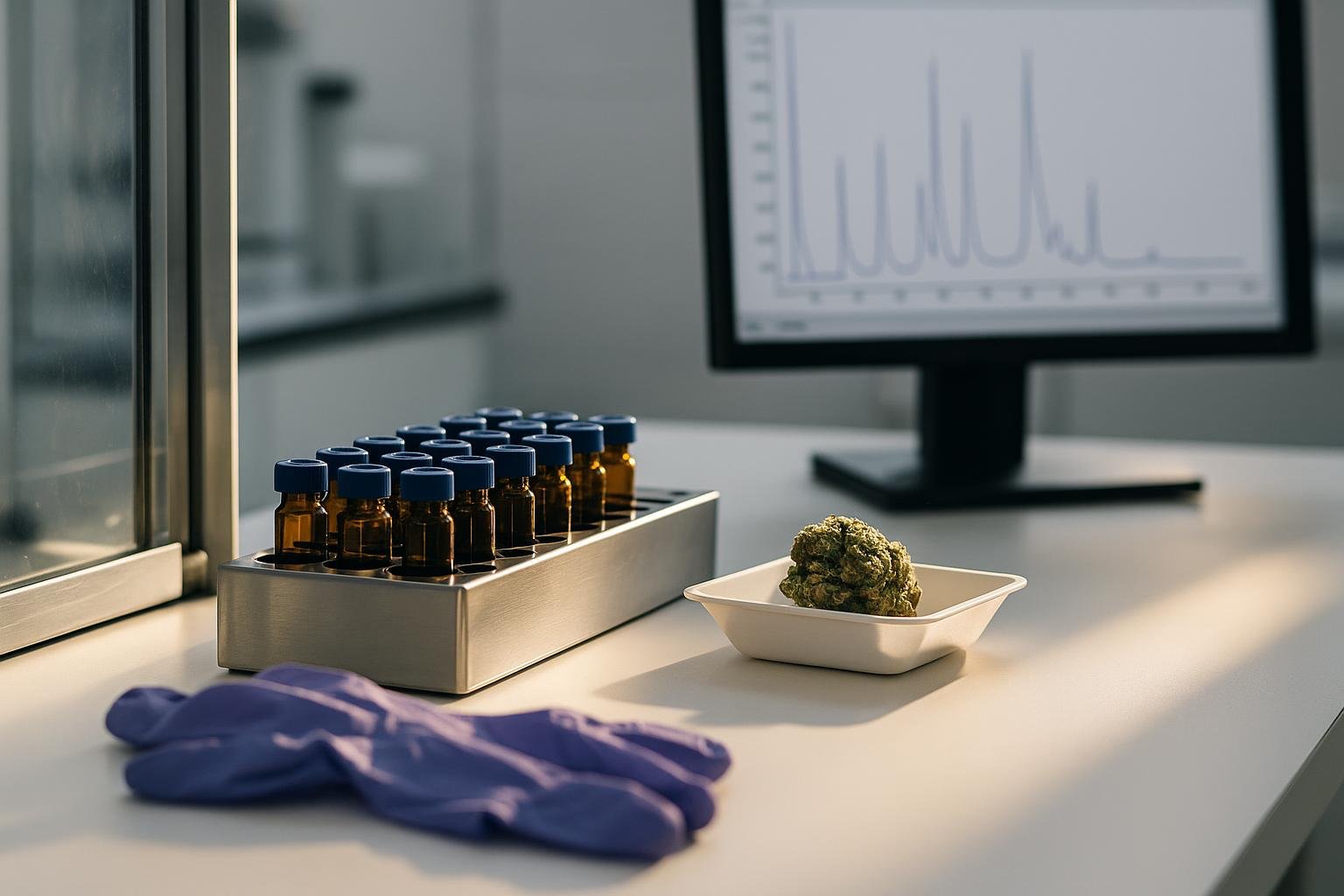
Most compliance labs run chromatography for potency, a mass-spec platform for pesticide and solvent contaminants, and ICP-MS for metals — and each of those choices is driven by hard analytical chemistry, not vendor preference. If you are setting up a lab, validating a method, or trying to understand why your testing invoice has five line items, this walkthrough is for you.
Whether you are a bench tech trying to understand what the instrument next to you actually does, a lab director pricing out a new assay, or a grower puzzled by why a metals test costs more than a potency test — this article gives you the instrument-level explanation, the assay it serves, and the one mistake buyers consistently make.
Here is what we cover:
- HPLC/UPLC — potency (cannabinoid profiling)
- GC and GC-MS — residual solvents and terpenes
- LC-MS/MS and GC-MS/MS — pesticide screening
- ICP-MS — heavy metals
- PCR and culture methods — microbial safety
- Buying mistakes that cost labs months of re-validation
Step 1: HPLC/UPLC — The Potency Workhorse
HPLC stands for high-performance liquid chromatography (a technique that separates compounds dissolved in a liquid mobile phase as they travel through a packed column, with each compound exiting at a characteristic time). UPLC is the same principle run at higher pressure with smaller particles, giving faster run times and sharper peaks.
For potency, HPLC with UV or photodiode array (PDA) detection is the dominant platform in licensed cannabis labs. The reason is thermodynamic: cannabinoids exist in two forms — the acid form (THCA, CBDA) and the neutral form (THC, CBD). Heat converts acid to neutral in a process called decarboxylation. GC requires heating the sample to vaporize it, which destroys the acid/neutral ratio that regulators actually report. HPLC runs at or near room temperature, so THCA stays THCA.
Maryland’s MCA Technical Authority Rev. 6 (effective February 2025) requires quantitative reporting of Δ9-THC, Δ8-THC, THCA, CBD, CBDA, and total THC for raw plant material — a panel that maps directly onto what a well-configured HPLC method delivers. Most other state programs have similar lists.
The one thing buyers get wrong here: purchasing an HPLC without a validated extraction protocol. The instrument is only as good as the sample prep upstream of it. A poorly sonicated (agitation via sound energy) or inconsistently diluted extract will give you terrible RSDs even on a $60,000 UPLC. Budget for the sample prep equipment and the method validation time, not just the column and detector.
For a deeper look at the separation chemistry and publicly available methods, see the Lab Overflow cannabinoid separation methods guide. For what validation acceptance criteria actually look like, see the method validation article.
Note: For hemp compliance, the federal definition matters. Under 7 U.S.C. § 1639o as originally enacted, hemp is Cannabis sativa L. with a delta-9 THC concentration of not more than 0.3% on a dry weight basis. Public Law 119-37, enacted November 2025, amends that to a total THC concentration — including THCA — of not more than 0.3% on a dry weight basis. Per Congressional Research Service analysis, the amended definition is scheduled to take effect November 12, 2026. That shift makes THCA quantitation even more consequential for hemp labs.
Step 2: GC and Headspace GC-MS — Residual Solvents and Terpenes
Gas chromatography (separation of volatile compounds carried through a column by an inert gas) is the right tool when your analytes are volatile — meaning they will vaporize at temperatures a GC oven can reach without destroying them. Residual solvents (ethanol, butane, propane, acetone, heptane, and dozens of others left behind after extraction) and terpenes both fit that description.
The critical configuration detail for cannabis labs is headspace injection (heating a sealed vial so volatile analytes partition into the gas above the sample, then injecting only that vapor). An Agilent application seminar from 2017 explains exactly why: cannabis concentrates are sticky, high-viscosity matrices that will foul a GC inlet and column within a handful of direct injections. Static headspace keeps the matrix in the vial.
For residual solvents, GC-MS in selected ion monitoring mode (SIM — the detector watches only the mass-to-charge ratios characteristic of your target compounds, ignoring everything else) dramatically improves sensitivity. A Shimadzu application poster describes a headspace GC-MS method using SIM for 20 Category I and II residual solvents in cannabis concentrates — a configuration that mirrors what most compliance labs run.
The one thing buyers get wrong: ordering a GC without specifying the headspace autosampler. I have seen labs receive a perfectly capable GC-MS and then discover the headspace module was a separate line item they did not budget for. The autosampler is not optional for concentrate matrices — it is the method.
For terpene testing context, see the terpene testing explainer.
Note: Residual solvent limits vary by state and product type. At the time of the Agilent seminar’s publication, no formal health-based residual solvent limits had been established specifically for cannabis, and labs referenced ICH pharmaceutical limits as surrogates. Most state programs have since codified their own limits — check your state’s current rule text.
Step 3: LC-MS/MS and GC-MS/MS — Pesticide Screening
Pesticide panels are where instrument selection gets politically complicated inside labs, because the answer is almost always “you need two platforms” and that is an expensive conversation.
The chemistry reason: pesticides span an enormous range of polarity, volatility, and thermal stability. Organochlorines and some pyrethroids are GC-amenable — they vaporize cleanly and produce reproducible mass spectra. But many of the fungicides, plant growth regulators, and systemic insecticides that cannabis growers actually use are polar, involatile, or thermally labile. They require liquid chromatography–tandem mass spectrometry (LC-MS/MS — the compound is separated in liquid phase, then fragmented twice by mass analyzers to produce a highly specific signature) for reliable quantitation at the parts-per-billion levels regulators demand.
Colorado’s Marijuana Enforcement Division, in 1 CCR 212-3 effective January 1, 2023, publishes a multi-page table of pesticides with compound-specific action limits in ppm. The list is long, dynamic, and periodically updated — the rule text does not state a fixed total count, and any specific number you see cited elsewhere should be verified against the current rule. Colorado’s list includes compounds like abamectin, spinosad, spirotetramat, tebuconazole, and thiamethoxam, each with its own limit. A 2026 state-testing overview confirms that most U.S. state programs require a broad panel covering insecticides, fungicides, and plant growth regulators.
The one thing buyers get wrong: assuming one instrument covers the full state panel. It usually does not. Before purchasing, map every compound on your state’s required list to its preferred ionization mode and decide whether GC-MS/MS, LC-MS/MS, or both are needed to cover it. See the detailed pesticide testing guide for the compound-level breakdown.
Note: Hemp pesticide panels may differ from marijuana panels in your state. Check both rule sets if your lab handles both matrices.
Step 4: ICP-MS — Heavy Metals at Parts-Per-Trillion
ICP-MS stands for inductively coupled plasma–mass spectrometry (a technique that atomizes and ionizes a liquid sample in a plasma torch burning at roughly 6,000–8,000 K, then separates ions by mass-to-charge ratio to identify and quantify individual elements). It is the only platform that routinely achieves the parts-per-trillion detection limits required for regulated heavy metals — lead, arsenic, cadmium, and mercury — in cannabis matrices.
AOAC First Action method 2021.03, published in a peer-reviewed study in October 2022, validates microwave-assisted acid digestion followed by ICP-MS as the approved workflow for trace metals in cannabis and cannabis-derived products — flower, concentrates, edibles, and more. AOAC SMPR 2020.001 specifies the performance requirements: sub-parts-per-billion limits of quantitation, defined accuracy and precision windows, for arsenic, cadmium, lead, and mercury. An Agilent ICP-MS Journal case study (Issue 86) illustrates the instrument’s application to cannabis heavy-metals compliance testing following microwave digestion.
The Agilent AOAC heavy-metals page describes ICP-MS as offering parts-per-trillion detection capability — necessary because state action limits for lead and arsenic in cannabis are typically in the low-ppb range, and you need your LOQ well below the action limit to have any statistical confidence in a passing result.
The one thing buyers get wrong: budgeting for the ICP-MS but not the microwave digestion system. The AOAC method requires microwave-assisted acid digestion as sample preparation — you cannot inject raw cannabis extract into an ICP-MS. A microwave digestion system is a separate capital purchase, and skipping it or substituting an unvalidated hotplate digestion will fail your method validation. I suggest labs treat the digestion system as part of the ICP-MS line item from day one.
For the clinical and regulatory context of why these four metals matter, see the heavy metals testing explainer.
Step 5: PCR and Culture Methods — Microbial Safety
Microbial testing sits entirely outside chromatography. The two main platform types are:
- Culture-based methods (growing organisms on selective media and counting colonies) — the classical approach, slow (24–72 hours), but inexpensive per sample.
- qPCR (quantitative polymerase chain reaction — amplifying and detecting specific DNA sequences from target pathogens) — faster (same-day results), more specific, and increasingly required or accepted by state programs.
Maryland’s MCA Technical Authority Rev. 6 (February 2025) explicitly lists Salmonella spp. and Listeria monocytogenes among required microbial targets, alongside total aerobic count, total yeast and mold count, and others. The 2026 state-testing overview confirms that E. coli and Salmonella are among the most commonly mandated microbial analytes across U.S. programs.
The one thing buyers get wrong: treating microbial as an afterthought because it does not involve a chromatograph. A qPCR instrument, biosafety cabinet, and dedicated sample prep area represent real capital and operational costs. More importantly, microbial failures are the most common reason a batch gets rejected outright — not a potency miss, not a metals flag. Build the microbial workflow before you open, not after your first failure.
Note: Mycotoxins (aflatoxins, ochratoxin A) are a separate analyte class from general microbial counts and typically require LC-MS/MS or immunoassay methods. See the mycotoxins testing article for details.
Quick answers
What instrument does a cannabis lab use for potency testing? Most compliance labs run potency — THC, THCA, CBD, CBDA, and other cannabinoids — on an HPLC or UPLC system with UV or photodiode array (PDA) detection. HPLC is preferred over GC for potency because it does not require heat, which would decarboxylate THCA into THC and destroy the acid/neutral ratio regulators actually care about. For a deeper look at the separation chemistry, see the Lab Overflow cannabinoid separation methods guide.
What instrument is used for heavy metals testing in cannabis? ICP-MS (inductively coupled plasma–mass spectrometry) is the standard platform for heavy metals — lead, arsenic, cadmium, and mercury — in cannabis compliance testing. AOAC First Action method 2021.03, validated in a peer-reviewed study published October 2022, specifies microwave-assisted acid digestion followed by ICP-MS as the approved workflow. Sub-parts-per-billion limits of quantitation are required to meet AOAC SMPR 2020.001 performance criteria.
Can a GC-MS be used for cannabis pesticide testing? GC-MS or GC-MS/MS can screen a subset of pesticides — mainly organochlorines and other volatile, thermally stable compounds — but many modern pesticides used in cannabis cultivation are polar or thermally labile and require LC-MS/MS for reliable quantitation. Most full-panel pesticide methods in regulated state programs use LC-MS/MS as the primary platform, sometimes paired with GC-MS/MS for the GC-amenable fraction. Colorado’s 1 CCR 212-3 pesticide table, effective January 1, 2023, lists compound-specific action limits that drive instrument selection.
What does headspace GC-MS do in a cannabis lab? Headspace GC-MS analyzes volatile compounds — residual solvents and terpenes — by heating a sealed sample vial so volatiles partition into the gas phase above the sample, then injecting only that vapor into the GC column. This keeps the sticky cannabis matrix out of the inlet and column, dramatically extending column life and reducing carryover. An Agilent application seminar from 2017 describes static headspace sampling specifically for residual solvents and terpenes in cannabis concentrates.
Do I need separate instruments for each cannabis test, or can one instrument do multiple assays? In practice, compliance labs run at least three distinct instrument platforms because the physics of each assay demands it: HPLC for non-volatile cannabinoids, GC-based systems for volatile solvents and terpenes, and ICP-MS for trace metals. Pesticides typically require a high-sensitivity mass-spec platform — LC-MS/MS, GC-MS/MS, or both — depending on the state panel. Microbial testing sits entirely outside chromatography, relying on PCR or culture-based methods.
What is the hemp THC limit under federal law? Under 7 U.S.C. § 1639o as originally enacted, hemp is defined as Cannabis sativa L. and any part thereof with a delta-9 THC concentration of not more than 0.3 percent on a dry weight basis. Public Law 119-37, enacted November 2025, amends that definition to a total tetrahydrocannabinols concentration — including THCA — of not more than 0.3 percent on a dry weight basis; per Congressional Research Service analysis, this amended definition is scheduled to take effect November 12, 2026.
Sources
- 7 U.S.C. § 1639o — U.S. Code, current prelim edition (updated July 23, 2026)
- Shimadzu — Category I and II Residual Solvents in Cannabis, GC-MS application poster
- Congressional Research Service — CRS Insight IF13136 (2026), hemp THC definition amendment
- Agilent — ICP-MS Journal Issue 86, cannabis heavy metals case study
- Agilent — AOAC-approved heavy metals testing method for cannabis and hemp
- PubMed — AOAC First Action 2021.03, heavy metals in cannabis by ICP-MS (published October 2022)
- Amptius — AOAC SMPR 2020.001 instrumentation guide (June 3, 2025)
- Agilent — Headspace GC-MS systems for residual solvents and terpenes in cannabis (August 2017 seminar)
- Congressional Research Service — CRS Insight IN12620 (2026), hemp total THC amendment
- CannabisPromotions — State cannabis testing requirements overview (last updated August 22, 2026)
- Maryland MCA Technical Authority Rev. 6, effective February 2025
- Colorado MED — 1 CCR 212-3 Final Adopted Rules, effective January 1, 2023
FAQ
Frequently asked
- What instrument does a cannabis lab use for potency testing?
- Most compliance labs run potency — THC, THCA, CBD, CBDA, and other cannabinoids — on an HPLC or UPLC system with UV or photodiode array (PDA) detection. HPLC is preferred over GC for potency because it does not require heat, which would decarboxylate THCA into THC and destroy the acid/neutral ratio regulators actually care about. For a deeper look at the separation chemistry, see the Lab Overflow [cannabinoid separation methods guide](/blog/cannabinoid-separation-methods-in-the-public-domain-everything-you-need-to-know/).
- What instrument is used for heavy metals testing in cannabis?
- ICP-MS (inductively coupled plasma–mass spectrometry) is the standard platform for heavy metals — lead, arsenic, cadmium, and mercury — in cannabis compliance testing. AOAC First Action method 2021.03, validated in a peer-reviewed study published October 2022, specifies microwave-assisted acid digestion followed by ICP-MS as the approved workflow. Sub-parts-per-billion limits of quantitation are required to meet AOAC SMPR 2020.001 performance criteria.
- Can a GC-MS be used for cannabis pesticide testing?
- GC-MS or GC-MS/MS can screen a subset of pesticides — mainly organochlorines and other volatile, thermally stable compounds — but many modern pesticides used in cannabis cultivation are polar or thermally labile and require LC-MS/MS for reliable quantitation. Most full-panel pesticide methods in regulated state programs use LC-MS/MS as the primary platform, sometimes paired with GC-MS/MS for the GC-amenable fraction. Colorado's 1 CCR 212-3 pesticide table, effective January 1, 2023, lists compound-specific action limits that drive instrument selection.
- What does headspace GC-MS do in a cannabis lab?
- Headspace GC-MS analyzes volatile compounds — residual solvents and terpenes — by heating the sealed sample vial so volatiles partition into the gas phase above the sample, then injecting only that vapor into the GC column. This keeps the sticky cannabis matrix out of the inlet and column, dramatically extending column life and reducing carryover. An Agilent application seminar from 2017 describes static headspace sampling specifically for residual solvents and terpenes in cannabis concentrates.
- Do I need separate instruments for each cannabis test, or can one instrument do multiple assays?
- In practice, compliance labs run at least three distinct instrument platforms because the physics of each assay demands it: HPLC for non-volatile cannabinoids, GC-based systems for volatile solvents and terpenes, and ICP-MS for trace metals. Pesticides typically require a high-sensitivity mass-spec platform — LC-MS/MS, GC-MS/MS, or both — depending on the state panel. Microbial testing sits entirely outside chromatography, relying on PCR or culture-based methods. Trying to collapse these onto fewer platforms almost always means failing a detection-limit requirement somewhere.
- What is the hemp THC limit under federal law?
- Under 7 U.S.C. § 1639o as originally enacted, hemp is defined as Cannabis sativa L. and any part thereof with a delta-9 THC concentration of not more than 0.3 percent on a dry weight basis. Public Law 119-37, enacted November 2025, amends that definition to a total tetrahydrocannabinols concentration — including THCA — of not more than 0.3 percent on a dry weight basis; according to Congressional Research Service analysis, this amended definition is scheduled to take effect November 12, 2026.
Related guides
All guides- 01
Cannabis Lab 101: The Cannabis Testing Market in 2026 — Who Tests What, and What It Costs
I spent four years on the bench watching growers squint at invoices and ask why a flower panel costs $600. This article breaks down who is licensed to test cannabis, what analytes every compliance panel must cover, what real labs charge per test, and why a single national market-size number is harder to find than it looks.
- 02
Cannabis Lab 101: Heavy Metals Testing by ICP-MS — Digestion, Limits, and Common Failures
I spent years running ICP-MS in a licensed cannabis lab and watched heavy-metals failures blindside operators who thought soil was the only risk. This guide covers microwave digestion, the big-four analytes, how state limits actually differ, and where contamination hides in vape products.
- 03
Cannabis Lab 101: How to Become a Weed Tester — What the Job Actually Is
I spent four years on the bench in licensed cannabis testing labs, and the number-one question I get is whether 'weed tester' is a real job. It is — but nobody is paying you to smoke. Here is what the actual roles look like, what instruments you will run, and how to get hired.
Need this tested?
Compare labs that run these assays and get quotes in one go — no account, no fee.