· 11 min read
Cannabis Lab 101: Microbial Testing — Plating vs qPCR and Why Labs Disagree
I spent years running microbial panels on cannabis flower and concentrates, and the plating-vs-qPCR argument never gets old. This article breaks down total yeast and mold, Aspergillus species testing, AOAC SMPRs, state limits, and the dead-DNA problem that makes regulators and lab directors argue at every conference.
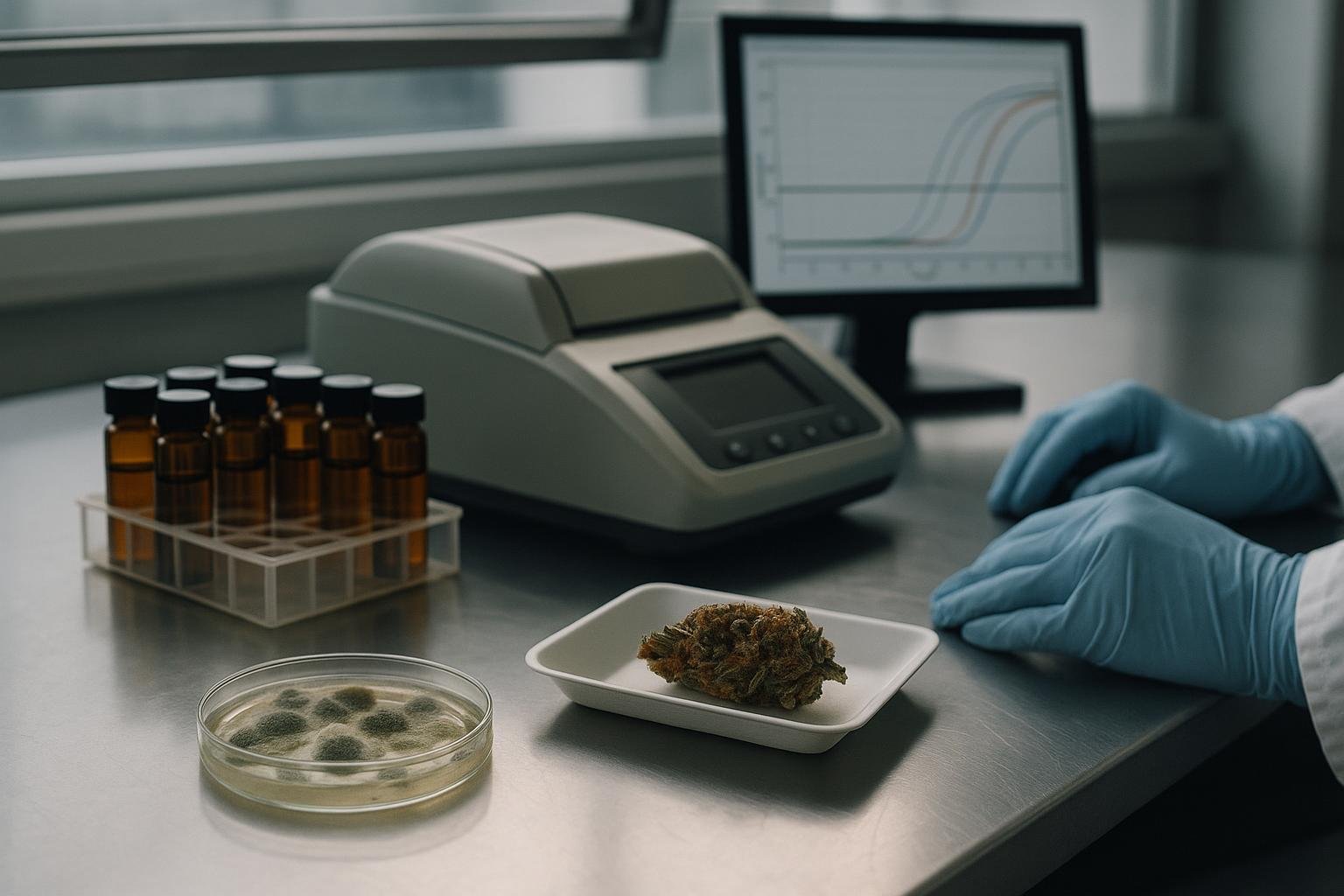
Microbial testing is the panel that keeps cannabis lab directors up at night — not because the chemistry is exotic, but because two perfectly valid analytical methods can give you different answers on the same sample, and a regulator is waiting at the end of the chain. Total yeast and mold, Aspergillus species, the plating-vs-molecular argument, false positives from dead DNA: this article works through all of it from the bench up.
Whether you are a lab technician setting up a new microbial workflow, a lab director choosing between culture and molecular platforms, or a grower trying to understand why your flower failed a test you thought it should pass — this article gives you the method logic, the regulatory citations, and the interpretation framework you need to make an informed decision.
Here is what we are covering:
- What total yeast and mold (TYM) actually measures and what it does not
- How Aspergillus testing differs from TYM, and which four species regulators care about
- How agar plating works and where it can miss viable organisms
- How qPCR works and why dead DNA is a legitimate analytical problem
- What AOAC SMPRs 2019.001 and 2021.009 require of candidate methods
- How Minnesota and Michigan frame their limits and acceptance criteria
- How to think about confirmatory testing when a screen comes back positive
Step 1: Understand what you are actually measuring — TYM vs Aspergillus
The single biggest source of confusion in cannabis microbial testing is treating total yeast and mold and Aspergillus species testing as interchangeable — they are not, and they answer completely different regulatory questions.
Total yeast and mold is an enumeration assay. You are counting how many colony-forming units (discrete visible growths on agar, each originating from one viable propagule) grow under a defined set of culture conditions — medium, temperature, incubation time. The result is expressed in CFU/g. AOAC SMPR 2021.009 covers candidate methods for viable yeast and mold count enumeration in cannabis and cannabis products; the word “viable” is doing a lot of work there.
Aspergillus testing is a presence/absence assay for four specific pathogenic species: A. niger, A. fumigatus, A. flavus, and A. terreus. AOAC SMPR 2019.001 names those four species explicitly and covers methods applied to cannabis plants and flowers, concentrates, infused edibles, and infused nonedibles. The regulatory endpoint is almost always “not detected” in a defined sample mass — not a count.
A product can pass a TYM limit and still fail an Aspergillus screen, because a sample carrying a small number of A. fumigatus colonies may sit well below a TYM threshold while still triggering a not-detected failure. The two panels must both be run; they are not redundant.
State limits reflect this distinction. Minnesota Rule 4770.3021 sets a TYM limit of less than 10⁴ CFU/g for dried raw cannabis. Limits for other product categories differ; always check the product-category-specific table in your state’s current official guidance — not a summary document — before setting your acceptance criteria.
Note: Limits for hemp products may differ from marijuana product limits within the same state. Always check the product-category-specific table in your state’s current official guidance — not a summary document — before setting your acceptance criteria.
Step 2: Know how agar plating works and where it can mislead you
Plating is the older of the two main platform classes and, for TYM enumeration, it is what AOAC SMPR 2021.009 is written around. The workflow is straightforward in principle: you homogenize your sample in a diluent, plate serial dilutions onto a selective or non-selective agar medium, incubate under defined conditions, and count colonies after the incubation period. The count you report is a function of what grew — which means it is a function of what could grow under your specific conditions.
That conditionality is the method’s main limitation. AOAC SMPR 2021.009 requires that candidate methods be validated using both stressed and non-stressed cultures, precisely because stressed or injured organisms — cells that are viable but not growing robustly — may fail to form countable colonies under standard conditions. Cannabis flower and concentrate matrices can also suppress recovery through antimicrobial compounds, oils, and pH effects. A plate count of zero does not always mean zero viable organisms; it means zero colonies formed under your conditions.
For Aspergillus specifically, plating on selective media can support species identification by morphology, but morphological ID of Aspergillus to species level is not trivial — it requires trained mycologists and is slow. Turnaround for a culture-based Aspergillus screen is typically several days, which has real implications for a grower waiting on a compliance hold.
I suggest labs take it a step further than the minimum: run positive controls with each plate batch using the target organisms at a known inoculum level, so you have ongoing evidence that your culture conditions are actually recovering the organisms you are supposed to detect.
Step 3: Know how qPCR works and why dead DNA is a real problem
qPCR (quantitative polymerase chain reaction — a molecular method that amplifies and simultaneously quantifies a target DNA sequence) has become the dominant platform for Aspergillus screening in cannabis labs, and for good reason: it is faster than culture, it provides species-level identification when the assay’s primers and probes are designed and validated for the four target species, and it is less dependent on the organism’s ability to grow under artificial conditions.
AOAC SMPR 2019.001 requires that Aspergillus screening employ two methods using different technologies, such as agar plate, PCR, or ELISA — a direct acknowledgment that no single platform is sufficient on its own.
The core limitation of qPCR for microbial testing is that it detects nucleic acids, not living organisms. DNA from dead or non-viable fungal cells can persist in a sample after the organism is no longer capable of growth and can be amplified by qPCR. A sample that was irradiated, heat-treated, or simply old enough that the fungal cells have died may still carry intact DNA that a well-designed qPCR assay will amplify and flag as a positive. This is not a flaw in the assay — the assay is doing exactly what it is designed to do — but it means a molecular positive does not automatically confirm a viable contamination event.
The magnitude of this effect is not universal; it depends on the organism, the sample’s processing history, DNA persistence under the specific matrix conditions, and the assay’s design. Do not let a vendor quote you a single universal false-positive rate for dead-DNA qPCR signals in cannabis without method-specific validation data to back it up.
Note: Some labs use propidium monoazide (PMA) or ethidium monoazide (EMA) pre-treatment, which can intercalate into DNA from membrane-compromised cells and block amplification, theoretically limiting the signal to viable-cell DNA. This approach requires its own validation before you rely on it for compliance reporting, and it is not embedded in AOAC SMPRs for cannabis.
Step 4: Apply the AOAC SMPR framework to your method selection
AOAC SMPRs are performance requirements for candidate methods — they define what a method must demonstrate to be considered fit for purpose, not which specific commercial kit or instrument you must buy. AOAC SMPR 2019.001 and AOAC SMPR 2021.009 are the two documents governing cannabis microbial testing at the method-performance level, and they are worth reading in full rather than relying on summaries.
For Aspergillus screening under SMPR 2019.001, the key structural requirement is two methods employing different technologies. That means if your primary screen is qPCR, your confirmatory or orthogonal method must use a different analytical principle — culture, ELISA, or another platform — not simply a second qPCR assay.
Michigan’s Sampling and Testing Technical Guidance for Marijuana Products lists the same four Aspergillus species with a “not detected in 1 gram” criterion — a tighter sample mass than some other jurisdictions, which affects your limit of detection requirements.
AOAC SMPRs are not automatically equivalent to a state’s legal acceptance criteria — a method that meets SMPR performance requirements still needs to be validated in your laboratory against your state’s specific limits and matrices before you report compliance results. See the method validation article for the full validation workflow.
For TYM, AOAC SMPR 2021.009 requires that candidate methods be evaluated using live cultures and/or fungal spores for inclusivity and exclusivity testing and for inoculating test matrices during matrix studies. If your method was validated only on clean matrices with non-stressed cultures, your validation package has a gap.
Step 5: Build a defensible interpretation workflow for positive results
A screen-positive result — whether from plating or qPCR — is the beginning of an analytical decision, not the end of one. The industry argument about which platform is “better” is mostly a distraction from the more important question: what does your laboratory’s interpretation workflow look like when a screen comes back positive?
For Aspergillus, the two-technology requirement in AOAC SMPR 2019.001 gives you the framework: a positive on one technology triggers evaluation by a second technology using a different principle. Your SOP should define exactly which confirmatory method you use, what the acceptance criteria are for the confirmatory result, and how discordant results between screen and confirmation are handled and documented.
For TYM, a count above the limit is generally a straightforward fail, but check whether your state allows a retest on a second sample from the same batch before a final disposition — some do, some do not, and the answer is in the regulation text, not in the SMPR.
Document your controls. Every microbial run should include a positive control at a known concentration, a negative control, and a matrix spike where your state or AOAC method requires it. A positive result with no control data is a result you cannot defend in a dispute. For more on the cost implications of running a full microbial panel, the cost-per-sample article has the breakdown. If your lab also runs mycotoxins alongside microbials — which many state panels require — the mycotoxins article covers that workflow separately.
Note: Edibles and concentrates present different matrix challenges than flower. Extraction of nucleic acids from high-fat or high-sugar matrices requires validated homogenization and lysis protocols; a method validated on flower is not automatically valid for a caramel edible. AOAC SMPR 2019.001 covers methods applied to cannabis plants and flowers, concentrates, infused edibles, and infused nonedibles.
Quick answers
What is the difference between total yeast and mold testing and Aspergillus testing in cannabis? Total yeast and mold is a count of all viable yeast and mold colonies under the selected culture conditions, expressed in CFU/g; it tells you how much fungal material is present but not which species. Aspergillus testing targets four specific pathogenic species — A. niger, A. fumigatus, A. flavus, and A. terreus — and is typically reported as detected or not detected in a defined sample mass. A product can pass a TYM limit and still fail an Aspergillus screen, because the two assays answer different questions.
Can qPCR give a false positive for Aspergillus in cannabis? Yes — qPCR detects target DNA sequences, and DNA from dead or non-viable fungal cells can persist in a sample after the organism is no longer capable of growth. This means a molecular-positive result does not automatically confirm viable contamination, which is one reason AOAC SMPR 2019.001 calls for screening with two methods employing different technologies. Whether a positive triggers a fail or a confirmatory step depends on your state’s rules, not on the qPCR result alone.
What Aspergillus species does cannabis testing target? AOAC SMPR 2019.001 identifies A. niger, A. fumigatus, A. flavus, and A. terreus as the four target species for cannabis Aspergillus testing. Minnesota and Michigan list the same four species in their official testing guidance; check your state regulator’s current published limits for the acceptance criterion and sample mass that applies to your product category. The acceptance criterion in most state frameworks is not detected in a specified sample mass.
Does AOAC require both plating and qPCR for cannabis microbial testing? AOAC SMPR 2019.001 states that screening for Aspergillus requires two methods employing different technologies — such as agar plate, PCR, or ELISA — but this is a performance requirement for candidate methods, not a universal state-law mandate. Whether your state requires a two-technology screen or accepts a single validated method depends on that state’s regulations; check your state regulator’s official testing standards page directly.
What is the total yeast and mold limit for cannabis in Minnesota? Minnesota Rule 4770.3021 sets a total yeast-and-mold limit of less than 10⁴ CFU/g for dried raw cannabis. Limits for other product categories differ; always verify the current limit against the official rule text, because product-category-specific limits vary.
Why do labs disagree about which method is better for cannabis microbial testing — plating or qPCR? The disagreement is methodologically legitimate: plating only detects viable organisms capable of growing under the selected conditions, so stressed or matrix-suppressed cells can be missed; qPCR detects nucleic acids regardless of viability, so dead-cell DNA can trigger a positive. Neither method is universally superior — accuracy depends on target definition, assay validation, sample matrix, and whether the regulatory endpoint is viable count or nucleic-acid detection. AOAC SMPR 2019.001’s two-technology screening requirement exists precisely because no single platform answers every question.
Sources
- AOAC SMPR 2019.001 — Detection of Aspergillus in Cannabis and Cannabis Products
- AOAC SMPR 2021.009 — Viable Yeast and Mold Count Enumeration in Cannabis and Cannabis Products
- Minnesota Rule 4770.3021 — Microbiological Testing of Dried Raw Cannabis
- Michigan CRA — Sampling and Testing Technical Guidance for Marijuana Products
- PMC3084655 — DNA persistence and PMA/EMA pre-treatment in viability PCR
FAQ
Frequently asked
- What is the difference between total yeast and mold testing and Aspergillus testing in cannabis?
- Total yeast and mold (TYM) is a count of all viable yeast and mold colonies under the selected culture conditions, expressed in CFU/g; it tells you how much fungal material is present but not which species. Aspergillus testing targets four specific pathogenic species — A. niger, A. fumigatus, A. flavus, and A. terreus — and is typically reported as detected or not detected in a defined sample mass. A product can pass a TYM limit and still fail an Aspergillus screen, because the two assays answer different questions.
- Can qPCR give a false positive for Aspergillus in cannabis?
- Yes — qPCR detects target DNA sequences, and DNA from dead or non-viable fungal cells can persist in a sample after the organism is no longer capable of growth. This means a molecular-positive result does not automatically confirm viable contamination, which is one reason AOAC SMPR 2019.001 calls for screening with two methods employing different technologies. Whether a positive triggers a fail or a confirmatory step depends on your state's rules, not on the qPCR result alone.
- What Aspergillus species does cannabis testing target?
- AOAC SMPR 2019.001 identifies A. niger, A. fumigatus, A. flavus, and A. terreus as the four target species for cannabis Aspergillus testing. Minnesota and Michigan list the same four species in their official testing guidance; check your state regulator's current published limits for the acceptance criterion and sample mass that applies to your product category. The acceptance criterion in most state frameworks is not detected in a specified sample mass.
- Does AOAC require both plating and qPCR for cannabis microbial testing?
- AOAC SMPR 2019.001 states that screening for Aspergillus requires two methods employing different technologies — such as agar plate, PCR, or ELISA — but this is a performance requirement for candidate methods, not a universal state-law mandate. Whether your state requires a two-technology screen or accepts a single validated method depends on that state's regulations; check your state regulator's official testing standards page directly.
- What is the total yeast and mold limit for cannabis in Minnesota?
- Minnesota Rule 4770.3021 sets a total yeast-and-mold limit of less than 10⁴ CFU/g for dried raw cannabis. Limits for other product categories differ; always verify the current limit against the official rule text, because product-category-specific limits vary.
- Why do labs disagree about which method is better for cannabis microbial testing — plating or qPCR?
- The disagreement is methodologically legitimate: plating only detects viable organisms capable of growing under the selected conditions, so stressed or matrix-suppressed cells can be missed; qPCR detects nucleic acids regardless of viability, so dead-cell DNA can trigger a positive. Neither method is universally superior — accuracy depends on target definition, assay validation, sample matrix, and whether the regulatory endpoint is viable count or nucleic-acid detection. AOAC SMPR 2019.001's two-technology screening requirement exists precisely because no single platform answers every question.
Related guides
All guides- 01
Cannabis Lab 101: Cannabis Testing Cost Per Sample — 2026 Price Ranges by Assay
I pulled published price lists from licensed labs in New Jersey, Minnesota, and Oregon, plus Utah's state fee schedule, to show you exactly what each assay costs in 2026 — and why the same test can cost twice as much in one state as another.
- 02
Cannabis Lab 101: The Cannabis Testing Market in 2026 — Who Tests What, and What It Costs
I spent four years on the bench watching growers squint at invoices and ask why a flower panel costs $600. This article breaks down who is licensed to test cannabis, what analytes every compliance panel must cover, what real labs charge per test, and why a single national market-size number is harder to find than it looks.
Need this tested?
Compare labs that run these assays and get quotes in one go — no account, no fee.