· 11 min read
Cannabis Lab 101: Hemp Testing Labs — How Hemp Compliance Testing Differs From Marijuana
I spent four years on the bench running cannabis compliance panels, and hemp testing still trips up experienced chemists. This guide breaks down the USDA total THC rule, the decarboxylation maths, the DEA registration requirement, the 30-day sampling window, and what a hot crop actually means for your lab.
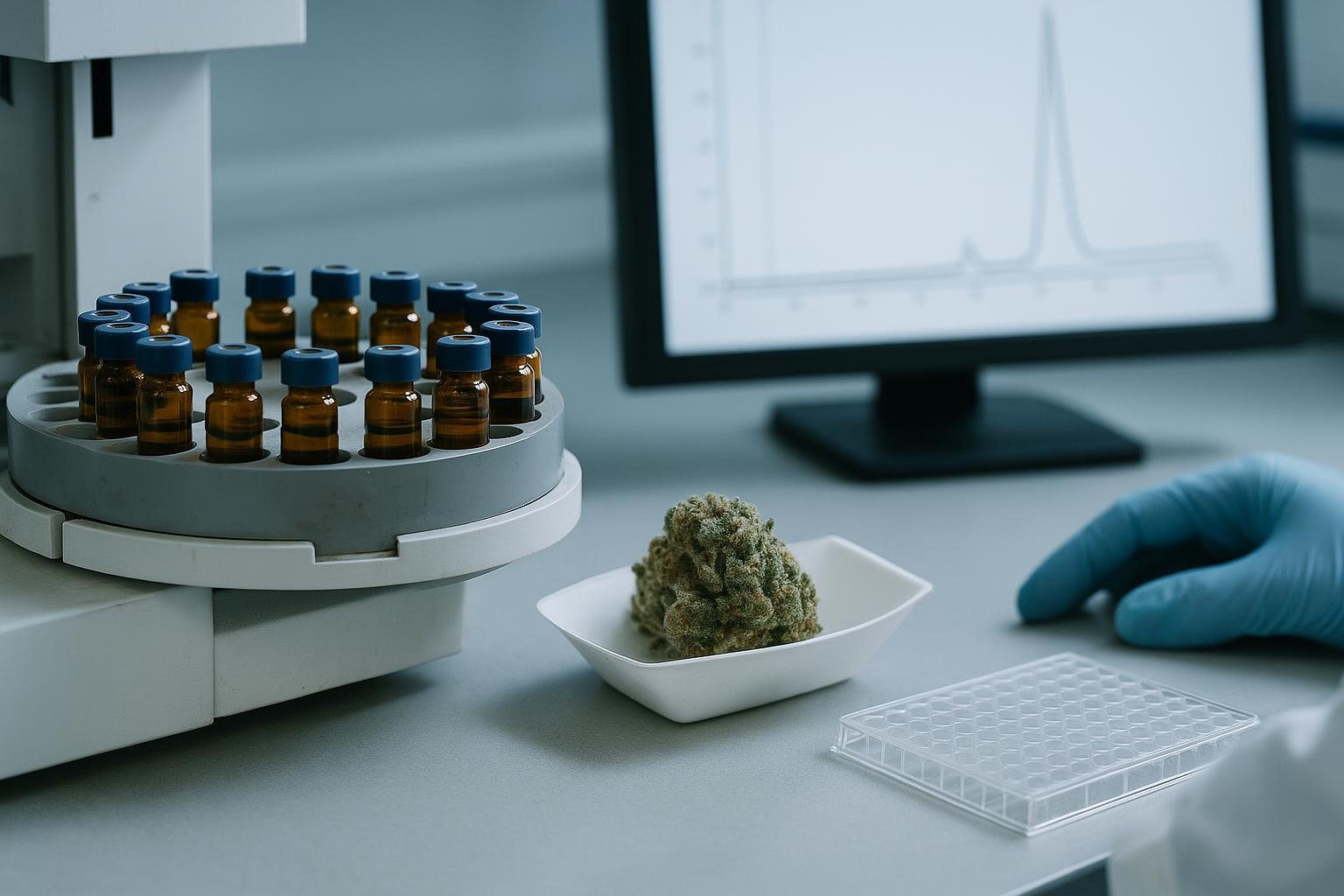
Hemp testing labs operate under a completely different legal framework than marijuana labs — and if you walk into one expecting the same workflow, you will be wrong about the most consequential number in the whole assay before you even open the instrument software.
Whether you are a bench technician trying to understand why hemp potency reports look different from marijuana COAs, a lab director evaluating whether your facility can legally accept hemp compliance samples, or a hemp grower trying to decode what your state agent is actually doing in your field 30 days before harvest — this article is for you. Consumers looking for dispensary recommendations and investors looking for market-size figures should look elsewhere.
This article covers:
- The federal legal definition of hemp and why the 0.3% threshold is more complicated than it sounds
- The decarboxylation maths every hemp lab technician must be able to do by hand
- The 30-day sampling window and who is allowed to collect the sample
- The DEA registration requirement, its enforcement history, and where it stands today
- What a hot crop means for your lab and for the grower
Step 1: Understand What “Total THC” Actually Means — and Why It Is Not the Same as Delta-9-THC
The single most important thing to know about hemp compliance testing is that you are not measuring delta-9-THC alone — you are measuring total THC, which includes the acid precursor THCA, and that distinction can be the difference between a legal crop and a controlled substance.
Federal hemp law requires that total THC not exceed 0.3% on a dry weight basis. Under 7 CFR § 990.1, total THC is defined as the value determined after decarboxylation or by applying a conversion factor that expresses the potential total delta-9 THC derived from both THC and THCA, reported on a dry weight basis. THCA (the carboxylated, non-decarboxylated acid form of THC found in raw plant material) is not psychoactive on its own, but it converts to delta-9-THC when heated — a process called decarboxylation (the loss of a carboxyl group as CO2 under heat).
USDA’s regulatory implementation requires post-decarboxylation or an equivalent method to determine total THC level. This means a hemp plant with very low free delta-9-THC but high THCA can still be non-compliant — and a lab that only reports free delta-9-THC is not running a compliant hemp test.
The formula every hemp bench tech should have memorized:
Total THC = delta-9-THC + (THCA × 0.877)
The 0.877 factor is the molar conversion ratio — when THCA loses its carboxyl group as CO2, the resulting THC molecule is lighter by that proportion. If your HPLC reports 0.05% delta-9-THC and 0.30% THCA, your total THC is 0.05 + (0.30 × 0.877) = 0.313% — a hot crop, even though free THC alone looked fine. For more on the chromatographic methods used to separate these cannabinoids, see our guide to cannabinoid separation methods.
Note: For hemp-derived extracts and concentrates, the same total THC calculation applies, but the matrix is very different from flower. Extraction can dramatically concentrate both THC and THCA, so a compliant flower can yield a non-compliant extract. State hemp programs vary on whether they require retesting of finished extract — check your state plan.
Step 2: Report Measurement of Uncertainty — It Is Not Optional
This is the part of the USDA hemp rule that surprises even experienced marijuana lab directors. Under 7 CFR § 990.1, a sample reaches the acceptable hemp THC level not simply when the point estimate is at or below 0.3%, but when the reported result — after applying measurement of uncertainty (the quantified range within which the true value is expected to fall, expressed as ± a value at a stated confidence level) — produces a range that includes 0.3% or less.
This means a result of 0.31% total THC with a measurement uncertainty of ±0.02% is compliant, because the lower bound of the range (0.29%) includes 0.3% or below. Conversely, a result of 0.28% with very tight uncertainty that puts the upper bound above 0.3% is a more complicated conversation.
The USDA Laboratory Testing Guidelines require labs to report THC concentration on a dry-weight basis and include a measurement of uncertainty with every compliance result. USDA does not prescribe specific instrument types — HPLC and GC platforms both appear in practice — but the method must be validated and fit for purpose. If your lab has not formally calculated and documented measurement of uncertainty for your hemp potency method, you are not compliant with the federal requirement, regardless of how good your R-squared looks. See our method validation guide for the mechanics of building an uncertainty budget.
Note: Measurement of uncertainty in hemp compliance testing is distinct from the general method validation concepts used in marijuana state programs. Most marijuana state regulations do not require reporting of measurement uncertainty on the COA — hemp federal rules do. If your lab runs both, make sure your LIMS is configured to handle both report formats.
Step 3: Know the 30-Day Sampling Window and Who Is Allowed to Touch the Sample
In marijuana compliance testing, the licensed producer or manufacturer typically delivers a sample to the lab — the chain of custody starts at the facility. Hemp compliance testing under the USDA program works nothing like that: the grower cannot collect their own sample.
Under 7 CFR 990.3(a)(2)(i), a licensed sampling agent — typically a state or USDA-authorized official — must collect the sample, and producers may not collect samples from their own growing facilities. The collection must happen no more than 30 days before the anticipated harvest date.
The January 2021 USDA Final Rule extended this window from the original 15 days to 30 days, specifically to give state regulators more scheduling flexibility — a practical acknowledgment that sampling hundreds of farms in a short window is a logistics problem, not just a chemistry problem.
For a lab director, this has direct operational implications. Your hemp compliance samples arrive with a state-issued chain of custody, not a grower-generated one. Your intake procedure needs to verify that the collection date is within the 30-day window and that the sampling agent is authorized under the applicable state hemp plan. If the paperwork does not support both of those facts, the sample’s compliance result may be legally meaningless — and you do not want your lab’s name on a COA that gets challenged in an enforcement action.
Note: State hemp programs that operate under USDA-approved state plans may have additional sampling requirements layered on top of the federal minimums. Always verify against your state’s approved plan, not just 7 CFR 990.
Step 4: Understand the DEA Registration Requirement — and Its Enforcement History
This is the provision the industry has been fighting since the 2018 Farm Bill, and it is still standing. Any laboratory that tests hemp for THC compliance under the USDA program must be registered with the DEA under 21 CFR part 1301.
The rationale is straightforward and not going away: a sample that tests above 0.3% delta-9 THC is legally marijuana — a Schedule I controlled substance under the Controlled Substances Act. The lab handling that sample is, at the moment the result is confirmed, in possession of a controlled substance. DEA registration is the mechanism that makes that legal. As the USDA Interim Final Rule preamble explains, the requirement exists precisely because labs cannot know in advance whether a sample is hemp or marijuana until the assay is complete.
The enforcement timeline has been extended repeatedly. USDA’s Information for Hemp Testing Laboratories page — updated March 7, 2026 — states that enforcement is delayed until December 31, 2026. A previous deadline of December 31, 2025 was also extended. I would not bet on another extension; if your lab intends to run hemp compliance samples, the DEA registration process under 21 CFR part 1301 should already be in progress.
I suggest labs take it a step further and review whether their existing DEA Schedule I research registration (if they have one) covers the specific activity of hemp compliance testing, or whether a separate registration category is needed — the DEA’s registration types are not interchangeable.
Note: The DEA registration requirement applies specifically to THC compliance testing under the USDA program. Hemp labs running only non-THC panels — CBD quantitation for product labeling, terpene profiles, heavy metals — may not trigger the same requirement, but you should verify with your DEA Diversion Investigator before accepting any sample described as a compliance test.
Step 5: Know What a Hot Crop Means for Your Lab — Not Just for the Grower
A hot crop is industry shorthand for a hemp sample that tests above 0.3% total THC on a dry weight basis. The moment that result is confirmed, the material is treated as marijuana under the Controlled Substances Act — because the CSA’s legal distinction between hemp and marijuana is anchored to delta-9 THC concentration at 0.3% on a dry weight basis — and the consequences ripple outward from the grower to your lab.
For the grower, a hot crop typically means mandatory disposal of the entire lot and potential loss of their hemp producer license. For the lab, it means you are holding or have handled a Schedule I controlled substance, which is exactly why the DEA registration requirement exists. A lab without DEA registration that confirms a hot crop result is in a genuinely uncomfortable legal position — which is another reason to get that registration sorted before the December 2026 enforcement date.
From an analytical standpoint, a hot crop result should trigger your lab’s out-of-specification (OOS) investigation protocol before the result is reported. Verify the sample identity, check the extraction and dilution factors, and confirm the calibration was valid at the time of the run. A false positive on a hemp compliance test has serious consequences for the producer; a false negative has serious consequences for the supply chain. Neither outcome is acceptable, and the measurement-of-uncertainty requirement exists partly to create a defensible buffer zone around the threshold.
For context on what a full contaminant panel looks like when hemp is tested beyond just THC compliance — pesticides, heavy metals, mycotoxins — see our articles on pesticide testing, heavy metals, and mycotoxins. Hemp compliance testing under USDA is focused on the THC threshold, but state hemp programs and buyers increasingly expect a broader safety panel.
Note: Some states require hemp destined for food or inhalable products to pass a full contaminant panel equivalent to marijuana testing requirements. The USDA federal program sets the THC compliance floor; state rules can add substantially more on top.
Quick answers
What is the total THC limit for hemp compliance testing? The federal limit is 0.3% total THC on a dry weight basis, where total THC is determined after decarboxylation or by applying a conversion factor that accounts for both delta-9-THC and THCA. Under 7 CFR § 990.1, a sample is compliant when the reported result plus its measurement uncertainty produces a range that includes 0.3% or less — so a result of, say, 0.31% with sufficient uncertainty can still pass. This measurement-of-uncertainty requirement is one of the most misunderstood parts of the rule.
Does a hemp compliance lab need to be registered with the DEA? Yes — USDA requires that laboratories testing hemp for THC compliance be registered with the DEA under 21 CFR part 1301, because any sample that tests above 0.3% delta-9 THC is legally marijuana, a Schedule I controlled substance under the Controlled Substances Act. USDA has delayed enforcement of this requirement to December 31, 2026. Check the USDA AMS Information for Hemp Testing Laboratories page for the current enforcement date before assuming your lab is covered.
How do you calculate total THC for hemp — what is the decarboxylation formula? Total THC is calculated as delta-9-THC plus (THCA multiplied by 0.877), where 0.877 is the molar conversion factor accounting for the mass of CO2 lost when THCA decarboxylates to THC. USDA requires post-decarboxylation or an equivalent method that captures this conversion; reporting free delta-9-THC alone is not compliant with federal hemp testing requirements. Both HPLC and GC methods can satisfy the requirement as long as the method is validated and measurement uncertainty is reported.
What is the hemp sampling window and who collects the sample? Under 7 CFR 990.3(a)(2)(i), a licensed sampling agent — not the grower — must collect samples no more than 30 days before the anticipated harvest date; producers may not collect samples from their own growing facilities. The grower cannot self-sample for federal compliance purposes. USDA extended this window from the original 15 days in the January 2021 final rule to give state regulators more scheduling flexibility.
What happens if a hemp crop tests hot — above 0.3% total THC? A crop that exceeds 0.3% total THC on a dry weight basis cannot be sold or processed as hemp, and the material is treated as marijuana — a Schedule I controlled substance under the Controlled Substances Act — because the CSA distinction is anchored to delta-9 THC concentration at 0.3% on a dry weight basis. The consequences range from mandatory disposal to potential federal enforcement action. This is also the core reason USDA requires testing labs to hold DEA registration — the lab may be handling a Schedule I substance without knowing it until the result is in.
How is hemp compliance testing different from state marijuana testing? Hemp compliance testing is focused on a single binary question — does total THC exceed 0.3% on a dry weight basis — with federally mandated sampling protocols and a DEA-registered lab requirement. State marijuana testing programs typically require a broader panel covering potency across multiple cannabinoids, terpenes, residual solvents, pesticides, heavy metals, and microbials, with rules set independently by each state regulator rather than a federal agency. The legal stakes are also different: a hemp test determines whether the plant is a legal agricultural commodity or a controlled substance, while a marijuana test primarily serves consumer safety and label accuracy.
Sources
- 7 CFR § 990.1 — USDA Hemp Definitions (Cornell LII)
- 7 CFR § 990.3 — USDA Hemp Sampling Requirements (Cornell LII)
- USDA AMS Hemp FAQ
- USDA AMS Laboratory Testing Guidelines
- USDA AMS Information for Hemp Testing Laboratories, updated March 7, 2026
- USDA — Extension of DEA-Registered Lab Enforcement Deadline
- Federal Register Vol. 86 No. 11 — USDA Hemp Final Rule, January 19, 2021
- USDA Interim Final Rule Preamble, Federal Register, October 31, 2019
- FrankList — What Is THCA (decarboxylation conversion factor)
- CRS Report R48637 — Hemp Policy Overview
- CRS IN12620 — CSA Hemp/Marijuana Distinction
FAQ
Frequently asked
- what is the total THC limit for hemp compliance testing
- The federal limit is 0.3% total THC on a dry weight basis, where total THC is determined after decarboxylation or by applying a conversion factor that accounts for both delta-9-THC and THCA. Under 7 CFR § 990.1, a sample is compliant when the reported result plus its measurement uncertainty produces a range that includes 0.3% or less — so a result of, say, 0.31% with sufficient uncertainty can still pass. This measurement-of-uncertainty requirement is one of the most misunderstood parts of the rule.
- does a hemp compliance lab need to be registered with the DEA
- Yes — USDA requires that laboratories testing hemp for THC compliance be registered with the DEA under 21 CFR part 1301, because any sample that tests above 0.3% delta-9 THC is legally marijuana, a Schedule I controlled substance under the Controlled Substances Act. USDA has delayed enforcement of this requirement to December 31, 2026, giving labs more time to obtain registration. Check the USDA AMS Information for Hemp Testing Laboratories page for the current enforcement date before assuming your lab is covered.
- how do you calculate total THC for hemp — what is the decarboxylation formula
- Total THC is calculated as delta-9-THC plus (THCA multiplied by 0.877), where 0.877 is the molar conversion factor accounting for the mass of CO2 lost when THCA decarboxylates to THC. USDA requires post-decarboxylation or an equivalent method that captures this conversion; reporting free delta-9-THC alone is not compliant with federal hemp testing requirements. Both HPLC and GC methods can satisfy the requirement as long as the method is validated and measurement uncertainty is reported.
- what is the hemp sampling window and who collects the sample
- Under 7 CFR 990.3(a)(2)(i), a licensed sampling agent — not the grower — must collect samples no more than 30 days before the anticipated harvest date; producers may not collect samples from their own growing facilities. The grower cannot self-sample for federal compliance purposes. USDA extended this window from the original 15 days in the January 2021 final rule to give state regulators more scheduling flexibility.
- what happens if a hemp crop tests hot — above 0.3% total THC
- A crop that exceeds 0.3% total THC on a dry weight basis cannot be sold or processed as hemp, and the material is treated as marijuana — a Schedule I controlled substance under the Controlled Substances Act — because the CSA distinction is anchored to delta-9 THC concentration at 0.3% on a dry weight basis. The consequences range from mandatory disposal to potential federal enforcement action. This is also the core reason USDA requires testing labs to hold DEA registration — the lab may be handling a Schedule I substance without knowing it until the result is in.
- how is hemp compliance testing different from state marijuana testing
- Hemp compliance testing is focused on a single binary question — does total THC exceed 0.3% on a dry weight basis — with federally mandated sampling protocols and a DEA-registered lab requirement. State marijuana testing programs typically require a broader panel covering potency across multiple cannabinoids, terpenes, residual solvents, pesticides, heavy metals, and microbials, with rules set independently by each state regulator rather than a federal agency. The legal stakes are also different: a hemp test determines whether the plant is a legal agricultural commodity or a controlled substance, while a marijuana test primarily serves consumer safety and label accuracy.
Need this tested?
Compare labs that run these assays and get quotes in one go — no account, no fee.