· 10 min read
Cannabis Lab 101: How to Become a Cannabis Extraction Technician
I spent four years on the bench watching extraction techs get hired for the wrong reasons and passed over for the wrong ones. This is the real skills ladder, the actual wage benchmarks, and the state-level licensing reality that nobody puts in one place.
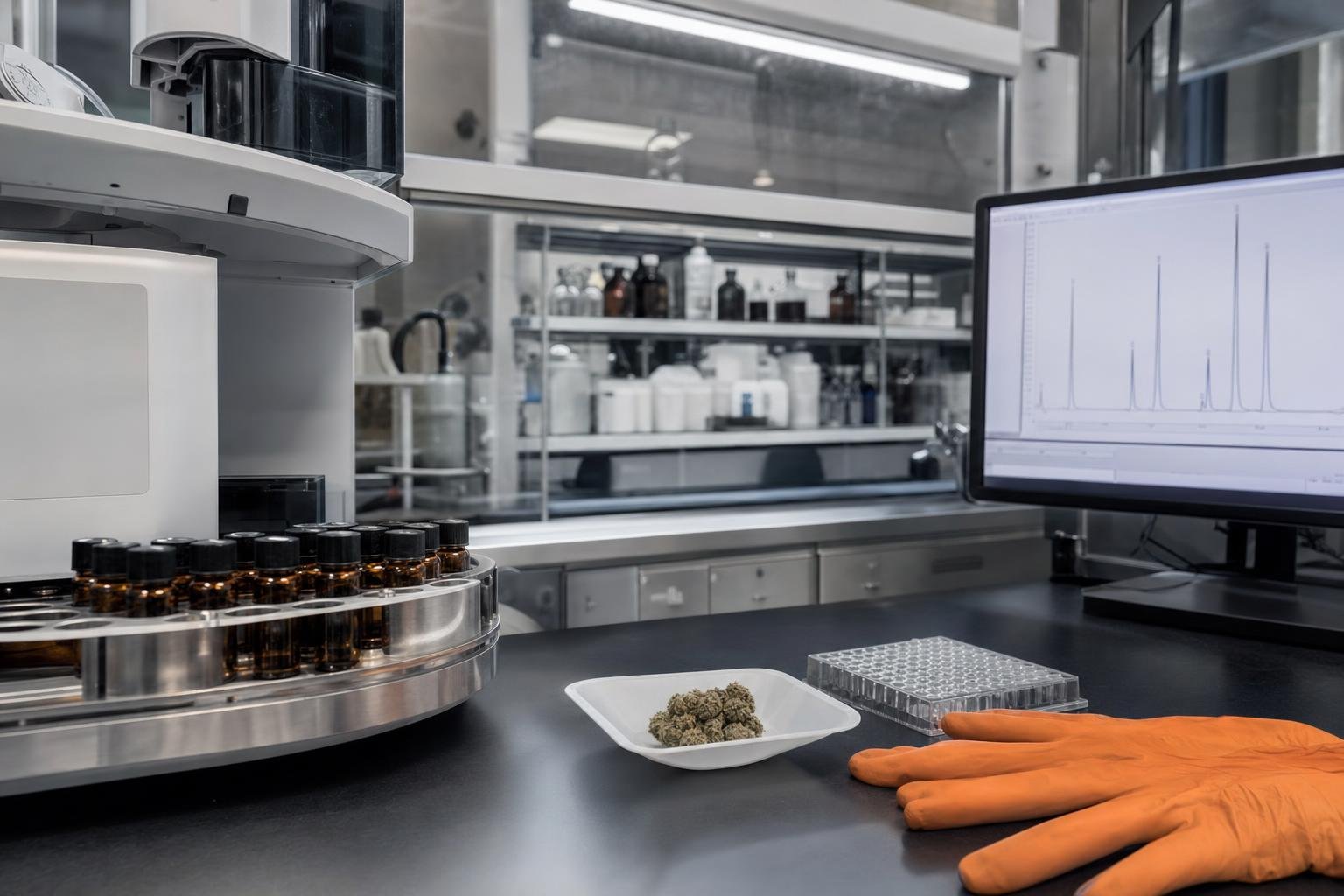
Extraction technician is one of those job titles that means three different things depending on who posts the listing. At one company it means running a closed-loop butane system in a manufacturing facility. At another it means doing solid-phase extraction (a sample-preparation technique in which analytes are separated by passing a solution through a sorbent-packed cartridge) in a testing lab before a chromatography run. And at a third it means washing glassware and logging samples while the senior tech does the actual chemistry. This article is for people who want to understand what the role actually involves, what the skills ladder looks like from the bottom, what the pay benchmarks say, and what state licensing requirements you need to sort out before you walk through the door.
Whether you are a recent graduate trying to break into cannabis analytical chemistry, a trimmer or cultivation worker looking to move into a technical role, or a lab director writing a job description and wondering what credentials to ask for, this article gives you the real picture. It is not a guide for consumers or investors.
Here is what we cover:
- The difference between extraction in a manufacturing facility and extraction in a testing lab
- The skills ladder from sample intake to extraction lead
- Wage benchmarks from BLS data and what they actually mean for cannabis roles
- State licensing and badge requirements and how to look them up
- The instruments you will be expected to operate and in what order you will likely learn them
- How to build a competitive application without a four-year degree
Step 1: Understand what extraction technician actually means in this industry
The title covers two genuinely different jobs, and confusing them will send your resume to the wrong pile.
Manufacturing extraction technician works inside a licensed cannabis manufacturer. The job is producing concentrate, oil, distillate, or isolate from plant material. The solvents involved range from ethanol to hydrocarbons to supercritical CO2. California regulations require that anyone using volatile solvents, flammable liquids, or solvents that create an asphyxiant gas (a gas that displaces oxygen and can cause unconsciousness or death in an enclosed space) must follow specific safety requirements set by the state. This is the role most people picture when they hear “extraction tech,” and it is physically demanding, shift-based work with real chemical-hazard exposure.
Testing-lab extraction technician works inside a licensed analytical laboratory. Here, extraction is a sample-preparation step, not a production step. You are isolating target analytes from a cannabis matrix so that a chromatograph or mass spectrometer can quantify them. The New York Department of Labor describes cannabis laboratory technicians as workers who may culture, extract, or test cannabis samples using analytical instrumentation, and lists solid-phase extraction alongside gas chromatography, liquid chromatography, ICP-MS (inductively coupled plasma-mass spectrometry, an elemental-analysis technique), and PCR (polymerase chain reaction, a molecular method for detecting microbial DNA) as associated techniques.
Both roles exist. Both are legitimate career paths. The skills overlap, but the regulatory environment, the physical hazards, and the day-to-day tasks are different enough that you should decide which one you are targeting before you apply.
Note: If you are interested specifically in the testing-lab side of the career, the companion piece how to become a cannabis lab technician covers the analytical-chemistry track in more detail, including instrument-specific skills and method-validation context.
Step 2: Map the skills ladder honestly
There is no single nationally mandated career ladder for cannabis extraction technicians. What I am describing here is an illustrative pathway drawn from how the New York Department of Labor describes entry and progression in cannabis laboratory roles, combined with what regulated labs actually require under state rules.
Entry point: laboratory assistant or sample-intake technician. The New York DOL categorizes laboratory assistant as an entry-level role involving sample acceptance, sample-size checks, testing requirements, and turnaround times. This is where most people without prior cannabis bench experience start. You are learning chain-of-custody (the documented record of who handled a sample and when), basic quality-control logistics, and the physical layout of the facility. It is not glamorous, but it is where you build the credibility to move up.
Next step: extraction or testing technician. The New York DOL describes this level as involving actual extraction or testing of cannabis samples using analytical instrumentation. In a testing lab this means running solid-phase extraction, preparing calibration standards (solutions of known concentration used to build a response curve for the instrument), and operating GC or LC systems under supervision. In a manufacturing facility it means operating extraction equipment, monitoring process parameters, and maintaining solvent logs.
Senior or lead technician. At this level you are troubleshooting instrument failures, training junior staff, reviewing data for quality, and often writing or revising SOPs (standard operating procedures, the written step-by-step instructions that govern every regulated task). California regulations require licensed laboratories to establish and implement employee-training programs that demonstrate competency for assigned laboratory functions, which means someone has to run those programs. That someone is usually a senior tech or lead.
The degree question. The BLS identifies an associate’s degree as the typical entry-level education for chemical technicians, the closest comparable BLS occupation, and reports no required prior experience in a related occupation. The cited regulatory sources do not establish that a college degree is legally required for every extraction-technician position. In practice, an associate’s in chemistry or a related science, or even a strong set of community-college lab courses, will make your application competitive for entry-level roles. Bench time matters more than the credential at the junior level; the credential matters more as you move toward lead or supervisory roles.
Step 3: Sort out your state licensing before you apply
Many cannabis states require a worker permit, agent card, or occupational badge before you can legally handle cannabis, and you need to sort this out before your first day, not after. Requirements differ by state and there is no single national standard.
California, for example, requires all laboratory employees to be at least 21 years old and requires labs to document that each employee meets applicable qualifications. California also requires ISO/IEC 17025 accreditation for licensed testing laboratories, which means the lab’s quality system governs what your training records must look like. If you want to understand what ISO/IEC 17025 means for a working technician, the article on preparing for ISO 17025 audits is worth reading before your first week.
The New York DOL notes explicitly that its cannabis-career descriptions do not represent New York Office of Cannabis Management or Department of Labor regulations. That disclaimer matters: a career-exploration page is not a compliance document. For your specific state, go to the state cannabis regulator’s website directly. Do not rely on a job posting or a career guide (including this one) to tell you whether you need a badge.
Note: Some states require the badge before you can even interview on-site at a licensed facility. Others allow a conditional hire while the application processes. Check the current rules in your state before you schedule a facility tour.
Step 4: Understand the wage benchmarks and what they actually mean
There is no BLS occupational category specifically for cannabis extraction technicians, which means any salary figure you see on a job board is not verified against a national dataset. The closest published benchmark is the BLS chemical-technician category, which reported a 2025 median wage of $29.03 per hour, or $60,390 per year. In chemical manufacturing specifically, the BLS reports a 2025 median of $30.31 per hour, or $63,040 per year, for chemical technicians in that industry.
These are benchmarks, not cannabis-specific figures. Use them as a floor for negotiation and as a sanity check on what a posting is offering. A role that pays significantly below the chemical-technician median for your region and asks for the same skills is worth scrutinizing.
For comparison, the BLS reports a 2025 median of $95,060 per year for chemists and materials scientists, which gives you a sense of the ceiling for the analytical-chemistry career track if you continue your education. The BLS also projects 5% employment growth for chemical technicians from 2025 through 2035, which is roughly in line with average occupational growth.
The practical takeaway: entry-level extraction roles in cannabis will likely pay somewhere in the range of the chemical-technician median, with significant variation by state, facility type, and whether the role is in a testing lab or a manufacturing operation. Negotiate based on the BLS benchmarks and the specific skills you bring.
Note: Manufacturing extraction roles that involve hazardous solvents often carry a shift differential or a hazard premium that testing-lab roles may not. Factor that into any comparison.
Step 5: Build the skills that make you hireable right now
The BLS reports moderate-term on-the-job training as the typical path for chemical technicians, with no required prior experience in a related occupation. That is good news if you are starting from scratch. Here is how to build a competitive profile without waiting for a cannabis-specific credential to appear.
Get bench time anywhere you can. Community-college chemistry labs, food-science programs, environmental testing labs, and pharmaceutical manufacturing all teach the pipetting, weighing, solution preparation, and documentation habits that cannabis labs hire for. The New York DOL notes that prior experience with adult-use or medical cannabis, hemp, or similar products is helpful but not required.
Learn the instrument classes, not just the brand names. Gas chromatography (GC, a separation technique that vaporizes analytes and separates them by their interaction with a stationary phase), liquid chromatography (LC, a separation technique that uses a liquid mobile phase, often used for cannabinoids because it does not require heat), and ICP-MS are the instrument classes the New York DOL associates with cannabis laboratory work. Understanding what each instrument class does and why a lab chooses one over another is more durable knowledge than knowing how to click through one vendor’s software. The articles on cannabinoid separation methods and heavy metals testing give you the applied context.
Build your documentation habits early. California requires labs to document that each employee meets applicable qualifications. That means your training records are a compliance artifact, not just an HR formality. Get in the habit of dating and signing every training record, every instrument log, and every SOP you read. Labs notice.
Look at open roles before you finalize your resume. The Lab Overflow job board lists current cannabis lab and extraction openings. Reading five or ten current postings in your target state will tell you more about what employers actually want than any career guide, including this one.
Quick answers
How much does a cannabis extraction technician make per hour? The BLS does not track cannabis extraction technicians as a separate category. The 2025 BLS median for chemical technicians is $29.03 per hour overall and $30.31 per hour in chemical manufacturing. These are the most defensible benchmarks available; actual cannabis extraction pay varies by state, facility type, and experience level.
Do you need a degree to become a cannabis extraction technician? A degree is not legally required for every position, but the BLS identifies an associate’s degree as the typical entry-level education for chemical technicians, the closest comparable occupation. California requires documented competency training for all laboratory employees, so verifiable bench training matters regardless of whether you hold a formal credential.
What state licences or badges do you need to work as a cannabis extraction technician? Requirements differ by state and there is no single national standard. California requires laboratory employees to be at least 21 and to meet documented qualification requirements. Check your state cannabis regulator’s current rules directly, because badge and permit requirements change and cannot be generalised across states.
What instruments does a cannabis extraction technician actually use? The New York Department of Labor lists solid-phase extraction, gas chromatography, liquid chromatography, ICP-MS, and PCR among techniques associated with cannabis laboratory-technician work. Which instruments you operate depends on whether your role is in a manufacturing extraction facility or an analytical testing lab.
Is cannabis extraction technician the same as cannabis lab technician? Not exactly. A cannabis lab technician in a licensed testing lab runs analytical assays for potency, pesticides, heavy metals, and microbials. An extraction technician may work in a manufacturing facility producing concentrates or in a testing lab running sample-prep steps before analysis. The skills overlap significantly, but the daily tasks and regulatory environment differ. The companion article on how to become a cannabis lab technician covers the testing-lab track in detail.
How long does it take to become a cannabis extraction technician? The BLS reports moderate-term on-the-job training as the typical path for chemical technicians, with no required prior experience in a related occupation. In practice, most entry-level extraction roles expect some bench familiarity, which you can build through an associate’s degree program, community-college chemistry coursework, or a laboratory-assistant role before moving to hands-on extraction work.
Sources
- BLS Occupational Outlook Handbook: Chemical Technicians
- BLS Industry at a Glance: Chemical Manufacturing NAICS 325
- BLS Occupational Outlook Handbook: Chemists and Materials Scientists
- California Department of Cannabis Control: Text of Regulations
- New York Department of Labor: Cannabis Career Exploration
FAQ
Frequently asked
- how much does a cannabis extraction technician make per hour
- There is no BLS category specifically for cannabis extraction technicians, so the closest published benchmark is the 2025 BLS median for chemical technicians: $29.03 per hour, or $60,390 per year. In chemical manufacturing specifically, the 2025 BLS median for chemical technicians is $30.31 per hour. Treat these as orientation figures, not guarantees, because cannabis lab pay varies by state, facility type, and whether the role sits in a testing lab or a manufacturing operation.
- do you need a degree to become a cannabis extraction technician
- A degree is not legally required for every extraction-technician position, but the BLS identifies an associate's degree as the typical entry-level education for chemical technicians, the closest comparable occupation. California regulations require documented competency training for all laboratory employees, so even without a degree you will need verifiable, on-the-job training records. Some employers substitute relevant bench experience for formal credentials.
- what state licences or badges do you need to work as a cannabis extraction technician
- Requirements differ by state and there is no single national standard. Many cannabis states require a worker permit, agent card, or occupational badge before you can handle cannabis, and some have age minimums: California, for example, requires laboratory employees to be at least 21. Check your state cannabis regulator's current rules directly, because badge requirements change and a specific state's rules cannot be generalised to others.
- what instruments does a cannabis extraction technician actually use
- The New York Department of Labor lists solid-phase extraction, gas chromatography, liquid chromatography, inductively coupled plasma-mass spectrometry, and polymerase chain reaction among techniques associated with cannabis laboratory-technician work. Which instruments you touch depends on whether your role is in a manufacturing extraction facility or an analytical testing lab. Testing labs lean heavily on chromatography and ICP-MS; manufacturing extraction operations focus more on preparative extraction equipment and solvent handling.
- is cannabis extraction technician the same as cannabis lab technician
- Not exactly. A cannabis lab technician in a licensed testing lab runs analytical assays to verify potency, pesticides, heavy metals, and microbials on finished or in-process product. An extraction technician may work in a manufacturing facility producing concentrates, oils, or distillates, or in a testing lab running sample-prep steps before analysis. The skills overlap significantly, but the regulatory environment and daily tasks differ. See the companion article on how to become a cannabis lab technician for the testing-lab side of the career.
- how long does it take to become a cannabis extraction technician
- The BLS reports moderate-term on-the-job training as the typical path for chemical technicians, with no required prior experience in a related occupation. In practice, most entry-level extraction roles expect some bench familiarity, which you can build through an associate's degree program, a community-college chemistry course, or a laboratory-assistant role doing sample intake and quality-control logistics before moving to hands-on extraction work.
Related guides
All guides- 01
Cannabis Lab 101: Cannabis Edibles Testing Cost — Why Infused Products Cost More to Test
I spent four years running potency assays on everything from flower to fudge, and infused products always took longer and cost more. Here is exactly why — matrix effects, homogeneity requirements, and the extra sample prep no one explains — plus real prices from published lab menus.
- 02
Cannabis Lab 101: Cannabis Lab Technician Salary by State and Role
I pulled every sourced number I could find from ZipRecruiter, Indeed, and Salary.com to build a real salary table by role — from sample-prep tech to lab manager. Here is what the data actually says, what drives the spread, and how to negotiate your next offer.
- 03
Cannabis Lab 101: Proficiency Testing — How Labs Prove They Get the Right Answer
I spent years running compliance assays and watching labs treat proficiency testing as a paperwork box to check. It is not. PT is the only external proof that your numbers mean something — and regulators in every licensed state are watching the scores.
Need this tested?
Compare labs that run these assays and get quotes in one go — no account, no fee.