· 13 min read
Cannabis Lab 101: How to Start a Cannabis Testing Lab — Licensing, Accreditation, and Startup Costs
I spent four-plus years on the bench before anyone told me what opening a cannabis lab actually costs. This guide walks through state licensing requirements, ISO/IEC 17025 accreditation timelines, instrument capital expenditures by assay class, staffing minimums, and realistic runway — every number sourced.
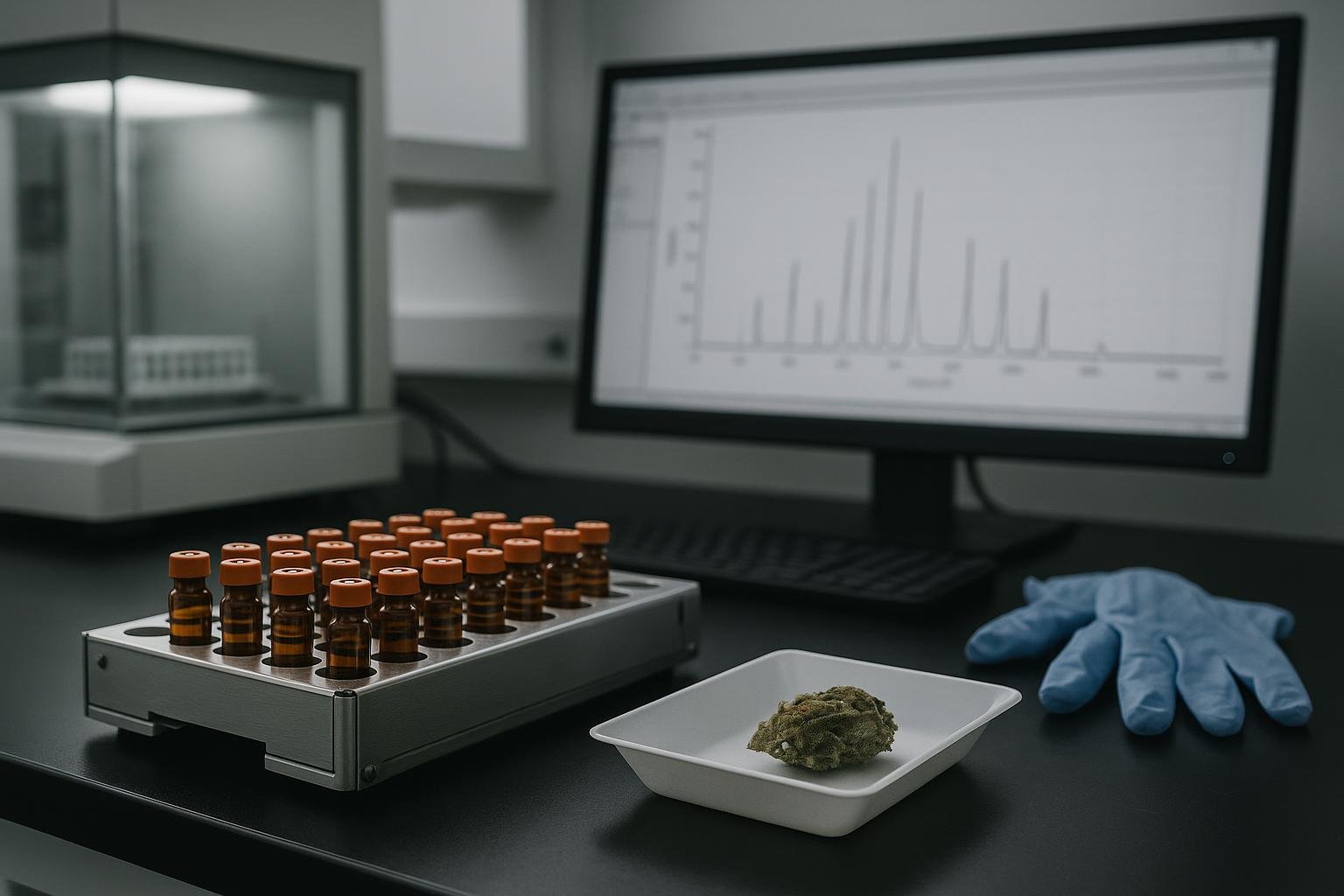
Opening a cannabis testing lab is one of the few business decisions in this industry where the regulatory complexity genuinely matches the capital requirement. I spent four-plus years on the bench before anyone told me what it actually costs — in dollars, in months, and in bureaucratic patience. This guide walks through state licensing requirements, ISO/IEC 17025 accreditation timelines, instrument capital expenditures by assay class, staffing minimums, and realistic runway, with every number sourced so you can take it into a business plan or a bank meeting.
Whether you are a working chemist thinking about going independent, a lab director handed a greenfield build, or a cannabis operator trying to understand why third-party testing costs what it does — this article is for you. Investors looking for market-size figures and consumers looking for dispensary recommendations will not find what they need here.
This article covers a lot of ground. Here is what is coming:
- Step 1: Understand the two-track licensing structure (state cannabis license + ISO accreditation)
- Step 2: Navigate state-specific licensing requirements and fees
- Step 3: Plan your ISO/IEC 17025 accreditation timeline
- Step 4: Build your instrument capital budget by assay class
- Step 5: Staff to regulatory minimums and quality system requirements
- Step 6: Model your runway from lease signing to first billable test
Step 1: Understand the Two-Track Licensing Structure
Every cannabis testing lab in a licensed state operates under two parallel regulatory frameworks, and conflating them is the single most common planning mistake I see.
Track one is your state cannabis testing laboratory license — issued by the state cannabis regulator (a cannabis commission, a department of health, a liquor and cannabis board, depending on the state). This license says you are legally permitted to receive cannabis samples, handle them, and report results to the state’s seed-to-sale tracking system. Without it, you cannot touch a regulated sample.
Track two is ISO/IEC 17025 accreditation — a technical competence credential issued by a third-party accreditation body such as A2LA, ANAB, or PJLA. This credential says your quality management system, your methods, and your personnel meet an internationally recognized standard for testing laboratory competence. Most states require it as a condition of maintaining your cannabis license.
The two tracks run on different clocks and are administered by different bodies. Your state regulator will not wait for your ISO accreditation body, and your accreditation body does not care about your state license application deadline. You must plan both tracks simultaneously from day one, or you will run out of runway before you run out of money.
For a deeper dive into what the ISO/IEC 17025 audit actually looks like from the inside, see our ISO 17025 audit preparation guide.
Step 2: Navigate State-Specific Licensing Requirements
There is no federal cannabis testing laboratory license. Every state with a regulated cannabis market has its own application process, fee schedule, and technical requirements. The variation is real and it matters for your planning.
Rhode Island establishes its cannabis testing laboratory license under Title 21, Chapter 21-28.11, Section 21-28.11-11, requiring applicants to be at least 21 years old, be state residents, pass a criminal background check, be current on tax filings, and pay both a nonrefundable application fee and an annual license fee set by commission rules.
Connecticut created its cannabis testing laboratory license through Section 16 of Public Act 23-79, administered by the Department of Consumer Protection. The fee schedule is one of the few in the country published with specific dollar figures: a provisional license costs $500, a final license costs $1,000, and annual renewal is $1,000. Applicants must also submit a contract with an approved seed-to-sale tracking system — a requirement that catches first-timers off guard.
Washington State requires cannabis quality assurance testing laboratories to be accredited by the Washington State Department of Agriculture under Chapter 16-310 WAC before the Liquor and Cannabis Board will certify them — meaning WSDA accreditation is a prerequisite to the state cannabis license, not a parallel track.
Maryland under GAB § 36-408(b) requires independent testing laboratories to meet accreditation, inspection, and testing standards established by the Administration and to pay an application fee determined by the Administration — without publishing a fixed fee in the statute itself.
Note: Fee schedules and residency requirements change. Always pull the current version of your state’s primary regulatory text — the statute or administrative code — not a summary from a consulting firm. The citations above link directly to primary sources.
The practical takeaway: budget 2 to 6 months for state licensing, and assume you will need a dedicated person tracking the application, responding to deficiency notices, and coordinating with the seed-to-sale tracking vendor. This is not a one-afternoon task.
Step 3: Plan Your ISO/IEC 17025 Accreditation Timeline
ISO/IEC 17025 accreditation for a well-prepared cannabis lab typically takes 6 to 12 months from initial application to approval. That range is not padding — it reflects real variation in how complete your quality management system documentation is when you apply, how quickly your accreditation body schedules its on-site assessment, and how many corrective actions come out of that assessment.
What the standard actually requires is documented in ISO/IEC 17025:2017: a quality management system, documented methods, demonstrated method validation, personnel competency records, equipment calibration and maintenance records, and an internal audit program. Michigan’s R. 420.305(1) specifically references the 2017 edition, so make sure your quality manual is written to that version, not the 2005 edition.
The accreditation bodies most commonly accepted in cannabis states are A2LA, ANAB, and PJLA — all recognized by the International Laboratory Accreditation Cooperation (ILAC). Missouri’s 19 CSR 100-1.110 requires accreditation by an ILAC-recognized body, as does Michigan. Check your state’s rule for the approved list before you apply.
The deadline risk is real. Missouri 19 CSR 100-1.110 requires ISO/IEC 17025 accreditation within one year of receiving department approval to operate; a testing licensee that does not meet that deadline must cease testing and may be fined up to $1,000 for every day out of compliance. Michigan’s R. 420.305(1) sets the same one-year clock.
I suggest labs take it a step further than the minimum: begin your quality management system documentation during the facility build-out phase, not after instruments are installed. Every month you delay the QMS is a month added to your accreditation timeline at the back end.
See our method validation guide for the specific validation parameters — linearity, LOD, LOQ, precision, accuracy — you will need to document before your accreditation assessor arrives.
Step 4: Build Your Instrument Capital Budget by Assay Class
This is where most business plans go wrong — they list one or two instruments and forget that a full compliance test menu requires multiple analytical platforms, each with its own installation, qualification, and consumable costs.
Shimadzu’s cannabis lab start-up guide is one of the few vendor documents that publishes list prices, so it is worth using as a planning anchor — with the understanding that list price is not street price, and that Shimadzu is one vendor among several (Agilent, Waters, and Sciex all compete in this space).
- LC-MS/MS (liquid chromatography tandem mass spectrometry — the standard platform for high-sensitivity cannabinoid quantitation and many contaminant panels): list price approximately $350,000 per the Shimadzu guide.
- Triple-quadrupole GC-MS with headspace autosampler (gas chromatography tandem mass spectrometry with automated headspace injection for volatile analytes — the standard platform for residual solvents and volatile pesticides): list price $159,000 for the GCMS-TQ8050 with HS-20 headspace autosampler per the same guide.
Beyond those two platforms, a full compliance menu also requires an ICP-MS (inductively coupled plasma mass spectrometry) for heavy metals — see our heavy metals testing overview — and microbiology equipment for total yeast and mold, total aerobic count, and pathogen panels. Neither of those platforms is cheap, and neither is optional in most state test menus.
Add to instrument cost: installation and site qualification, annual service contracts (typically 8–12% of instrument list price per year — this is a typical industry figure, not a sourced requirement), columns and consumables for the first six months of validation, and reference standards for every analyte on your scope.
Note: Concentrate and edible matrices often require additional sample preparation equipment — rotary evaporators, analytical balances rated to 0.01 mg, and homogenization equipment — that is easy to undercount in a capex budget focused on the big instruments.
Total investment for a cannabis testing lab realistically starts around $1 million once facility build-out, licensing fees, initial reagents and consumables, software, and working capital are included. I have not seen a credible full-scope lab open for less. For context on what the market charges per sample once you are operational, see our cost of testing breakdown.
Step 5: Staff to Regulatory Minimums and Quality System Requirements
ISO/IEC 17025 does not specify headcount — it requires that personnel are competent for the tasks they perform, with documented evidence. But state regulations do set minimum qualification floors, and those floors matter for hiring.
Missouri’s 19 CSR 100-1.110 sets an explicit benchmark in the regulatory record: individuals performing or overseeing marijuana product sampling and testing must hold at least a bachelor’s degree in a natural science — biology, chemistry, physics, engineering, or environmental sciences — or have at least two years of applicable experience. That is a floor, not a ceiling.
Connecticut’s DCP license requirements require applicants to submit a list of names, titles, and addresses of all persons handling drugs at the laboratory as part of the application — which means you need to have your key staff identified before you can complete the license application, not after.
Beyond the regulatory minimums, a functioning ISO 17025 quality system requires at minimum a designated Quality Manager (responsible for the QMS, internal audits, and corrective actions) and a Technical Manager (responsible for method validation and analyst competency). In a small startup, one person often holds both roles — but the roles must be defined and documented separately in your quality manual.
The staffing reality for a startup lab is that you will need bench analysts who can run validated methods, a quality manager who can write and maintain the QMS, and someone who understands the state’s LIMS (Laboratory Information Management System) and seed-to-sale reporting requirements. If you are planning to hire from the environmental testing sector, the analytical skills transfer well; the cannabis-specific regulatory layer does not. Budget for training time.
For a detailed look at the career paths and qualification routes for bench staff, see our cannabis lab technician career guide.
Step 6: Model Your Runway from Lease Signing to First Billable Test
The timeline is almost always longer than the business plan says, and the capital requirement is almost always higher.
OnePointe Solutions’ cannabis lab startup guide breaks the pre-revenue period into overlapping phases that add up to 9 to 15 months from lease signing to first billable test:
- Facility build-out: 3 to 5 months. Cannabis labs have specific HVAC, electrical, plumbing, and security requirements that standard commercial space does not meet. Permitting delays are common.
- Instrument installation and method validation: 2 to 4 months. Instruments ship with lead times of 8 to 16 weeks in the current market. Validation — linearity, LOD, LOQ, precision, accuracy, matrix effects — takes additional time after installation.
- State licensing: 2 to 6 months. Application review timelines vary enormously by state and by application volume at the regulator.
- ISO/IEC 17025 accreditation: 6 to 12 months, running in parallel with the above phases where possible.
The phases overlap but they do not compress as much as investors hope. The accreditation clock in particular cannot be shortened by spending more money — it is gated by your assessor’s schedule, your corrective action response time, and the accreditation body’s review queue.
Working capital needs to cover payroll, rent, consumables, and debt service for the entire pre-revenue period plus a buffer for the ramp-up period when you have a license but not yet a full client roster. The $1 million floor figure from ScienceInsights is a starting point for a lean operation; a full-scope lab in a high-cost market will be higher.
Note: Hemp-derived product testing operates under a different federal framework. Under 7 U.S.C. 1639o(1), as amended by P.L. 119-37, hemp is defined by total tetrahydrocannabinols concentration — including THCA — of not more than 0.3 percent on a dry weight basis. The older delta-9-only framing is the superseded pre-amendment wording. If your lab intends to serve hemp clients alongside marijuana clients, confirm that your state’s hemp testing program has its own license pathway and that your methods are validated for the relevant matrix and analyte set.
Quick answers
How much does it cost to start a cannabis testing lab? Total investment for a cannabis testing lab realistically starts around $1 million once facility build-out, licensing fees, instruments, reagents, software, and working capital are included. Individual analytical instruments can run from roughly $159,000 list price for a triple-quadrupole GC-MS with headspace autosampler up to approximately $350,000 list price for an LC-MS/MS platform. That figure does not include real estate, HVAC upgrades, or the internal labor cost of ISO/IEC 17025 accreditation.
How long does ISO 17025 accreditation take for a cannabis lab? For a well-prepared cannabis lab, ISO/IEC 17025 accreditation typically takes 6 to 12 months from initial application to approval. Most states allow a lab to operate under a provisional or conditional license during that window, but several — including Missouri under 19 CSR 100-1.110 — require accreditation within one year of opening or the lab must cease testing. Build the accreditation timeline into your pre-opening schedule, not as an afterthought.
Do I need ISO 17025 to open a cannabis testing lab? In most licensed cannabis states, yes — ISO/IEC 17025 accreditation is either a condition of licensure or must be achieved within one year of receiving your state lab license. Michigan (R. 420.305(1)), Missouri (19 CSR 100-1.110), New York (Part 130), and Washington (WAC 314-55-102) all require it explicitly. Check your state’s primary regulatory text because the deadline and the approved accreditation bodies vary.
What instruments does a cannabis testing lab need? A compliance cannabis lab needs at minimum a chromatography platform for potency, a mass-spectrometry platform for pesticides and contaminants, and an ICP-MS for heavy metals — plus microbiology equipment for microbial safety panels. LC-MS/MS is the standard high-sensitivity platform for cannabinoids and many contaminants; a triple-quadrupole GC-MS with headspace autosampler covers residual solvents and volatile pesticides. Instrument needs scale with your state’s required test menu.
What qualifications do cannabis lab staff need? Missouri’s cannabis testing rule requires that individuals performing or overseeing marijuana product testing hold at least a bachelor’s degree in a natural science or have at least two years of applicable experience. ISO/IEC 17025 also requires that laboratory personnel be competent for the specific tasks they perform, with documented training records for every analyst. Most lab directors come from analytical chemistry or environmental testing backgrounds.
How long does it take to open a cannabis testing lab from scratch? Plan for 9 to 15 months from lease signing to first billable test: roughly 3 to 5 months for facility build-out, 2 to 4 months for instrument installation and method validation, 2 to 6 months for state licensing, and 6 to 12 months for ISO/IEC 17025 accreditation running in parallel. These phases overlap but they do not compress as much as investors hope. The accreditation clock is usually the longest single constraint.
Sources
- OnePointe Solutions — How to Start a Cannabis Testing Laboratory
- Rhode Island General Laws § 21-28.11-11 — Cannabis Testing Laboratory License
- Alabama Medical Cannabis Commission — Chapter 538-X-10, Regulation of State Testing Laboratories
- Missouri 19 CSR 100-1.110 — Marijuana Testing Facility Requirements (via Cornell LII)
- Michigan Administrative Code R. 420.305 — Cannabis Testing Laboratory Accreditation (via Cornell LII)
- New York Office of Cannabis Management — Part 130 Laboratory Regulations
- Washington Administrative Code WAC 314-55-102 — Cannabis Quality Assurance Testing Laboratories
- Connecticut Department of Consumer Protection — Cannabis Testing Laboratory License
- Maryland GAB § 36-408 — Independent Testing Laboratory Registration
- Shimadzu Scientific Instruments — Cannabis Lab Start-Up Guide (PDF)
- ScienceInsights — How to Start a Cannabis Testing Lab: Costs & Steps
- ISO/IEC 17025:2017 — General Requirements for the Competence of Testing and Calibration Laboratories
- ILAC — International Laboratory Accreditation Cooperation
FAQ
Frequently asked
- how much does it cost to start a cannabis testing lab
- Total investment for a cannabis testing lab realistically starts around $1 million once you account for facility build-out, licensing fees, instruments, reagents, software, and working capital to cover operations before revenue arrives. Individual analytical instruments can run from roughly $159,000 list price for a triple-quadrupole GC-MS with headspace autosampler up to approximately $350,000 list price for an LC-MS/MS platform. That figure does not include real estate, HVAC upgrades, or the internal labor cost of ISO/IEC 17025 accreditation.
- how long does ISO 17025 accreditation take for a cannabis lab
- For a well-prepared cannabis lab, ISO/IEC 17025 accreditation typically takes 6 to 12 months from initial application to approval. Most states allow a lab to operate under a provisional or conditional license during that window, but several — including Missouri under 19 CSR 100-1.110 — require accreditation within one year of opening or the lab must cease testing. Build the accreditation timeline into your pre-opening schedule, not as an afterthought.
- do I need ISO 17025 to open a cannabis testing lab
- In most licensed cannabis states, yes — ISO/IEC 17025 accreditation is either a condition of licensure or must be achieved within one year of receiving your state lab license. Michigan (R. 420.305(1)), Missouri (19 CSR 100-1.110), New York (Part 130), and Washington (WAC 314-55-102) all require it explicitly. Check your state's primary regulatory text because the deadline and the approved accreditation bodies vary.
- what instruments does a cannabis testing lab need
- A compliance cannabis lab needs at minimum a chromatography platform for potency, a mass-spectrometry platform for pesticides and contaminants, and an ICP-MS for heavy metals — plus microbiology equipment for microbial safety panels. LC-MS/MS is the standard high-sensitivity platform for cannabinoids and many contaminants; a triple-quadrupole GC-MS with headspace autosampler covers residual solvents and volatile pesticides. Instrument needs scale with your state's required test menu.
- what qualifications do cannabis lab staff need
- Missouri's cannabis testing rule requires that individuals performing or overseeing marijuana product testing hold at least a bachelor's degree in a natural science or have at least two years of applicable experience. ISO/IEC 17025 also requires that laboratory personnel be competent for the specific tasks they perform, with documented training records for every analyst. Most lab directors come from analytical chemistry or environmental testing backgrounds.
- how long does it take to open a cannabis testing lab from scratch
- Plan for 9 to 15 months from lease signing to first billable test: roughly 3 to 5 months for facility build-out, 2 to 4 months for instrument installation and method validation, 2 to 6 months for state licensing, and 6 to 12 months for ISO/IEC 17025 accreditation running in parallel. These phases overlap but they do not compress as much as investors hope. The accreditation clock is usually the longest single constraint.
Related guides
All guides- 01
Cannabis Lab 101: Cannabis Edibles Testing Cost — Why Infused Products Cost More to Test
I spent four years running potency assays on everything from flower to fudge, and infused products always took longer and cost more. Here is exactly why — matrix effects, homogeneity requirements, and the extra sample prep no one explains — plus real prices from published lab menus.
- 02
Cannabis Lab 101: Writing SOPs That Survive an Audit
I spent four years watching labs fail accreditation audits over paperwork that should have been airtight. This guide walks through the structure of a defensible SOP, version control that actually works, training records auditors accept, and the recurring findings that accreditation bodies flag most often.
- 03
Cannabis Lab 101: Cannabis Lab Technician Salary by State and Role
I pulled every sourced number I could find from ZipRecruiter, Indeed, and Salary.com to build a real salary table by role — from sample-prep tech to lab manager. Here is what the data actually says, what drives the spread, and how to negotiate your next offer.
Need this tested?
Compare labs that run these assays and get quotes in one go — no account, no fee.