· 12 min read
Cannabis Lab 101: Non-Laboratory Cannabis Testing — What Handheld and Benchtop Devices Can and Cannot Tell You
I spent four years running potency assays on a benchtop HPLC, and I still get asked whether a handheld NIR or a TLC spot kit can replace a lab result. Here is an honest breakdown of what each device class actually measures, where the published accuracy data land, and why none of them count as compliance tests.
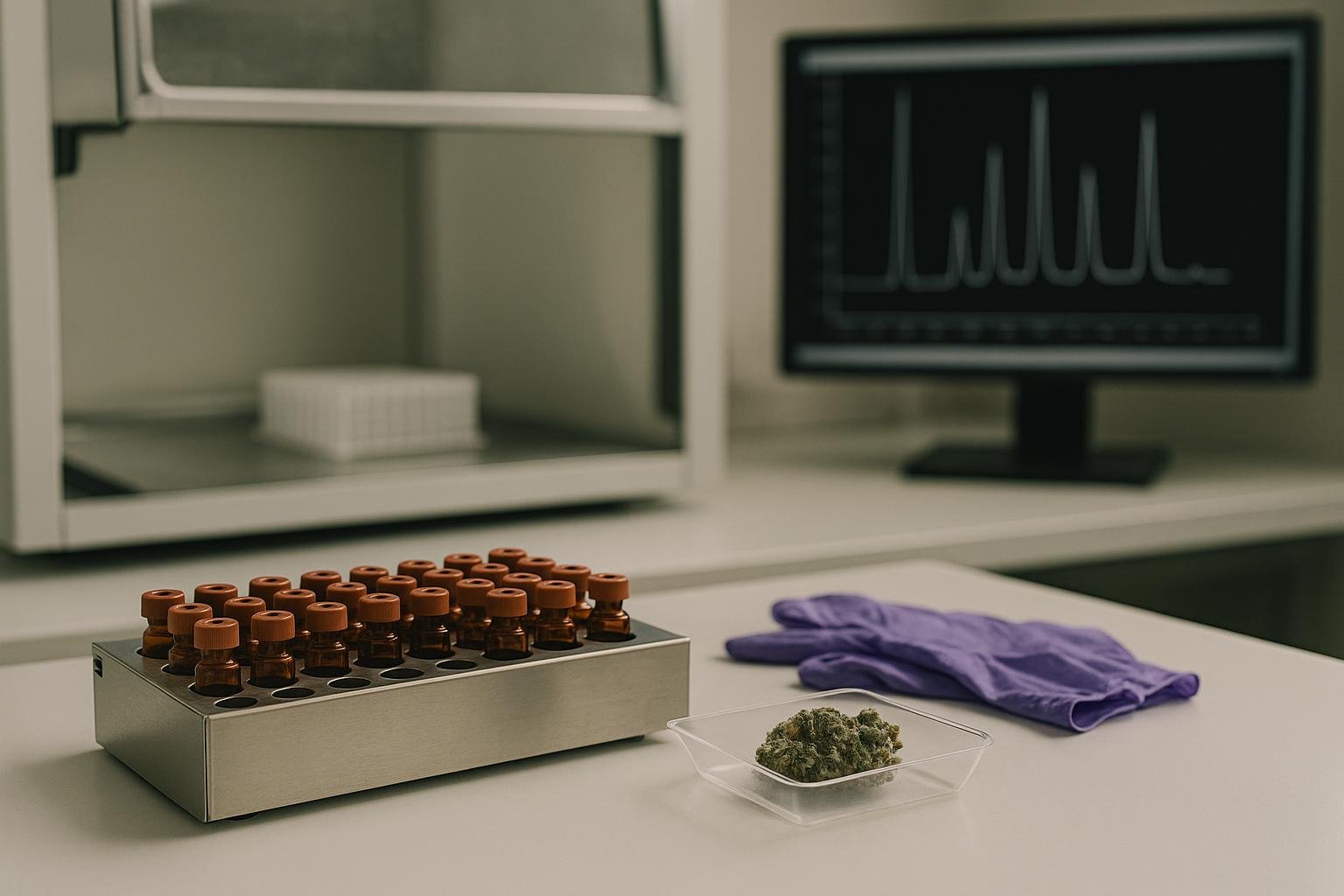
Non-laboratory cannabis testing devices — TLC spot kits, handheld NIR spectrometers, portable Raman units, and compact desktop HPLC systems — are everywhere at trade shows and increasingly in cultivation facilities. The honest answer to whether any of them can replace an accredited lab result is no, and the more interesting question is exactly where each technology breaks down and why.
Whether you are a grower trying to decide whether to buy a field NIR device, a lab director evaluating in-house screening tools, or a technician who has been asked to explain to a client why their TLC kit reading does not match the COA — this article is for you. Consumers looking for dispensary recommendations and investors looking for market-size figures will not find either here.
Here is what this article covers:
- Why the compliance/non-compliance line exists and what it actually requires
- TLC and colorimetric kits: what they detect and what they cannot quantify
- Handheld NIR: the published classification accuracy and the calibration trap
- Handheld Raman: the hemp-vs-cannabis discrimination story and its limits
- Benchtop desktop HPLC: the closest non-lab option and why accreditation still matters
- A plain-language summary of when each tool is worth using
Note: None of the device classes described in this article — TLC kits, handheld NIR, handheld Raman, or unaccredited desktop HPLC — constitute a compliance test in any U.S. state cannabis program or under the USDA domestic hemp production program. This is not a technicality. USDA’s final rule (86 Fed. Reg. 5596) and its Laboratory Testing Guidelines make clear that only the official pre-harvest test result from a DEA-registered laboratory determines regulatory compliance for hemp. The 2026 cannabis testing requirements guide confirms the same principle applies across state cannabis programs.
Step 1: Understand the compliance line before you buy anything
The device in your hand does not matter; the quality system behind the result is what regulators audit.
Every U.S. state cannabis program and the federal hemp program draws a hard line between a compliance test and everything else. On the compliance side sits an ISO/IEC 17025:2017 accredited laboratory with a scope document that explicitly names cannabis or hemp matrices and the specific test methods — potency, pesticides, heavy metals, residual solvents, microbials, mycotoxins — for which it is accredited. The 2026 cannabis testing requirements guide is direct on this: accreditation is scope-specific, meaning a laboratory accredited for water chemistry or food microbiology is not automatically accredited for cannabis potency. You should ask any lab for their scope document and read it. See our deeper treatment at Cannabis Lab 101: ISO 17025 Audit Preparation.
For hemp specifically, the USDA situation is worth stating precisely because it has been misread repeatedly. The USDA AMS Laboratory Testing Guidelines state that hemp testing laboratories “are not required to be ISO accredited, although USDA strongly encourages adherence to the ISO 17025 standard.” What is required — and this is not optional — is DEA registration to handle hemp as a controlled substance, with a compliance deadline of December 31, 2025. USDA’s pilot program recognizing third-party accreditation bodies does require ISO/IEC 17025 participation for enrolled labs, as the ACIL comment letter to USDA noted in 2020. The practical effect: most labs doing hemp compliance work are pursuing ISO 17025 because state programs and sophisticated buyers demand it, even where the federal rule stops short of mandating it.
Compliance potency testing also uses a specific formula. Total THC is calculated as delta-9 THC plus THCA multiplied by 0.877, the factor that accounts for mass lost when THCA decarboxylates to delta-9 THC during heating. The federal hemp definition under 7 U.S.C. 1639o(1) as amended by P.L. 119-37 is based on total tetrahydrocannabinols — including THCA — not delta-9 THC alone. The older delta-9-only framing is superseded law; do not rely on it.
Step 2: Know what TLC and colorimetric kits actually detect
TLC (thin-layer chromatography, a technique that separates compounds by how far they travel up a coated plate when drawn by solvent) and colorimetric spot kits are the cheapest entry point into cannabis testing and the most frequently misunderstood. A TLC kit works by dissolving a small amount of plant material in a solvent, spotting it on a silica plate, running the plate through a developing solvent, and then spraying or dipping in a reagent that produces a color reaction with cannabinoids. The result is a spot at a position that corresponds to a compound class, and a color that confirms presence.
What a TLC kit can tell you: whether THC or CBD is present. What it cannot tell you is how much. AOAC SMPR 2017.001 — the standard method performance requirement for quantitative cannabinoid determination — lists HPLC and GC as the accepted platforms and sets defined limits of quantification, accuracy, and precision that TLC-based consumer kits cannot document to the same standard. The SMPR does not list TLC as a suitable method for potency reporting, and the 2026 testing requirements guide confirms that compliance potency testing is expected to use validated HPLC or GC under an ISO/IEC 17025 quality system.
I have seen TLC kits used usefully in two situations: a breeder doing a quick presence-or-absence screen on seedlings to cull obvious CBD-dominant plants before investing in full potency panels, and a law enforcement officer doing a field presumptive test. In both cases the user understood they were getting a binary signal, not a percentage. The problem is when a grower treats a TLC color reaction as a potency number and then disputes the lab COA — those two things are not measuring the same thing.
Note: For edibles and concentrates, TLC kits are even less informative. The matrix — fats, sugars, waxes — interferes with extraction and spot migration, and the cannabinoid concentration range in a concentrate is far outside what a visual spot comparison can resolve.
Step 3: Evaluate handheld NIR devices honestly
Near-infrared spectroscopy (NIR, a technique that shines light in the 700–2500 nm wavelength range onto a sample and measures how much is absorbed or reflected at each wavelength) is genuinely useful analytical chemistry. Benchtop NIR instruments have been used in grain and pharmaceutical quality control for decades. The question is what happens when you shrink the spectrometer and point it at a cannabis flower.
A 2024 peer-reviewed study in Sensors built and validated a chemometric (multivariate statistical) classification model on a handheld NIR device to categorize cannabis samples as low-, medium-, or high-THC. The device performed well as a classifier — distinguishing low-THC hemp from higher-THC cannabis samples with high accuracy within the study’s dataset. The key word is classifier: the device was not reporting a THC percentage, it was sorting samples into tiers.
The same paper is candid about the limitations. Moisture content, sample heterogeneity, and whether the material was ground or intact all shift the NIR spectrum, requiring careful sample preparation to maintain model performance. More fundamentally, the chemometric model is only valid within the domain of samples it was trained on. Point a model trained on a handful of cultivars at a new exotic chemotype and you have no guarantee the classification holds. The authors explicitly caution that extending the model to significantly different chemotypes requires retraining and revalidation.
NIR does not provide a molecule-specific measurement. It infers THC levels from bulk spectral features correlated with chemistry — it is reading a shadow of the molecule, not the molecule itself. That is fine for screening. It is not fine for a COA number. See our potency testing overview for what a chromatographic measurement actually resolves.
Note: Some vendors sell benchtop NIR units marketed to dispensaries or producers as “lab-grade” potency testers. The instrument may be well-built. The limitation is the calibration model and the absence of an accredited quality system — not the hardware.
Step 4: Understand what handheld Raman devices can and cannot do
Raman spectroscopy (a technique that measures the inelastic scattering of laser light by molecular bonds, producing a spectrum characteristic of specific chemical structures) has a different strength from NIR: it is more molecule-specific and can be done non-invasively through packaging or on intact plant material without any sample preparation.
A 2022 study in Analytical and Bioanalytical Chemistry demonstrated that a handheld Raman spectrometer could differentiate hemp from cannabis samples with 100% accuracy in the study’s dataset, using principal component analysis and discriminant analysis on the Raman spectra. The non-destructive, non-invasive capability is real and practically useful — you can screen a sealed bag without opening it.
The authors frame this explicitly as a classification tool for distinguishing hemp from cannabis, not as a quantitative potency method. The paper does not claim to produce THC percentages comparable to chromatographic results, and the 100% classification accuracy applies to the specific sample population the model was trained on. The authors caution that extending the model to significantly different chemotypes requires retraining. Raman spectral signatures reflect both cannabinoids and other plant metabolites, so the model is responding to a chemical fingerprint, not to THC alone.
Where I think handheld Raman earns its place: law enforcement screening at a border or traffic stop, where the binary hemp-vs-cannabis question is exactly what is needed and speed matters more than a percentage. For a grower trying to decide whether a plot is compliant before harvest, a Raman classification is useful intelligence — but it does not replace the DEA-registered lab’s pre-harvest test that USDA actually requires.
Note: Fluorescence interference from plant pigments can degrade Raman signal quality, particularly in fresh or green material. Most handheld Raman devices use 785 nm or 1064 nm excitation lasers to minimize this, but it remains a practical consideration in field use.
Step 5: Assess benchtop desktop HPLC — the closest non-lab option
Compact benchtop HPLC (high-performance liquid chromatography, which separates cannabinoids by passing a liquid sample through a column packed with stationary phase material and detecting compounds as they elute) units designed for in-house producer or dispensary use are the most analytically capable of the non-laboratory options. They use the same separation principle as the instruments in accredited labs, and AOAC SMPR 2017.001 recognizes HPLC as a primary platform for quantitative cannabinoid determination.
The instrument is not the problem — the quality system is. A benchtop HPLC outside an ISO/IEC 17025 accredited laboratory, without a validated method, without documented calibration traceability, without trained analysts following a quality manual, produces a number that a regulator will not accept. The 2026 testing requirements guide is explicit: compliance laboratories’ accredited scopes distinguish between matrices — flower, concentrates, edibles — because method performance and sample preparation differ between product types. An in-house HPLC running a method that has never been validated against those matrices is not producing an equivalent result.
There is a legitimate use case for in-house HPLC: a large producer doing internal process monitoring, trend analysis, or harvest-timing decisions — not for label claims, but for operational intelligence. If you go this route, I suggest labs take it a step further and run split samples against an accredited lab periodically to check whether your in-house results are tracking. Drift in column performance, reference standard degradation, and sample preparation inconsistency are all real failure modes that a quality system catches and an informal setup misses. Our HPLC methods article and method validation guide cover what a proper validation looks like.
Method performance goals for cannabinoid quantification — such as relative standard deviation and recovery criteria described in AOAC SMPR 2017.001 — function as analytical performance targets, not as statutory tolerances written into law. The 2026 testing requirements guide describes similar figures as typical quality system goals. Whether your in-house HPLC meets those goals is something only a proper validation study can tell you.
Quick answers
Can a handheld NIR or Raman device replace a lab test for cannabis compliance? No handheld or portable device is recognized as a compliance method for cannabis or hemp potency testing in any U.S. regulatory program. USDA regulations require that official pre-harvest THC tests for hemp be performed by DEA-registered laboratories, and the 2026 cannabis testing requirements guide confirms that hand-held or on-site devices are not accepted substitutes for accredited laboratory results. These tools are useful for screening and classification, not for regulatory sign-off.
How accurate are handheld NIR devices for measuring THC in cannabis? Published research shows handheld NIR devices perform well as classifiers — distinguishing low-THC from higher-THC samples — but not as precise quantitative instruments. A 2024 peer-reviewed study in Sensors found that chemometric NIR models could categorize samples by THC tier with high classification accuracy within the study’s dataset, while noting that moisture, sample heterogeneity, and the boundaries of the training dataset limit generalization to new varieties. For a reported percentage you can put on a label, you need a validated chromatographic method.
What does a TLC cannabis test kit actually tell you? A TLC spot kit can confirm the presence or absence of certain cannabinoids based on color reactions, but it cannot reliably quantify THC or CBD to the accuracy required for compliance reporting. AOAC SMPR 2017.001 lists HPLC and GC as the accepted platforms for quantitative cannabinoid determination and does not recognize TLC-based kits as suitable for potency reporting. Think of a TLC kit as a presence-or-absence screen, not a potency number.
Does a cannabis lab need ISO 17025 accreditation to do compliance testing? For state-licensed cannabis programs, most U.S. jurisdictions require ISO/IEC 17025 accreditation scoped specifically to cannabis matrices and test methods. For hemp under the USDA domestic program, ISO 17025 accreditation is strongly encouraged but not mandated by the final rule; however, laboratories must be DEA-registered to handle hemp as a controlled substance for official compliance testing, with a deadline of December 31, 2025. Always check the specific scope document — a lab can be ISO 17025 accredited for unrelated work and still have no accredited cannabis methods.
What is the total THC formula used in cannabis compliance testing? Compliance potency testing commonly calculates total THC as delta-9 THC plus THCA multiplied by 0.877, which accounts for the loss of mass when THCA decarboxylates to delta-9 THC. This formula is described in the 2026 cannabis testing requirements guide and reflects the chemistry of the decarboxylation reaction. Under 7 U.S.C. 1639o(1) as amended by P.L. 119-37, the federal hemp definition is based on total tetrahydrocannabinols concentration — including THCA — not delta-9 THC alone.
Can a benchtop desktop HPLC outside an accredited lab be used for compliance potency testing? The instrument itself is not the barrier — HPLC is the platform that AOAC SMPR 2017.001 and most state programs recognize for cannabinoid quantification. What disqualifies a result is the absence of an ISO/IEC 17025 accredited quality system scoped to the specific cannabis matrix and method, plus DEA registration for hemp work. A benchtop HPLC in a non-accredited setting can generate useful internal data, but that result will not satisfy a regulator.
Sources
- USDA Final Rule, 86 Fed. Reg. 5596 (January 19, 2021) — U.S. Domestic Hemp Production Program
- USDA AMS Laboratory Testing Guidelines for the U.S. Domestic Hemp Production Program
- AOAC SMPR 2017.001 — Standard Method Performance Requirements for Quantitation of Cannabinoids in Plant Materials and Concentrates
- AOAC SMPR 2017.002
- AOAC SMPR 2020.012 — Microbiological Methods for Cannabis and Cannabis Products
- AOAC Validation of Microbiological Methods for Cannabis and Cannabis Products (2022)
- Cannabis Testing Requirements Guide, casrai.org (2026)
- Sensors 2024 — Handheld NIR Classification of Cannabis Samples
- Analytical and Bioanalytical Chemistry 2022 — Handheld Raman Differentiation of Hemp and Cannabis (PMC)
- ACIL Comment Letter to USDA on Hemp Testing Accreditation (2020)
- Cannabis Labs Virtual Conference 2021 Presentation — CloudLIMS
FAQ
Frequently asked
- Can a handheld NIR or Raman device replace a lab test for cannabis compliance?
- No handheld or portable device is recognized as a compliance method for cannabis or hemp potency testing in any U.S. regulatory program. USDA regulations require that official pre-harvest THC tests for hemp be performed by DEA-registered laboratories, and the 2026 cannabis testing requirements guide confirms that hand-held or on-site devices are not accepted substitutes for accredited laboratory results. These tools are useful for screening and classification, not for regulatory sign-off.
- How accurate are handheld NIR devices for measuring THC in cannabis?
- Published research shows handheld NIR devices perform well as classifiers — distinguishing low-THC from higher-THC samples — but not as precise quantitative instruments. A 2024 peer-reviewed study in Sensors found that chemometric NIR models could categorize samples by THC tier with high classification accuracy, while also noting that moisture, sample heterogeneity, and the boundaries of the training dataset limit generalization to new varieties. For a reported percentage you can put on a label, you need a validated chromatographic method.
- What does a TLC cannabis test kit actually tell you?
- A TLC spot kit can confirm the presence or absence of certain cannabinoids based on color reactions, but it cannot reliably quantify THC or CBD to the accuracy required for compliance reporting. AOAC SMPR 2017.001 lists HPLC and GC as the accepted platforms for quantitative cannabinoid determination and does not recognize TLC-based kits as suitable for potency reporting. Think of a TLC kit as a presence-or-absence screen, not a potency number.
- Does a cannabis lab need ISO 17025 accreditation to do compliance testing?
- For state-licensed cannabis programs, most U.S. jurisdictions require ISO/IEC 17025 accreditation scoped specifically to cannabis matrices and test methods. For hemp under the USDA domestic program, ISO 17025 accreditation is strongly encouraged but not mandated by the final rule; however, laboratories must be DEA-registered to handle hemp as a controlled substance for official compliance testing by December 31, 2025. Always check the specific scope document — a lab can be ISO 17025 accredited for unrelated work and still have no accredited cannabis methods.
- What is the total THC formula used in cannabis compliance testing?
- Compliance potency testing commonly calculates total THC as delta-9 THC plus THCA multiplied by a 0.877 conversion factor, which accounts for the loss of mass when THCA decarboxylates to delta-9 THC. This formula is described in the 2026 cannabis testing requirements guide and reflects the chemistry of the decarboxylation reaction. Under 7 U.S.C. 1639o(1) as amended by P.L. 119-37, the federal hemp definition is based on total tetrahydrocannabinols concentration — including THCA — not delta-9 THC alone.
- Can a benchtop desktop HPLC outside an accredited lab be used for compliance potency testing?
- The instrument itself is not the barrier — HPLC is the platform that AOAC SMPR 2017.001 and most state programs recognize for cannabinoid quantification. What disqualifies a result is the absence of an ISO/IEC 17025 accredited quality system scoped to the specific cannabis matrix and method, plus DEA registration for hemp work. A benchtop HPLC in a non-accredited setting can generate useful internal data, but that result will not satisfy a regulator.
Related guides
All guides- 01
Cannabis Lab 101: Cannabis Edibles Testing Cost — Why Infused Products Cost More to Test
I spent four years running potency assays on everything from flower to fudge, and infused products always took longer and cost more. Here is exactly why — matrix effects, homogeneity requirements, and the extra sample prep no one explains — plus real prices from published lab menus.
- 02
Cannabis Lab 101: Heavy Metals Testing by ICP-MS — Digestion, Limits, and Common Failures
I spent years running ICP-MS in a licensed cannabis lab and watched heavy-metals failures blindside operators who thought soil was the only risk. This guide covers microwave digestion, the big-four analytes, how state limits actually differ, and where contamination hides in vape products.
- 03
Cannabis Lab 101: How Many Cannabis Testing Labs Are There in the US? A State-by-State Count
I spent time digging through state regulator license lists so you don't have to. This piece explains why there is no single national count, walks through what the official state-by-state lists actually show, and tells you exactly how to verify whether any lab you work with holds a current license and ISO/IEC 17025 accreditation.
Need this tested?
Compare labs that run these assays and get quotes in one go — no account, no fee.