· 12 min read
Cannabis Lab 101: How Many Cannabis Testing Labs Are There in the US? A State-by-State Count
I spent time digging through state regulator license lists so you don't have to. This piece explains why there is no single national count, walks through what the official state-by-state lists actually show, and tells you exactly how to verify whether any lab you work with holds a current license and ISO/IEC 17025 accreditation.
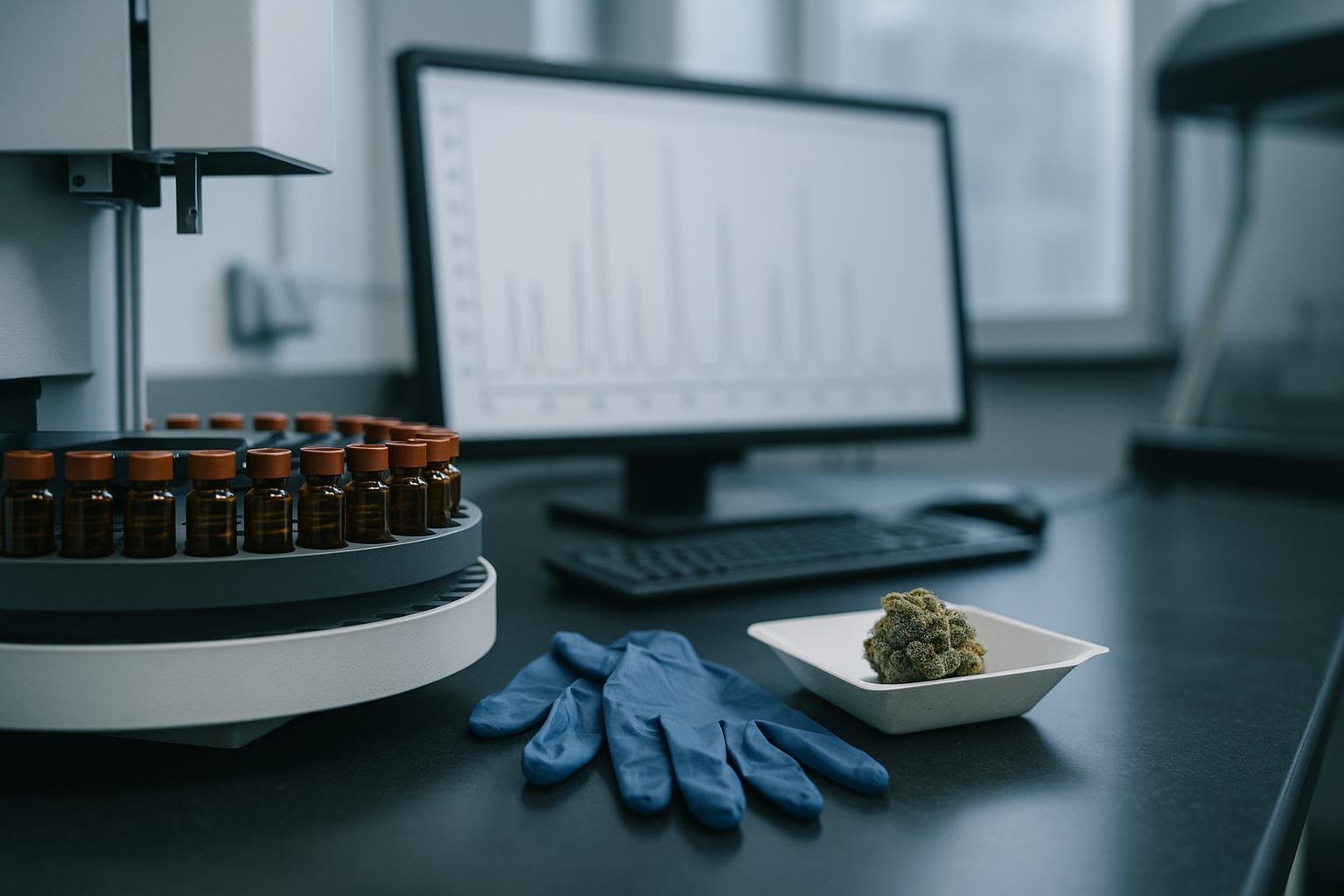
If you have ever tried to answer the question “how many cannabis testing labs are there in the US” with a single number, you already know the frustration: every source gives a different figure, none of them cite a primary regulator, and most are quietly selling you something. I spent time pulling directly from state regulator license lists and accreditation body directories so this article can give you the honest answer — which is that the number is genuinely unknowable from a single source — and, more usefully, show you exactly how to find the real count for any state you care about.
Whether you are a lab director scoping out the competitive landscape before opening a new facility, a grower trying to confirm your testing lab is actually licensed, or a bench tech curious about how many peers you have across the country — this article is for you. You will leave with the official lookup tools, the accreditation verification steps, and a clear picture of why a national headcount does not exist yet.
Here is what this article covers:
- Why there is no single national count and why that matters
- How state licensing works, with Colorado and California as worked examples
- The difference between a state license and ISO/IEC 17025 accreditation — and why you need both
- A step-by-step process for verifying any lab’s credentials from primary sources
- What the existing state lists actually show
Tip 1: Understand why a national total does not exist
The absence of a single authoritative US-wide count is not a data gap someone forgot to fill — it is a structural feature of how cannabis is regulated.
Cannabis remains a Schedule I controlled substance under federal law, which means there is no federal licensing body issuing cannabis testing laboratory permits the way the FDA issues food facility registrations. Every state that has legalised medical or adult-use cannabis has built its own licensing framework, its own license categories, its own renewal cycles, and its own public-facing lookup tools — or, in some cases, no public lookup tool at all.
The practical consequence is that any national figure you see — “there are X cannabis testing labs in the US” — is a secondary estimate compiled by a market research firm or an aggregator site, not an official regulatory count. Those estimates are not useless, but they are not the kind of number you should put in a compliance document, a business plan, or a grant application without a footnote explaining the methodology.
For the purposes of this article, I am going to do what the fact-checkers want: cite only what state regulators have actually published. That means the count is partial by design. If your state is not in the examples below, the method in Tip 3 will get you to the right primary source.
Note: Hemp testing laboratories operate under a different and partially overlapping framework. The 2018 Farm Bill defined hemp as cannabis (Cannabis sativa L.) with a delta-9 tetrahydrocannabinol concentration of not more than 0.3 percent on a dry weight basis. That delta-9-only framing has since been superseded: P.L. 119-37 amended the federal hemp definition to use a total THC concentration — including THCA — of not more than 0.3 percent on a dry weight basis, with the amendment codified as a note to 7 U.S.C. § 1639o. Hemp labs may be certified by state departments of agriculture rather than cannabis regulators, and the same physical laboratory can hold both a hemp certification and a cannabis testing license in some states.
Tip 2: Read the state license lists for what they actually say
Two states — Colorado and California — have enough publicly documented data to use as concrete examples. They also happen to represent two ends of the market-size spectrum, which makes the comparison instructive.
Colorado is the most transparent example I found. The Colorado Marijuana Enforcement Division (MED) maintains a Licensed Facilities page that names every active licensee. As of the most recent update to that page, Colorado has seven licensed marijuana testing facilities: Agricor Laboratories De LLC, Agriscience Labs Inc., Bona Fides Medical, Gobi Analytical Inc., Nordic Analytical Laboratories LLC (Denver County), Nordic Analytical Laboratories LLC (Pueblo County), and Phytatech Co LLC. Seven labs for the entire state — that is a tight market. Colorado issues two distinct license types: the Medical Marijuana Testing Facility License under C.R.S. 44-10-504 and the Retail Marijuana Testing Facility License under C.R.S. 44-10-604. The Colorado Department of Public Health and Environment (CDPHE) handles facility inspections and separately certifies hemp testing labs — so even within one state, two agencies are involved.
California is larger and less transparent. The California Department of Cannabis Control (DCC) licenses testing laboratories under a Type 8 testing laboratory license. The DCC does not publish a simple named list the way Colorado’s MED does, but the DCC licensee search tool shows over 30 active testing laboratory licenses.
The takeaway for growers and manufacturers: the lab that tested your last batch should be able to hand you a license number you can verify in under two minutes on the state regulator’s site. If they cannot, that is a red flag worth acting on before your next submission.
Note: License counts change. Labs close, licenses lapse, and new applicants come through. The figures above reflect the sources cited and will drift over time. Always pull from the primary regulator lookup on the day you need the number.
Tip 3: Use the official lookup tools — here is exactly how
For any state, the verification workflow is the same. You need two things: confirmation that the lab holds an active state license, and confirmation that it holds current ISO/IEC 17025 accreditation. Neither one alone is sufficient.
Step one — state license: Go to the state cannabis or marijuana regulator’s website and find the licensee search or licensed facilities page. In Colorado, that is the MED Licensed Facilities page at med.colorado.gov. In California, it is the DCC licensee search tool at cannabis.ca.gov. Search by the lab’s legal business name — not its trade name — and confirm the license type is a testing laboratory license and the status is active. Screenshot it with the date visible.
Step two — ISO/IEC 17025 accreditation: ISO/IEC 17025:2017 is the international standard for the competence of testing and calibration laboratories. It covers both the management system (document control, complaint handling, internal audits) and the technical requirements (method validation, measurement uncertainty, equipment calibration). California explicitly requires it by law — the DCC mandates ISO/IEC 17025 accreditation for all licensed cannabis testing laboratories. The ANSI National Accreditation Board (ANAB) runs a dedicated ISO/IEC 17025 Cannabis Testing Laboratory Accreditation Program covering chemical, microbiological, and non-destructive analyses on cannabis and cannabis-derived products. You can search ANAB’s accredited laboratory directory to confirm whether a specific lab holds current accreditation.
Step three — scope of accreditation: An ISO/IEC 17025 certificate has a scope — a list of the specific test methods the lab is accredited to perform. A lab can be accredited for potency but not for pesticides, or for microbials but not for heavy metals. Always ask for the scope document, not just the certificate. If the lab is testing your product for residual solvents or heavy metals and those methods are not on the scope, the accreditation does not cover that work.
Note: Michigan has an additional layer — ANAB administers the Michigan Marijuana Regulatory Agency (MRA) Marijuana Sampling and Testing Accreditation Program SR 2436 as a supplemental requirement for labs operating in that state. If you are working with a Michigan lab, check for both the standard ISO/IEC 17025 accreditation and the MRA supplemental program.
Tip 4: Know what the accreditation frameworks actually require
I see a lot of confusion — even from experienced lab directors — about the relationship between ISO/IEC 17025, state licensing, and the other quality frameworks that get mentioned in cannabis lab contexts. Here is the hierarchy as it actually works.
ISO/IEC 17025:2017 is the foundation. It is the internationally recognised standard for testing laboratory competence, and it is what ANAB’s accreditation programs assess. If a cannabis testing lab cannot show you a current ISO/IEC 17025 certificate with a scope that covers the methods they are running for you, walk away. The standard requires labs to validate their methods, demonstrate measurement uncertainty, maintain calibrated equipment, and participate in proficiency testing — all the things that make a result defensible in a regulatory dispute. For a deeper look at what method validation actually involves, see the Cannabis Lab 101 validation article.
ANAB also notes that cannabis lab quality systems may align with AOAC International guidelines for food laboratories and with 21 CFR Part 58 (FDA Good Laboratory Practice for Nonclinical Laboratory Studies). These are not required by most state cannabis regulations, but they are useful reference frameworks — particularly for labs that also handle hemp-derived ingredients in food products, where FDA oversight is more directly relevant.
State licensing sits alongside accreditation, not above or below it. Under 1 CCR 212-3 of the Colorado Code of Regulations, each harvest and production batch of regulated marijuana products must undergo potency testing and contaminants testing at a state-licensed facility before transfer or sale, with some allowances for reduced testing. The license is the legal permission to operate; the accreditation is the technical credibility behind the results. You need both, and they are issued by different bodies on different timelines.
For growers and manufacturers trying to understand what this costs, the cost-per-sample breakdown article is worth reading alongside this one. The number of licensed labs in your state directly affects turnaround time and pricing — a state with seven labs and a large production volume is a very different market from a state with thirty.
Note: California requires that testing laboratories upload a Certificate of Analysis (CoA) to the state’s track-and-trace system within one business day of completing batch testing and send a copy to the DCC. This is a compliance obligation on the lab, not the producer — but if your lab is routinely missing that window, it is worth asking why, because late CoAs can hold up your distribution.
Tip 5: Build your own state-by-state reference
Since no federal registry exists, the most useful thing a lab director or a compliance manager can do is build and maintain their own reference table. Here is the minimum viable version.
For each state you operate in or source samples from, record: the name of the licensing agency, the URL of the official licensee lookup tool, the license type name and the statutory citation that defines it, the accreditation body accepted by that state, and the date you last verified the information. Update it whenever a state regulation changes — sign up for the regulator’s email list if one exists, or set a calendar reminder to check the lookup page quarterly.
For Colorado, that table row would read: Colorado Marijuana Enforcement Division, med.colorado.gov/licensee-information-and-lookup-tool/licensed-facilities, Medical Marijuana Testing Facility License (C.R.S. 44-10-504) and Retail Marijuana Testing Facility License (C.R.S. 44-10-604), ANAB ISO/IEC 17025, verified 2026-09-03. The CDPHE handles inspections and hemp lab certification — note that separately.
For California: California Department of Cannabis Control, cannabis.ca.gov/licensees/testing-laboratories, Type 8 testing laboratory license, ANAB ISO/IEC 17025 required by law, verified 2026-09-03.
I suggest labs take it a step further and record the scope of accreditation for every external lab they send samples to — not just the certificate number. Scope creep in the wrong direction (a lab running a method outside its accredited scope) is one of the more common findings in regulatory audits, and it is entirely preventable if you are checking the scope document at least annually. The ISO 17025 audit preparation article covers what auditors actually look for.
If you are looking for labs in your state right now, the Lab Overflow directory is a practical starting point — but always cross-reference against the state regulator’s official lookup before you send a sample.
Quick answers
How many cannabis testing labs are there in the US? There is no single authoritative federal registry that lists every licensed cannabis testing laboratory across all states, so any single national figure you see online is a secondary estimate, not an official count. The only reliable method is to check each state regulator’s license lookup tool individually — for example, Colorado’s Marijuana Enforcement Division lists seven licensed marijuana testing facilities, while California’s Department of Cannabis Control reports over 30 active testing laboratory licenses. For a curated starting point, the Lab Overflow directory at laboverflow.com/cannabis-testing-labs/ aggregates labs by state.
How do I verify that a cannabis testing lab holds a current state license? Go directly to the state regulator’s official license lookup tool — in Colorado that is the MED Licensed Facilities page at med.colorado.gov, and in California it is the DCC licensee search tool at cannabis.ca.gov. Cross-reference the state license with the lab’s ISO/IEC 17025 accreditation certificate, which you can verify through the ANAB accredited laboratory directory at anab.ansi.org.
Is ISO/IEC 17025 accreditation required for cannabis testing labs? It depends on the state, but California is an example where it is explicitly required by law — the DCC mandates that all licensed cannabis testing laboratories maintain ISO/IEC 17025:2017 accreditation, with an interim license available while accreditation is being completed. ISO/IEC 17025:2017 is the international standard for the competence of testing and calibration laboratories, covering both management system and technical requirements. Most states with mature cannabis testing programs either require it outright or treat it as the de facto minimum for licensure.
What is the difference between a state cannabis testing license and ISO/IEC 17025 accreditation? A state license is a legal permission issued by the state regulator — such as Colorado’s Retail Marijuana Testing Facility License under C.R.S. 44-10-604 — that authorises a lab to accept and test regulated cannabis samples in that jurisdiction. ISO/IEC 17025 accreditation is a third-party technical assessment, typically issued by a body like ANAB, confirming that the lab’s quality system and technical competence meet the international standard. In states like California, you need both: the state license to operate legally and the accreditation to demonstrate analytical credibility.
Which state regulator do I contact to get a cannabis testing lab license in Colorado? The Marijuana Enforcement Division (MED) of the Colorado Department of Revenue issues both the Medical Marijuana Testing Facility License under C.R.S. 44-10-504 and the Retail Marijuana Testing Facility License under C.R.S. 44-10-604. The Colorado Department of Public Health and Environment (CDPHE) handles inspection of those testing facilities and separately certifies hemp testing laboratories. Start with the MED Licensed Facilities page at med.colorado.gov for the current list and application guidance.
What testing is legally required before cannabis can be sold in Colorado? Under 1 CCR 212-3 of the Colorado Code of Regulations, each harvest and production batch of regulated marijuana products must undergo mandatory potency testing and contaminants testing at a state-licensed testing facility before transfer or sale, with some allowances for reduced testing. Both test categories must be completed at an MED-licensed marijuana testing facility; a producer cannot use an unlicensed or out-of-state lab for compliance samples. Colorado currently has seven MED-licensed marijuana testing facilities to handle that workload.
Sources
- ColoradoCannabis.org — Colorado Cannabis Testing Labs
- California DCC — Licensee Search Tool
- ANAB — Cannabis Industry Accreditation
- CDPHE — Laboratory Services
- California DCC — Testing Laboratory License Types
- ANAB — ISO/IEC 17025 Cannabis Testing Laboratory Accreditation
- California DCC — Testing Laboratories
- ANAB — ISO/IEC 17025 Testing Laboratory Accreditation
- ANAB — Accreditation in the Cannabis Industry (webinar resource)
- Colorado MED — Licensed Facilities
- ANAB — Laboratory Accreditation
- ISO/IEC 17025:2017 — General requirements for the competence of testing and calibration laboratories
- 4 CCR § 15701 — California DCC Testing Laboratory Requirements
- 4 CCR § 15726 — California DCC Certificate of Analysis Requirements
- 1 CCR 212-3 — Colorado Regulated Marijuana Testing Program
- C.R.S. 44-10-504 — Medical Marijuana Testing Facility License
- C.R.S. 44-10-604 — Retail Marijuana Testing Facility License
- 21 CFR Part 58 — FDA Good Laboratory Practice for Nonclinical Laboratory Studies
- P.L. 119-37 — CRS Analysis of Hemp Definition Amendment
- 21 U.S.C. § 812 — Schedules of Controlled Substances
FAQ
Frequently asked
- How many cannabis testing labs are there in the US?
- There is no single authoritative federal registry that lists every licensed cannabis testing laboratory across all states, so any single national figure you see online is a secondary estimate, not an official count. The only reliable method is to check each state regulator's license lookup tool individually — for example, Colorado's Marijuana Enforcement Division lists seven licensed marijuana testing facilities, while California's Department of Cannabis Control reports over 30 active testing laboratory licenses. For a curated starting point, the Lab Overflow directory at laboverflow.com/cannabis-testing-labs/ aggregates labs by state.
- How do I verify that a cannabis testing lab holds a current state license?
- Go directly to the state regulator's official license lookup tool — in Colorado that is the MED Licensed Facilities page at med.colorado.gov, and in California it is the DCC licensee search tool at cannabis.ca.gov. Cross-reference the state license with the lab's ISO/IEC 17025 accreditation certificate, which you can verify through the ANAB accredited laboratory directory at anab.ansi.org.
- Is ISO/IEC 17025 accreditation required for cannabis testing labs?
- It depends on the state, but California is an example where it is explicitly required by law — the DCC mandates that all licensed cannabis testing laboratories maintain ISO/IEC 17025:2017 accreditation, with an interim license available while accreditation is being completed. ISO/IEC 17025:2017 is the international standard for the competence of testing and calibration laboratories, covering both management system and technical requirements. Most states with mature cannabis testing programs either require it outright or treat it as the de facto minimum for licensure.
- What is the difference between a state cannabis testing license and ISO/IEC 17025 accreditation?
- A state license is a legal permission issued by the state regulator — such as Colorado's Retail Marijuana Testing Facility License under C.R.S. 44-10-604 — that authorises a lab to accept and test regulated cannabis samples in that jurisdiction. ISO/IEC 17025 accreditation is a third-party technical assessment, typically issued by a body like ANAB, confirming that the lab's quality system and technical competence meet the international standard. In states like California, you need both: the state license to operate legally and the accreditation to demonstrate analytical credibility.
- Which state regulator do I contact to get a cannabis testing lab license in Colorado?
- The Marijuana Enforcement Division (MED) of the Colorado Department of Revenue issues both the Medical Marijuana Testing Facility License under C.R.S. 44-10-504 and the Retail Marijuana Testing Facility License under C.R.S. 44-10-604. The Colorado Department of Public Health and Environment (CDPHE) handles inspection of those testing facilities and separately certifies hemp testing laboratories. Start with the MED Licensed Facilities page at med.colorado.gov for the current list and application guidance.
- What testing is legally required before cannabis can be sold in Colorado?
- Under 1 CCR 212-3 of the Colorado Code of Regulations, each harvest and production batch of regulated marijuana products must undergo mandatory potency testing and contaminants testing at a state-licensed testing facility before transfer or sale, with some allowances for reduced testing. Both test categories must be completed at an MED-licensed marijuana testing facility; a producer cannot use an unlicensed or out-of-state lab for compliance samples. Colorado currently has seven MED-licensed marijuana testing facilities to handle that workload.
Related guides
All guides- 01
Cannabis Lab 101: Heavy Metals Testing by ICP-MS — Digestion, Limits, and Common Failures
I spent years running ICP-MS in a licensed cannabis lab and watched heavy-metals failures blindside operators who thought soil was the only risk. This guide covers microwave digestion, the big-four analytes, how state limits actually differ, and where contamination hides in vape products.
- 02
Cannabis Lab 101: How to Start a Cannabis Testing Lab — Licensing, Accreditation, and Startup Costs
I spent four-plus years on the bench before anyone told me what opening a cannabis lab actually costs. This guide walks through state licensing requirements, ISO/IEC 17025 accreditation timelines, instrument capital expenditures by assay class, staffing minimums, and realistic runway — every number sourced.
- 03
Cannabis Lab 101: Non-Laboratory Cannabis Testing — What Handheld and Benchtop Devices Can and Cannot Tell You
I spent four years running potency assays on a benchtop HPLC, and I still get asked whether a handheld NIR or a TLC spot kit can replace a lab result. Here is an honest breakdown of what each device class actually measures, where the published accuracy data land, and why none of them count as compliance tests.
Need this tested?
Compare labs that run these assays and get quotes in one go — no account, no fee.