· 13 min read
Cannabis Lab 101: Cannabis Method Validation and How Labs Prove a Pesticide or Potency Method Is Fit for Purpose
I walk through every parameter a cannabis testing lab must demonstrate when validating a new analytical method before compliance reporting begins, using pesticide and potency methods as worked examples. Covers selectivity, linearity, LOD, LOQ, accuracy, precision, matrix effects, carryover, stability, and how to structure a validation report that survives an ISO 17025 audit.
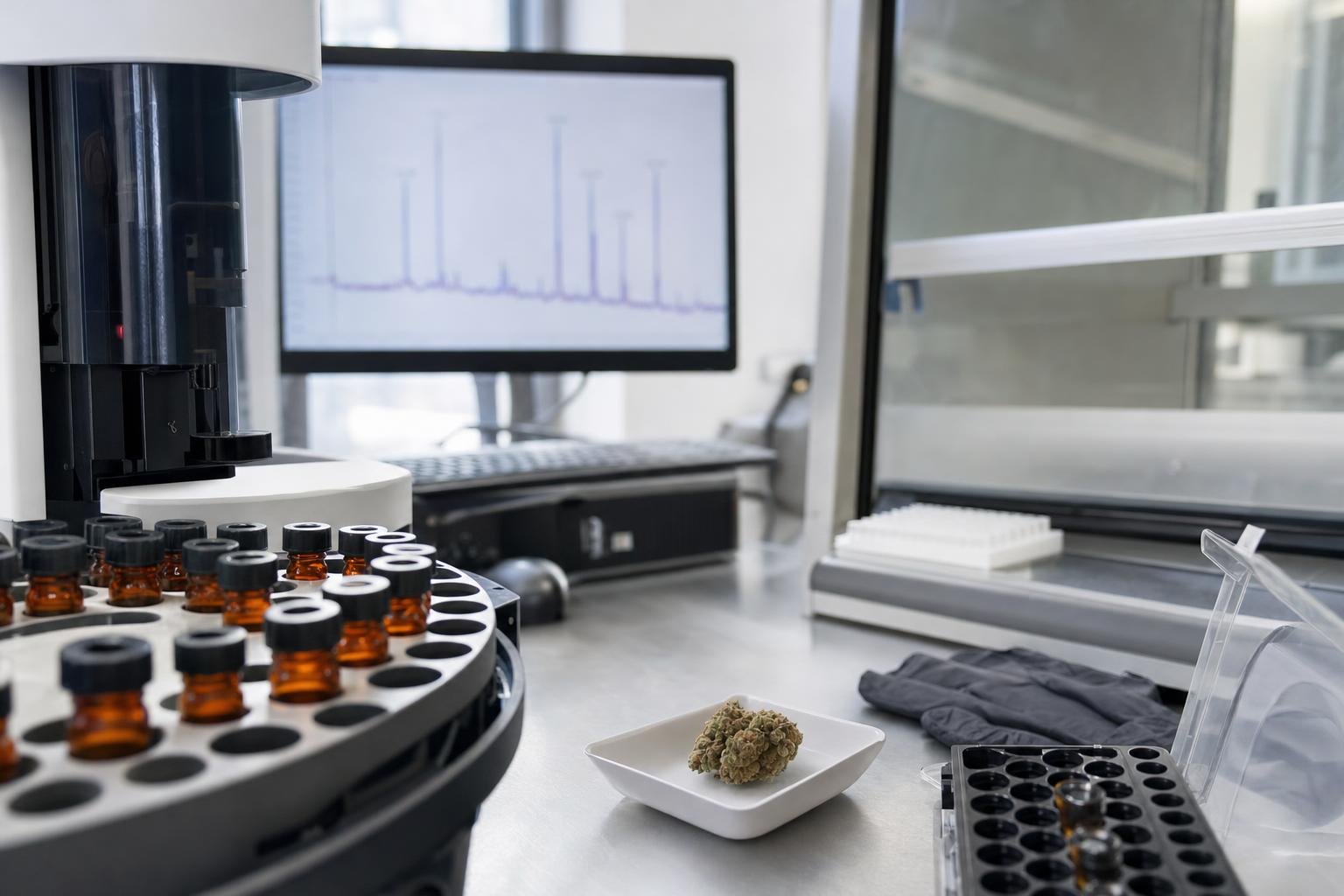
Method validation is the documented proof that your analytical procedure actually measures what you claim it measures, in the matrix you are testing, at the concentrations that matter for compliance. Without it, every potency result you report and every pesticide clearance you issue rests on assumption rather than evidence. This article walks through the full validation workflow that cannabis testing labs must complete before a method goes live, using pesticide and potency methods as concrete worked examples.
Whether you are an analytical chemist building a validation package from scratch, a lab director preparing for an ISO/IEC 17025 accreditation assessment, or a quality manager auditing an inherited method, this article gives you the parameter-by-parameter framework you need. It is not written for consumers or investors. It is written for people who will actually run the experiments.
Here is what this article covers:
- The regulatory and accreditation baseline that makes validation mandatory
- Writing a validation protocol before you run a single sample
- The core parameters: selectivity, linearity, LOD, LOQ, accuracy, precision, matrix effects, carryover, and stability
- Worked differences between a potency (HPLC) and a pesticide (LC-MS/MS or GC-MS) validation
- How to structure a validation report that survives an audit
- When a validated method needs to be revalidated
Step 1: Understand the Regulatory and Accreditation Baseline
Before you pipette anything, you need to know what your jurisdiction actually requires, because the floor varies.
ISO/IEC 17025 is the international standard for testing laboratory competence. It requires laboratories to validate non-standard, laboratory-developed, and modified methods and to retain documented evidence that performance is fit for the intended purpose; for standard methods used within their intended scope, verification that the laboratory can properly perform the method is required. Multiple states have made this accreditation mandatory for cannabis testing labs. Nevada requires accreditation within one year of licensure and directs labs to use AOAC, USDA, or equivalent third-party-validated methods when available. California requires ISO/IEC 17025 accreditation. Maryland requires ISO/IEC 17025 accreditation from an ILAC-recognized body. New York’s Cannabis Laboratory Quality System Standard requires a documented quality system addressing all five components of the current ISO/IEC 17025 standard.
On top of the accreditation requirement, states layer method-specific rules. Pennsylvania guidance requires methods to be fully validated for accuracy, precision, specificity, linearity, range, and sensitivity. Minnesota requires methods to be based on published peer-reviewed procedures, independently validated for cannabis testing, and internally verified by the licensed laboratory using AOAC Official Methods of Analysis appendices. New Jersey identifies AOAC SMPR 2018.011 as a pesticide-method validation benchmark that labs may use; check the NJ-CRC for the current operative potency-method requirements, as guidance in that state has been updated.
The practical takeaway: look up your state’s current regulator page before you design your validation protocol, because the acceptance criteria you write into the protocol must satisfy both ISO/IEC 17025 and your jurisdiction’s specific rules. For ISO 17025 audit preparation, see our ISO 17025 audit guide.
Note: If you are validating a method for hemp-derived products, check whether your state’s action limits differ from its marijuana limits. The applicable regulatory threshold directly determines the LOQ you must achieve.
Step 2: Write the Validation Protocol Before You Run Anything
This is the step most labs skip or do badly, and it is the one that kills validation packages during audits.
A validation protocol is a prospective document. You write it before the experiments, not after. It defines the scope and acceptance criteria so that the data either passes or fails against a predetermined standard, rather than being interpreted after the fact to support a conclusion you already wanted.
New York’s Laboratory Quality System Standard describes what a validation protocol should contain. At minimum, document:
- The intended matrix or matrices (flower, concentrate, edible, tincture)
- The target analytes and their concentration range
- The instrument platform and sample preparation procedure
- The calibration model you will use (linear, quadratic, weighted)
- The quality control materials and their sources
- The acceptance criteria for each parameter, stated as pass/fail thresholds
- The statistical treatment you will apply to the data
- The reporting limits you intend to claim
A protocol written after the data exists is not a protocol. It is a narrative, and an assessor will treat it as one.
For a pesticide method, the protocol should also name the specific analyte list and the regulatory action limits that your LOQ must fall below. For a potency method, it should define which cannabinoid forms the method is designed to measure, because this has direct implications for how you validate a GC-based platform (more on that in Step 3).
Note: If you are adapting a published AOAC or ASTM method rather than developing one from scratch, you still need an internal verification protocol. Minnesota explicitly requires internal verification even when a published peer-reviewed method is used as the basis.
Step 3: Run the Core Validation Parameters
Validation is not a single experiment. It is a structured series of experiments, each designed to characterize one aspect of method performance, and every parameter must be documented with raw data, calculations, and a pass or fail conclusion against the criterion you set in the protocol.
Here are the parameters you must address, with notes on how they play out differently for potency versus pesticide methods.
Selectivity (the ability of the method to measure the target analyte without interference from other components) is demonstrated by analyzing blank matrix, potential interferents, and the target analytes together. Pennsylvania guidance lists specificity as a required validation parameter. For an HPLC potency method, you are demonstrating that THCA and delta-9-THC peaks are resolved from each other and from other cannabinoids. For an LC-MS/MS pesticide method, you are confirming that the selected reaction monitoring transitions are free from isobaric (same nominal mass) interferences in cannabis matrix.
Linearity (the proportional relationship between analyte concentration and instrument response across the working range) is evaluated by preparing calibrators at multiple concentration levels spanning the intended reporting range and fitting a calibration model. Pennsylvania lists linearity as a required parameter. Your protocol should specify the minimum number of calibration levels, the acceptable residuals, and the goodness-of-fit criterion. For pesticide methods with wide dynamic ranges, a weighted regression or quadratic fit may be more appropriate than a simple linear model.
LOD and LOQ (limit of detection: the lowest concentration distinguishable from background; limit of quantitation: the lowest concentration measurable with defined accuracy and precision) must be determined experimentally and tied to the regulatory context. A 2025 peer-reviewed validation study evaluated cannabis pesticide methods for LOQs alongside linearity and precision. Your LOQ for each analyte must sit below the applicable state action limit; if it does not, you cannot report a compliant result for that analyte.
Accuracy and spike recovery are evaluated by fortifying (adding a known amount of analyte to) a blank or low-background matrix and comparing the measured result to the added amount. There is no single universal recovery range that applies across all cannabis methods and jurisdictions. A 2025 peer-reviewed study found that most pesticide analytes showed recoveries between 60% and 120% in cannabis and hemp matrices, but some analyte-matrix combinations performed substantially worse. Your acceptance criterion should come from the applicable AOAC SMPR, your state’s regulator, or a scientifically justified laboratory SOP. AOAC SMPR 2018.011 sets performance targets specifically for pesticide residues in dried cannabis flower and is a defensible benchmark.
Repeatability (precision measured by the same analyst on the same instrument in the same run) and intermediate precision (precision measured across changes in analyst, day, instrument, or calibration) together characterize how stable your results are under real laboratory conditions. For compliance methods, intermediate precision matters more than repeatability, because your method will be run by multiple analysts over months or years.
Matrix effects (changes in detector response caused by co-extracted cannabis components) are a serious concern for LC-MS/MS pesticide methods, where ion suppression or ion enhancement can shift apparent analyte concentrations without triggering an obvious instrument alarm. A 2025 peer-reviewed study specifically evaluated ion suppression in cannabis matrices for LC-MS/MS and GC-MS/MS pesticide methods. Isotopically labeled internal standards (compounds identical to the target analyte but with heavier atoms substituted so they can be distinguished by mass) compensate for matrix effects when they are available. When they are not, matrix-matched calibration is the next best option.
Carryover (residual analyte signal from a previous high-concentration injection contaminating the next injection) is tested by injecting a solvent blank immediately after a high-concentration standard or sample and confirming that the residual signal does not exceed a defined threshold relative to the LOQ. Documenting carryover testing is good practice and is expected in a complete validation package reviewed under ISO/IEC 17025.
Stability covers prepared standards, stock solutions, processed extracts, and representative cannabis materials under the storage conditions and time intervals your laboratory actually uses. If your extracts are held overnight before analysis, you need data showing that analyte concentrations are stable over that interval. Pennsylvania guidance includes a separate stability-testing section addressing final products, and your validation should address the stability of your working solutions and extracts under actual laboratory conditions.
Note: For edibles and concentrates, matrix effects and extraction recovery can differ substantially from flower. If your method scope includes multiple matrix types, you must validate each one separately or provide bridging data demonstrating that performance is equivalent.
Step 4: Apply the Validation Framework to Potency and Pesticide Methods Specifically
Potency and pesticide methods share the same validation parameter list but differ in instrument platform, analyte behavior, and the regulatory stakes of a false result.
Potency methods in cannabis labs most commonly use HPLC or UHPLC (ultra-high-performance liquid chromatography) as chromatographic platforms, as Pennsylvania guidance identifies. New York also identifies ASTM D8375-18, which uses LC-MS/MS. For HPLC potency methods, the selectivity challenge is resolving cannabinoids with overlapping spectra, particularly CBDA and CBD, or THCA and delta-9-THC. Your validation must demonstrate baseline resolution or, if peaks are not fully resolved, that the integration method produces accurate results.
For GC-based potency methods, the situation is more nuanced than it might appear. GC-based cannabinoid methods do not universally require prior decarboxylation. Acidic cannabinoids such as THCA can be analyzed by GC after chemical derivatization, preserving their acidic form. Non-derivatized GC commonly causes thermal decarboxylation (heat-driven conversion of the acidic cannabinoid to its neutral form) in the injector, so the method may measure neutral cannabinoids or a combined total depending on conditions. A laboratory using a GC potency method must explicitly define in its validation protocol whether the method measures native acidic cannabinoids, thermally converted neutral cannabinoids, derivatized acidic cannabinoids, or a calculated total-cannabinoid result, and must validate the method as defined. Pennsylvania guidance identifies chromatographic technologies without prescribing a universal GC decarboxylation requirement. See our technical overview of potency determination and cannabinoid separation methods for more on HPLC platform choices.
Pesticide methods carry higher consequence for false negatives because a missed pesticide can result in a product recall or patient harm. Pennsylvania guidance lists LC, GC/MS, and electron-capture detection among approaches for pesticide-residue analysis. LC-MS/MS is the dominant platform for multi-residue pesticide panels because it handles polar, thermally labile compounds that GC cannot resolve cleanly. Your validation must cover every analyte on your state’s action-limit list, and the LOQ for each analyte must sit below its action limit. For our detailed pesticide testing overview, see our pesticide testing guide.
Note: New Jersey identifies AOAC SMPR 2017.002 for usable cannabis, SMPR 2017.001 for concentrates, and SMPR 2017.019 for chocolate edibles as potency-validation benchmarks. If your scope includes edibles, you need matrix-specific validation data, not a transfer from flower.
Step 5: Structure the Validation Report and Know When to Revalidate
A validation report is not a summary. It is a traceable record that connects every claimed performance characteristic to the raw data that supports it.
New York’s Laboratory Quality System Standard requires written procedures for method validation and submission of validation documentation including study designs, summary results, raw-data materials, and method documentation. An assessor reviewing your validation package should be able to follow the chain from a single data point through the calculation to the pass or fail conclusion without asking you to explain anything.
Organize the report in the same order as the protocol. For each parameter: state the acceptance criterion, present the data, show the calculation, and state the conclusion. If a parameter failed and you revised the method, document the revision and repeat the affected experiments. Do not delete failing data.
The scope statement at the end of the report is as important as the data, because it defines the boundaries within which the method is valid and outside which it must not be used without additional validation.
Revalidation is required when something material changes. Minnesota requires validation or verification documentation for new testing methods and requires method verification to demonstrate sufficient specificity and sensitivity to meet applicable reporting limits. Common triggers in cannabis labs include a new instrument of the same class, a change in extraction solvent, a new product matrix added to scope, or a state regulator lowering an action limit below your current LOQ. A full revalidation is not always required for minor changes, but you need a documented change-control assessment that justifies whatever subset of parameters you choose to rerun.
For a broader look at compliance testing workflows, see our introduction to cannabis compliance testing and the lab directory if you are evaluating external validation support.
Quick answers
What parameters must be validated for a cannabis pesticide method? A cannabis pesticide method must demonstrate selectivity, linearity, LOD, LOQ, accuracy (spike recovery), repeatability, intermediate precision, matrix effects, carryover, and stability before it can be used for compliance reporting. States including Minnesota require internal verification to follow AOAC Official Methods of Analysis appendices and applicable standard method performance requirements. The exact acceptance criteria depend on the applicable AOAC SMPR, state regulation, or your laboratory’s accreditation scope.
What spike recovery range is acceptable for cannabis pesticide validation? There is no single universal recovery range that applies across all cannabis pesticide methods and jurisdictions. A 2025 peer-reviewed validation study found most pesticide analytes showed recoveries between 60% and 120% in cannabis and hemp matrices, with some analyte-matrix combinations performing substantially worse. Your acceptance window should be defined by the applicable AOAC SMPR, state regulator rule, or a scientifically justified laboratory SOP.
Do GC-based potency methods require decarboxylation before injection? No, GC-based cannabinoid methods do not universally require prior decarboxylation. Acidic cannabinoids such as THCA can be analyzed by GC after chemical derivatization, while non-derivatized GC commonly causes thermal decarboxylation in the injector and may measure neutral cannabinoids or a total cannabinoid result depending on method conditions. A lab using a GC potency method must explicitly define which form of each cannabinoid the method is measuring and validate accordingly.
Does ISO/IEC 17025 accreditation cover method validation for cannabis labs? ISO/IEC 17025 requires laboratories to validate non-standard, laboratory-developed, and modified methods and to document that performance is fit for the intended purpose, which is why accreditation and method validation are inseparable. States including Nevada and Maryland require cannabis testing labs to hold ISO/IEC 17025 accreditation from an ILAC-recognized body, and California requires ISO/IEC 17025 accreditation as well. The accreditation assessment will review your validation records, so a thin validation package is a direct audit risk.
What is the difference between LOD and LOQ in cannabis method validation? The limit of detection (LOD) is the lowest concentration at which an analyte can be reliably distinguished from background noise, while the limit of quantitation (LOQ) is the lowest concentration that can be measured with predefined accuracy and precision. For pesticide methods, your LOQ must sit below the applicable state regulatory action limit for each analyte on your panel. Reporting a result as non-detected when your LOQ sits above a state action limit is a compliance failure, not a passing result.
What is AOAC SMPR 2018.011 and why does it matter for cannabis labs? AOAC SMPR 2018.011 is the Standard Method Performance Requirement for identification and quantification of selected pesticide residues in dried cannabis flower, and it sets the minimum performance targets a method must meet to be considered fit for that matrix. New Jersey’s Cannabis Regulatory Commission identifies it as a pesticide-method validation benchmark that labs may use. Meeting an AOAC SMPR gives your method a defensible, publicly available performance standard that regulators and accreditation bodies recognize.
Sources
- Nevada Cannabis Compliance Board Regulation 11
- California Department of Cannabis Control testing-laboratory guidance
- Maryland Cannabis Administration Technical Authority
- New York Cannabis Laboratory Quality System Standard
- New Jersey Cannabis Regulatory Commission Testing Guidance
- New Jersey Cannabis Regulatory Commission approved guidance page
- Pennsylvania Office of Medical Marijuana testing guidance
- Peer-reviewed cannabis pesticide validation study (PMC12227361)
- Peer-reviewed cannabis pesticide validation study (PubMed 40498357)
- Minnesota Office of Cannabis Management Cannabis Technical Authority
- ISO/IEC 17025 standard page
FAQ
Frequently asked
- What parameters must be validated for a cannabis pesticide method?
- A cannabis pesticide method must demonstrate selectivity, linearity, LOD, LOQ, accuracy (spike recovery), repeatability, intermediate precision, matrix effects, carryover, and stability before it can be used for compliance reporting. States including Minnesota require internal verification to follow AOAC Official Methods of Analysis appendices and applicable standard method performance requirements. The exact acceptance criteria depend on the applicable AOAC SMPR, state regulation, or your laboratory's accreditation scope.
- What spike recovery range is acceptable for cannabis pesticide validation?
- There is no single universal recovery range that applies across all cannabis pesticide methods and jurisdictions. A 2025 peer-reviewed validation study found most pesticide analytes showed recoveries between 60% and 120% in cannabis and hemp matrices, with some analyte-matrix combinations performing substantially worse. Your acceptance window should be defined by the applicable AOAC SMPR, state regulator rule, or a scientifically justified laboratory SOP.
- Do GC-based potency methods require decarboxylation before injection?
- No, GC-based cannabinoid methods do not universally require prior decarboxylation. Acidic cannabinoids such as THCA can be analyzed by GC after chemical derivatization, while non-derivatized GC commonly causes thermal decarboxylation in the injector and may measure neutral cannabinoids or a total cannabinoid result depending on method conditions. A lab using a GC potency method must explicitly define which form of each cannabinoid the method is measuring and validate accordingly.
- Does ISO/IEC 17025 accreditation cover method validation for cannabis labs?
- ISO/IEC 17025 requires laboratories to validate non-standard, laboratory-developed, and modified methods and to document that performance is fit for the intended purpose, which is why accreditation and method validation are inseparable. States including Nevada and Maryland require cannabis testing labs to hold ISO/IEC 17025 accreditation, and California requires it as well. The accreditation assessment will review your validation records, so a thin validation package is a direct audit risk.
- What is the difference between LOD and LOQ in cannabis method validation?
- The limit of detection (LOD) is the lowest concentration at which an analyte can be reliably distinguished from background noise, while the limit of quantitation (LOQ) is the lowest concentration that can be measured with predefined accuracy and precision. For pesticide methods, your LOQ must sit below the applicable state regulatory action limit for each analyte on your panel. Reporting a result as non-detected when your LOQ sits above a state action limit is a compliance failure, not a passing result.
- What is AOAC SMPR 2018.011 and why does it matter for cannabis labs?
- AOAC SMPR 2018.011 is the Standard Method Performance Requirement for identification and quantification of selected pesticide residues in dried cannabis flower, and it sets the minimum performance targets a method must meet to be considered fit for that matrix. New Jersey's Cannabis Regulatory Commission identifies it as a pesticide-method validation benchmark that labs may use. Meeting an AOAC SMPR gives your method a defensible, publicly available performance standard that regulators and accreditation bodies recognize.
Related guides
All guides- 01
Cannabis Lab 101: Cannabis Edibles Testing Cost — Why Infused Products Cost More to Test
I spent four years running potency assays on everything from flower to fudge, and infused products always took longer and cost more. Here is exactly why — matrix effects, homogeneity requirements, and the extra sample prep no one explains — plus real prices from published lab menus.
- 02
Cannabis Lab 101: Cannabis Lab Record Retention (What to Keep, How Long, and What Auditors Actually Inspect)
I break down which laboratory records a cannabis testing lab must retain, for how long, and in what format to survive a state regulatory audit or an ISO/IEC 17025 surveillance assessment, covering raw data, chromatograms, COAs, chain-of-custody forms, training files, and corrective action records.
- 03
Cannabis Lab 101: Cannabis Lab Technician Salary by State and Role
I pulled every sourced number I could find from ZipRecruiter, Indeed, and Salary.com to build a real salary table by role — from sample-prep tech to lab manager. Here is what the data actually says, what drives the spread, and how to negotiate your next offer.
Need this tested?
Compare labs that run these assays and get quotes in one go — no account, no fee.