· 11 min read
Cannabis Lab 101: Pesticide Testing (LC-MS/MS vs GC-MS/MS) and Why You Need Both
I spent years running pesticide panels on cannabis flower and learned fast that no single instrument platform covers the full analyte list. This guide walks through QuEChERS extraction, matrix effects, why GC-MS/MS handles what LC-MS/MS cannot, and what California's §15719 actually requires your LOQ to be.
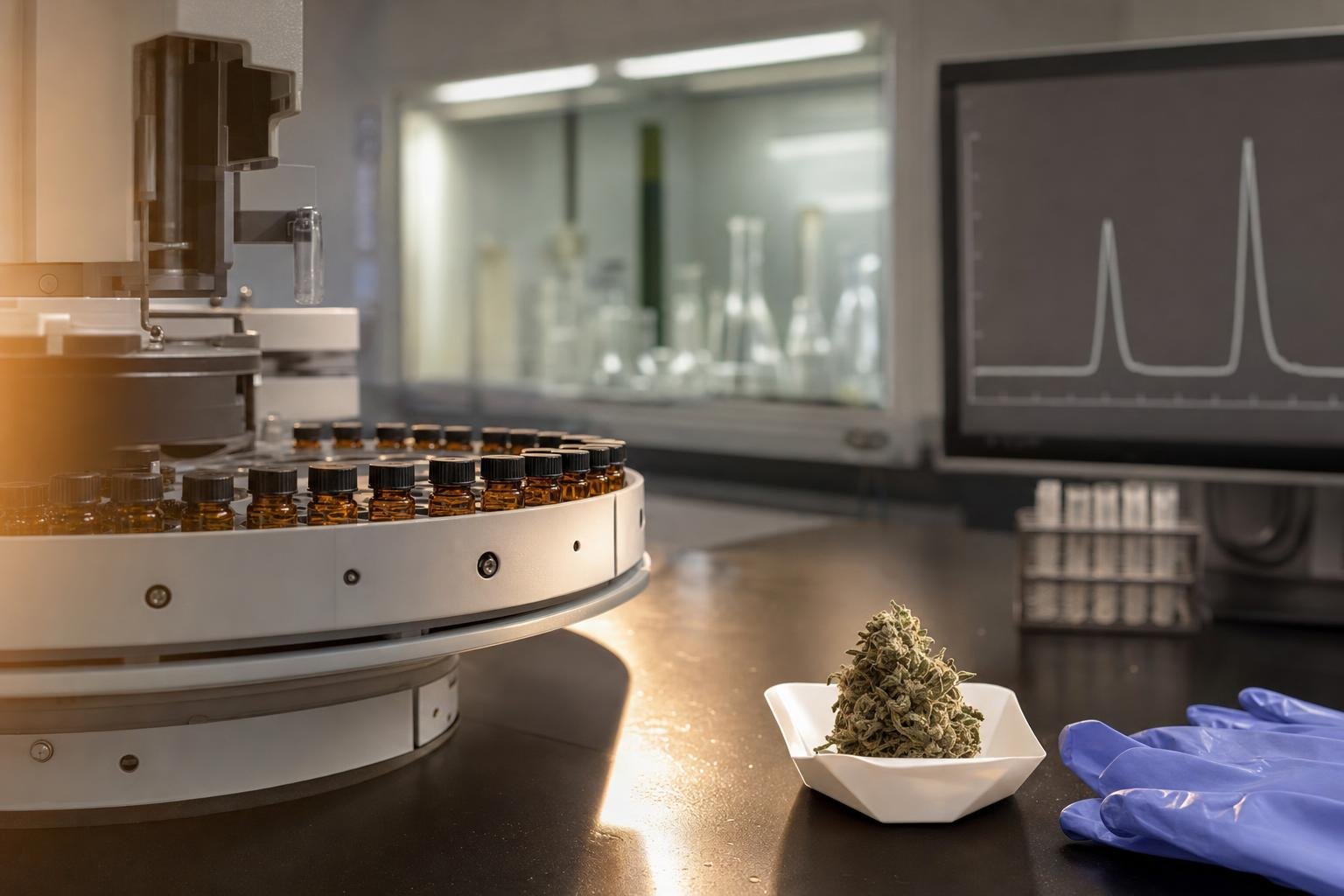
Pesticide testing is the compliance category that humbles labs the most. You can have a beautiful potency method, a clean heavy-metals run, and a tight microbials workflow, and then your pesticide panel falls apart because you underestimated the cannabis matrix or tried to cover the full analyte list with one instrument platform. This guide is the practitioner companion to the detailed pesticide testing overview already on this site. Here I go deeper on the analytical chemistry: why QuEChERS (Quick, Easy, Cheap, Effective, Rugged, Safe, a dispersive solid-phase extraction technique originally developed for food commodities) is not a plug-and-play solution for cannabis flower, why the LC-MS/MS and GC-MS/MS split exists, and what California’s §15719 actually demands from your LOQ.
Whether you are a bench technician setting up a pesticide method for the first time, a lab director validating a combined LC/GC platform, or a grower trying to understand why your lab charges what it charges and why a failure is so consequential, this article gives you the analytical and regulatory framework you need. You will not need anything else open.
Here is what this article covers:
- Why the cannabis matrix makes pesticide extraction harder than food matrices
- How QuEChERS works and where it breaks down for flower
- The LC-MS/MS vs GC-MS/MS split and which analyte properties drive the decision
- Matrix effects: what they are, how they corrupt your data, and how matrix-matched calibration fixes them
- California §15719 LOQ requirements, effective dates, and pass/fail consequences
- What to look for when reviewing a pesticide COA as a grower or manufacturer
Step 1: Understand Why Cannabis Flower Is a Difficult Pesticide Matrix
Before you touch an instrument, you need to respect the matrix. Cannabis flower is not a tomato. It contains high concentrations of cannabinoids, terpenes, waxes, chlorophylls, and lipids, and those co-extractants do not stay behind when you extract pesticide residues. They come along for the ride, and they cause problems downstream.
The core issue is that cannabis co-extractants compete with your pesticide analytes for ionization in the mass spectrometer source, and they win. This is what analytical chemists call a matrix effect: the signal you measure for a pesticide is not proportional to its true concentration because something else in the extract is suppressing or enhancing the ionization. You can have a perfectly linear calibration curve in clean solvent and still report a wrong number if you have not accounted for the matrix.
This is not a hypothetical. A peer-reviewed 96-pesticide validation study in cannabis found that matrix effects in cannabis flower were severe enough to prevent reliable quantification of GC-amenable analytes after QuEChERS extraction. The study used matrix-matched calibration (standards prepared in a blank cannabis extract rather than in clean solvent) as the primary mitigation strategy, and it used 10 internal standards to track and correct for variability across the run.
The lesson for lab directors: your method validation must include a matrix-effects assessment, and your calibration strategy must account for the result. If you are validating a new pesticide method, the method validation guide on this site walks through the general framework.
Note: Matrix composition varies with cultivar and product type. A high-THC flower extract and a CBD-dominant extract are not the same matrix. If your lab tests both, consider whether your matrix-matched calibrators represent the range of samples you actually run. Concentrates and edibles introduce additional co-extractants (fats, sugars, ethanol residues) that require separate validation work.
Step 2: Run QuEChERS Correctly and Know Its Limits
QuEChERS became popular in pesticide residue labs because it is fast, uses relatively little solvent, and scales well. The basic workflow is: add acetonitrile to the homogenized sample, shake, add a salt packet (typically magnesium sulfate and sodium chloride) to drive phase separation, centrifuge, then clean up the acetonitrile layer with dispersive-SPE (solid-phase extraction) sorbents to remove pigments, lipids, and other interferences.
For cannabis leaves and oil, published data supports QuEChERS as a workable extraction approach. For cannabis flower, the same published work found that QuEChERS produced high matrix effects that prevented reliable quantification of GC-amenable analytes. The flower matrix is simply too complex for the standard cleanup to handle adequately without additional steps.
If you are running QuEChERS on flower, you must validate recovery and matrix effects for your specific cleanup configuration, not assume that a food-matrix QuEChERS protocol transfers directly.
Practical implications for your method development:
- Use matrix-matched calibration as your baseline, not solvent calibration with a post-hoc correction factor.
- Include isotopically labeled internal standards (compounds with heavy isotopes such as deuterium or carbon-13 substituted at specific positions, used to track extraction and ionization variability) for as many analyte classes as your budget allows. The validated 96-pesticide method used 10 internal standards across the panel.
- Homogenize your sample thoroughly before extraction. California §15719(a) requires analysis of at least 0.5 g of the representative sample; your homogenization step determines whether that 0.5 g is actually representative.
- Document your cleanup sorbent choice and lot number. Sorbent performance varies, and a lot change mid-validation is a revalidation trigger.
Note: Hemp-derived products and marijuana-derived products may arrive at the lab with very different cannabinoid and terpene profiles. If your lab accepts both, your matrix-matched calibrators need to reflect that range.
Step 3: Assign Analytes to LC-MS/MS or GC-MS/MS Based on Chemistry, Not Convenience
This is where I see the most confusion from labs that are new to pesticide testing. The question is not “which instrument do we already have” but “which instrument does each analyte actually need.”
LC-MS/MS (liquid chromatography coupled to tandem mass spectrometry) ionizes analytes in solution, typically using electrospray ionization (ESI, where a high-voltage needle sprays the liquid eluent into charged droplets that evaporate to produce gas-phase ions). It excels at polar, thermally labile, and high-molecular-weight compounds that would degrade or not volatilize in a GC inlet. Most carbamate insecticides, many systemic fungicides, and several neonicotinoids (a class of systemic insecticides that act on insect nicotinic acetylcholine receptors) fall into this category.
GC-MS/MS (gas chromatography coupled to tandem mass spectrometry) requires analytes to be volatile and thermally stable enough to survive injection at elevated temperatures and travel through a heated column. Organochlorine pesticides, many organophosphates, and pyrethroids (synthetic insecticides modeled on natural pyrethrins) are classical GC analytes.
The validated 96-pesticide cannabis method split the panel between LC-MS/MS and GC-MS/MS precisely because no single platform gave reliable quantification across all analyte classes. This is not a regulatory mandate; it is an analytical reality. If your state’s required analyte list includes both polar systemic fungicides and nonpolar organochlorines, you need both platforms or you need a very well-justified argument for why one platform covers the other’s analytes in your validated method.
For the current California analyte list and action levels, go directly to Title 4, CCR §15719 Table 1 and count the analytes yourself. The fact sheet for this article confirmed that a specific analyte count cannot be reliably cited from secondary sources; the DCC regulation text is the authoritative source and it is updated as rulemaking proceeds.
Note: Other states have their own required analyte lists with different compounds and different action levels. I am not a lawyer and this is not legal advice: check your state’s cannabis regulator directly. The compliance overview on this site lists major state programs.
Step 4: Meet California’s LOQ Requirements Under §15719
California’s pesticide-testing regulation has a two-phase LOQ structure that became effective October 1, 2026, following the DCC-2025-03-R rulemaking.
Phase 1 (now through March 31, 2028): Under §15719(c)(1), your laboratory-established LOQ (limit of quantification, the lowest concentration at which the method can reliably measure an analyte with acceptable precision and accuracy) for each pesticide in Table 1 must be at or below that pesticide’s listed action level. The requirement is analyte-specific: if a pesticide has an action level of 0.05 µg/g, your LOQ for that analyte must be at or below 0.05 µg/g. There is no single universal LOQ threshold for this phase; you must meet the action level for each analyte individually.
Phase 2 (from April 1, 2028): Under §15719(d)(1), the rule tightens for Table 2 analytes. When a Table 2 pesticide’s action level is at or above 0.10 µg/g, your LOQ must be at or below 0.10 µg/g. When the action level is below 0.10 µg/g, your LOQ must still be at or below the listed action level. This is the conditional 0.10 µg/g structure, and it applies to Table 2 starting in 2028, not to the current Table 1 period.
Pass/fail is straightforward: a sample passes when detected residues do not exceed the applicable action levels per §15719(c)(2) and (d)(2). If a sample fails, the entire batch fails and may not be released for retail sale under §15719(e). The laboratory must report results in µg/g and mark pass or fail on the certificate of analysis per §15719(b).
For growers and manufacturers reading this: a pesticide failure is not a paperwork problem. It is a batch hold. The California Department of Pesticide Regulation provides guidance on which pesticides are registered for use on cannabis in California; using an unregistered pesticide is the most common route to a failure.
Step 5: Build Your QC Program Around the Matrix, Not the Instrument
Once your method is validated and your instruments are qualified, the ongoing QC program is what keeps your data defensible. For a pesticide panel running across two instrument platforms, that means coordinating QC across both.
At minimum, each analytical batch should include:
- A method blank (a sample of clean matrix carried through the full extraction and analysis procedure to check for contamination) to confirm no carryover or background contamination from reagents or glassware.
- A matrix-matched calibration curve for each platform, prepared fresh or verified against a stored curve with a calibration verification standard.
- A matrix spike (a known amount of pesticide standard added to a blank cannabis matrix before extraction) to assess recovery for that batch. Recovery outside your validated acceptance window is a flag to investigate before reporting.
- A continuing calibration verification (CCV, a mid-level standard analyzed periodically during a run to confirm the calibration remains stable) at a frequency your SOP specifies.
The matrix spike recovery is your early-warning system for extraction problems, and it is the first thing a state auditor or ISO 17025 assessor will ask to see. If your recoveries are drifting, the problem is usually in the extraction, not the instrument. Check your sorbent lot, your acetonitrile water content, and your centrifuge speed before you start chasing instrument parameters.
For ISO 17025 accreditation context, the ISO 17025 audit preparation guide on this site covers what assessors look for in method documentation and QC records. Pesticide methods are among the most scrutinized because the action levels are low, the matrices are complex, and the consequences of a false negative are significant.
Note: Proficiency testing (PT, where an external provider sends blind samples to your lab and evaluates your results against other participants) is required for accreditation and is a real-world check on whether your matrix-matched calibration is working. If you are consistently biased high or low on PT samples for a specific analyte class, that is a method problem, not bad luck.
Quick answers
What is the LOQ requirement for pesticide testing in California cannabis labs? Under California Title 4, CCR §15719(c)(1), a licensed laboratory must establish its LOQ for each pesticide at or below that pesticide’s listed action level in Table 1. This requirement applies until April 1, 2028, when Table 2 and its associated LOQ rules take over. The regulation does not set a single universal LOQ threshold; the limit is analyte-specific.
Why do cannabis pesticide labs use both LC-MS/MS and GC-MS/MS instead of one instrument? Different pesticides have different volatility, polarity, and ionization behavior, meaning no single chromatographic platform gives reliable quantification across a full compliance panel. A peer-reviewed 96-pesticide cannabis method split analytes between LC-MS/MS and GC-MS/MS precisely because some compounds performed poorly on one platform alone. Running both platforms is the validated approach for broad-spectrum panels.
What is QuEChERS and does it work for cannabis flower pesticide testing? QuEChERS (Quick, Easy, Cheap, Effective, Rugged, Safe) is a dispersive solid-phase extraction technique originally developed for food matrices. It works well for cannabis leaves and oil, but published research found it produced high matrix effects that prevented reliable quantification of GC-amenable pesticides in cannabis flower specifically. Labs using QuEChERS for flower should validate carefully and use matrix-matched calibration.
What happens to a California cannabis batch that fails pesticide testing? Under California Title 4, CCR §15719(e), if a sample fails residual-pesticide testing, the entire batch from which it was collected fails and may not be released for retail sale. There is no automatic remediation pathway built into the pesticide rule; the batch is held. The licensed laboratory must report results in µg/g and indicate pass or fail on the certificate of analysis per §15719(b).
What is a matrix effect in cannabis pesticide testing and why does it matter? A matrix effect occurs when co-extracted cannabis compounds suppress or enhance the ionization signal of a pesticide analyte in the mass spectrometer, causing the instrument to over- or under-report the true concentration. In cannabis flower, matrix effects are significant enough that solvent-based calibration curves can give wrong answers. Matrix-matched calibration, where standards are prepared in a blank cannabis extract, is the standard mitigation strategy.
When did California’s updated pesticide testing rules take effect? California’s DCC-2025-03-R pesticide-testing amendments were filed with the Secretary of State on July 27, 2026, and became effective October 1, 2026. The current Table 1 LOQ requirements apply until April 1, 2028, when Table 2 and its associated LOQ rules take over. The DCC rulemaking page tracks the full implementation history.
Sources
- California DCC: Title 4, CCR §15719 (current regulation text)
- California DCC: DCC-2025-03-R rulemaking status and history
- California DCC: DCC-2025-03-R final regulation text
- California DCC: DCC-2025-03-R Final Statement of Reasons
- California Department of Pesticide Regulation: Pesticide guidance for cannabis
- Blais et al., “Quantitative determination and validation of 96 pesticides in dried cannabis flower” (PMC12227361)
FAQ
Frequently asked
- what is the LOQ requirement for pesticide testing in California cannabis labs
- Under California Title 4, CCR §15719(c)(1), a licensed laboratory must establish its LOQ for each pesticide at or below that pesticide's listed action level in Table 1. This requirement applies until April 1, 2028, at which point the stricter Table 2 rules take effect. The regulation does not set a single universal LOQ threshold; the limit is analyte-specific.
- why do cannabis pesticide labs use both LC-MS/MS and GC-MS/MS instead of one instrument
- Different pesticides have different volatility, polarity, and ionization behavior, meaning no single chromatographic platform gives reliable quantification across a full compliance panel. A peer-reviewed 96-pesticide cannabis method split analytes between LC-MS/MS and GC-MS/MS precisely because some compounds performed poorly on one platform alone. Running both platforms is the validated approach for broad-spectrum panels.
- what is QuEChERS and does it work for cannabis flower pesticide testing
- QuEChERS (Quick, Easy, Cheap, Effective, Rugged, Safe) is a dispersive solid-phase extraction technique originally developed for food matrices. It works well for cannabis leaves and oil, but published research found it produced high matrix effects that prevented reliable quantification of GC-amenable pesticides in cannabis flower specifically. Labs using QuEChERS for flower should validate carefully and use matrix-matched calibration.
- what happens to a California cannabis batch that fails pesticide testing
- Under California Title 4, CCR §15719(e), if a sample fails residual-pesticide testing, the entire batch from which it was collected fails and may not be released for retail sale. There is no automatic remediation pathway built into the pesticide rule; the batch is held. The licensed laboratory must report results in µg/g and indicate pass or fail on the certificate of analysis per §15719(b).
- what is a matrix effect in cannabis pesticide testing and why does it matter
- A matrix effect occurs when co-extracted cannabis compounds suppress or enhance the ionization signal of a pesticide analyte in the mass spectrometer, causing the instrument to over- or under-report the true concentration. In cannabis flower, matrix effects are significant enough that solvent-based calibration curves can give wrong answers. Matrix-matched calibration, where standards are prepared in a blank cannabis extract, is the standard mitigation strategy.
- when did California's updated pesticide testing rules take effect
- California's DCC-2025-03-R pesticide-testing amendments were filed with the Secretary of State on July 27, 2026, and became effective October 1, 2026. The current Table 1 LOQ requirements apply until April 1, 2028, when Table 2 and its associated LOQ rules take over. The DCC rulemaking page tracks the full implementation history.
Related guides
All guides- 01
Cannabis Lab 101: Stability Testing, Expiry Dates, and How Labs Set a Shelf Life
I spent years running compliance panels and watched stability testing get treated as an afterthought. This article breaks down real-time vs accelerated studies, what states actually require, how THC degrades over time, and what acceptance criteria your data must hit before a regulator will approve an expiration date.
- 02
Cannabis Lab 101: Foreign Matter and Visual Inspection, the Cheapest Test That Fails the Most Flower
I walk you through the microscopy method, the photos-in-words of what actually fails, and how pass/fail thresholds differ by state, so you can run the inspection correctly, document it defensibly, and understand why a single hair can reject a whole batch.
- 03
Cannabis Lab 101: Heavy Metals Testing by ICP-MS — Digestion, Limits, and Common Failures
I spent years running ICP-MS in a licensed cannabis lab and watched heavy-metals failures blindside operators who thought soil was the only risk. This guide covers microwave digestion, the big-four analytes, how state limits actually differ, and where contamination hides in vape products.
Need this tested?
Compare labs that run these assays and get quotes in one go — no account, no fee.