· 11 min read
Cannabis Lab 101: Cannabis Sample Homogenization Before Potency Testing (Grinders, Particle Size, and Cross-Contamination Control)
I walk through how cannabis testing labs physically prepare a flower sample so the analytical portion actually represents the submitted batch. Covers grinder types, target particle size, moisture and heat effects, sub-sample mass, and cross-contamination control between samples.
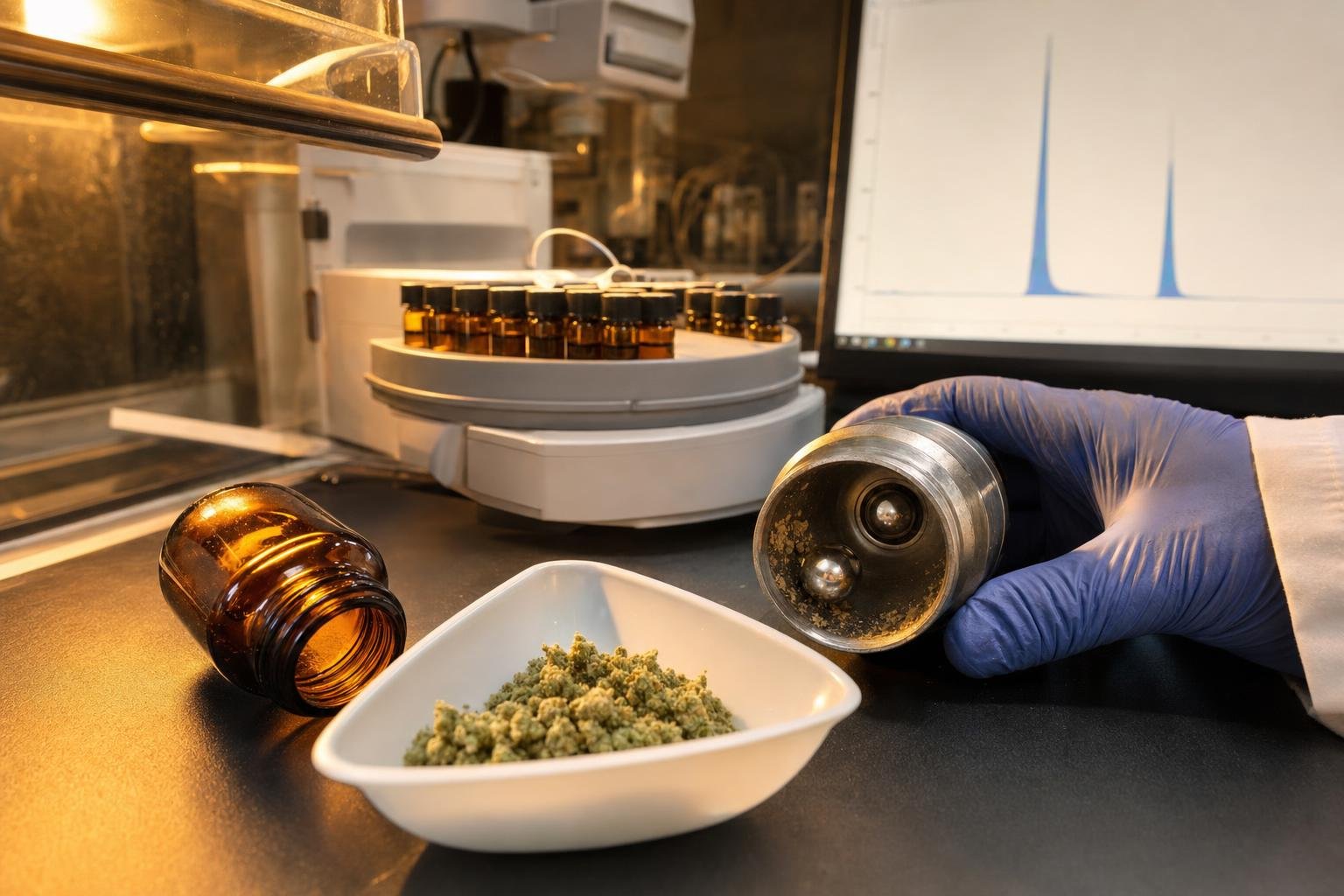
Homogenization is the step that decides whether your potency number means anything. You can run a perfectly calibrated HPLC with a five-point curve and an R-squared above 0.995, but if the 250 mg you extracted was pulled from a clump of leaf with no trichomes, the number on the certificate of analysis is wrong in a way the instrument will never flag. This article walks through how cannabis testing labs physically prepare a flower sample so the analytical portion actually represents the submitted batch, covering grinder types, target particle size, moisture and heat effects, sub-sample mass, and cross-contamination control between samples.
Whether you are a bench technician writing your first homogenization SOP, a lab director auditing an existing one, or a grower trying to understand why two labs returned different potency numbers on the same lot, this article gives you the procedural detail, the regulatory citations, and the instrument parameters you need to evaluate your current practice.
This article covers:
- Why flower is inherently non-homogeneous and what that means for your result
- Grinder classes and the parameters that distinguish them
- Target particle size, what the regulations actually say, and why the numbers differ
- Moisture, heat, and cryogenic pre-treatment
- Sub-sample mass and how it connects to extraction design
- Cross-contamination controls between samples
- How to trace high RSD back to sample prep rather than the instrument
Step 1: Understand Why Flower Needs Homogenization at All
Whole cannabis flower is not a uniform material. Trichome density varies across the bud, stems carry different cannabinoid concentrations than calyxes, and a single submitted sample can contain material from multiple positions on the plant. New York’s Office of Cannabis Management describes whole cannabis flower explicitly as non-homogeneous and naturally variable, requiring homogenization by grinding, quartering, and compositing before analysis. Maryland’s technical authority defines homogenization as manipulating a product by mixing and grinding to obtain equal distribution of components and reduce variability.
The practical consequence is this: if you weigh out 250 mg from an unground bud and a colleague weighs out 250 mg from the same bud, you are not testing the same material. The only way to make those two portions equivalent is to reduce the entire sample to a uniform particle size and mix it thoroughly before sub-sampling.
The instrument is not the source of error here; the sub-sample is.
This is also why high replicate RSD on potency results is one of the clearest diagnostic signals for a homogenization problem. If your instrument QC passes (calibration curve, check standard, system suitability) but your sample replicates are spread, look at the grind before you look at the column. For more on how potency methods are structured, see the technical overview of potency determination.
Step 2: Choose the Right Grinder Class for Your Matrix
Several grinder classes appear in cannabis laboratory practice, and each has different implications for throughput, heat generation, particle-size control, and cleanability.
Blade mills and food processors are inexpensive and widely available. Published milling research has used them as comparison instruments. Their limitations are real: blade geometry gives you limited control over final particle size, continuous operation generates heat, and the vessel geometry makes thorough cleaning between samples more difficult. They can work in a validated method if you document your cleaning protocol and verify it.
Mixer mills and vibrating mills use grinding balls inside sealed tubes. Retsch’s cannabis application note describes processing 4 g of dried flower per tube with two 15-mm steel grinding balls at 30 Hz for 3 minutes, achieving a grind size of 1 to 2 mm. Shimadzu’s cannabis application describes a vibrating mill with a special adapter that processes up to eight samples in conical centrifugal tubes per pass, using the same parameters: minus 20 degrees Celsius pre-freezing, 4 g per tube, two 15-mm steel balls, 30 Hz for 3 minutes, producing approximately 1 to 2 mm particles. The sealed-tube format limits cross-contamination between samples and makes throughput predictable.
Bead mills use active grinding media in conical tubes. A peer-reviewed hemp homogenization study placed flower in 50-mL conical tubes with active grinding media and evaluated processing at 25 Hz for cycles of 15, 30, 60, and 90 seconds total.
Blenders are recommended by New York for whole-flower composite preparation, specifically using an autoclavable jar, lid, blade, and collar in glass or stainless steel construction.
Note: No authoritative source in the reviewed material supports a universal claim that one grinder class is best for every cannabis matrix. Your choice should be driven by your validated method, your state’s requirements, and your throughput needs.
Step 3: Set and Validate Your Target Particle Size
The particle size you target is not a preference; it is a method parameter that directly controls extraction recovery and replicate precision.
Regulatory targets differ by jurisdiction, which is the first thing to internalize. California’s approved Standard Cannabinoids Test Method requires grinding to less than 1 mm using a tissue homogenizer or other size-reduction equipment capable of reaching that fineness. New York’s whole-flower guidance identifies approximately 3 to 5 mm as the desired particle size for its illustrated compositing procedure, which is a pre-grinding composite step before the final analytical grind. These are not contradictory; they describe different stages of a multi-step process, but they illustrate that you cannot assume one number applies everywhere.
On the analytical side, the data consistently favor finer particles. Shimadzu’s application data states that particles below 1 mm were sufficient to achieve very good reproducibility, and that shorter grinding producing approximately 2-mm particles could result in standard deviations of up to 12% in their illustrated comparison. The peer-reviewed hemp study reported that its active-media method produced 60.2% of particles below 1.25 mm and showed increased cannabinoid recovery compared with homogenates having larger average particle sizes.
For method validation, I suggest labs treat particle size as a variable to bracket: grind replicate portions to coarse, medium, and fine targets, extract each, and compare recovery and RSD. The particle size that gives you acceptable recovery and the tightest replicates is the one to lock into your SOP.
Note: California’s less-than-1-mm requirement applies to the final analytical grind. New York’s 3-to-5-mm guidance applies to the whole-flower compositing stage. Check your jurisdiction’s primary source before setting your SOP target.
Step 4: Control Moisture and Heat During Grinding
Heat is the enemy of accurate THCA measurement. Decarboxylation (the conversion of THCA to THC via loss of carbon dioxide) is a thermal process, and a grinder running hot enough to warm your sample meaningfully will shift the THCA-to-THC ratio before you ever reach the instrument. This matters because most potency calculations report both the acid and neutral forms, and a decarboxylation artifact in sample prep looks identical to a real result.
Both Retsch and Shimadzu specify deep-freezing cannabis flower at minus 20 degrees Celsius before their described milling procedures. Pre-freezing serves two purposes: it makes brittle plant material easier to reduce to a fine particle size, and it provides a thermal buffer against heat generated during milling. New York’s guidance recommends pulsing the blender for approximately 1 to 3 seconds with several seconds between pulses specifically to minimize heating of the composite sample.
The peer-reviewed hemp study reported no alteration of THCA or CBDA carboxylation states under its tested homogenization conditions, which used short processing cycles. That result is reassuring but specific to those conditions; it does not mean any grinding protocol is safe.
Pre-freeze your sample, use short processing cycles, and verify that your SOP’s conditions did not alter acid-form cannabinoids during your method validation.
Note: The reviewed sources establish freezing and heat-control parameters for specific procedures but do not provide a universal moisture-content threshold that applies to all cannabis flower grinding methods. If your state requires a moisture determination before grinding, follow that requirement and document it.
Step 5: Weigh Out Your Sub-Sample and Manage the Retained Portion
Once the sample is ground and mixed, you need to pull a reproducible sub-sample for extraction. The mass you take is set by your validated method and your state SOP, not by a universal standard.
Published research gives useful reference points. The peer-reviewed hemp study analyzed approximately 100-mg homogenate portions for sieve and HPLC assessment. A preprint milling study used approximately 3-g flower portions for milling and then pulled three aliquots of approximately 250 to 400 mg per milled sample for extraction, each extracted with 4 mL of methanol, vortexed and then sonicated (agitation via sound energy) for 15 minutes.
The critical point is that the sub-sample must be pulled from a well-mixed homogenate. Grinding produces a range of particle sizes, and the fines (the smallest particles) tend to settle or segregate. If you pull your 250-mg portion from the top of a pile that has stratified, you are not sampling the ground material representatively. Mix the ground material immediately before weighing.
For the retained portion: most states require the laboratory to retain a portion of the sample for a defined period in case of a retest or dispute. Your SOP should specify the retention mass, the container type, the storage temperature, and the retention period. Minnesota Rule 9810.3100 requires written SOPs describing collection of representative samples for each regulated product, which includes the retention and documentation chain.
Note: California’s approved method specifies that non-infused pre-roll testing includes the rolling paper in the homogenized sample. If you are testing pre-rolls, confirm whether your jurisdiction requires the same.
Step 6: Clean the Grinder and Prevent Cross-Contamination
A cannabis grinder that is not cleaned between samples is a cross-contamination vector. The risk is asymmetric: carry-over from a high-potency sample into a low-potency sample inflates the result; carry-over in the other direction deflates it. Either outcome is a compliance failure.
The preprint milling study cleaned blade-mill and food-processor vessels with ethanol and sonication between milling runs and used a different single-use container for each milling condition to avoid cross-contamination. New York’s guidance calls for aseptic combination of samples in a sterile blender jar and aseptic removal of microbiological portions.
Your cleaning SOP should define the solvent, the contact time, a drying or rinsing step, and a verification method such as a blank grind followed by extraction and injection.
For sealed-tube mixer-mill formats, single-use tubes eliminate vessel carry-over entirely, which is one practical advantage of that format. For blenders and blade mills, the geometry of the vessel matters: crevices around the blade hub are the hardest areas to clean and the most likely to retain material. Disassemble the blade assembly fully for cleaning if your equipment allows it.
The reviewed sources support cleaning, aseptic handling, and single-use-container controls but do not prescribe one universal solvent, contact time, or acceptance criterion for every laboratory. Your cleaning validation should demonstrate that the procedure reduces carry-over to below a level that would affect a reported result, and that demonstration should be documented in your ISO 17025 quality records.
Note: If your lab runs microbiological testing on the same homogenate as potency, the aseptic handling requirements for the micro portion drive the procedure for the whole sample. New York’s guidance directs laboratories to aseptically remove at least 20 doses for microbiological analyses before the remainder is used for potency and other contaminant testing.
Quick answers
What particle size should cannabis flower be ground to before potency testing? Target particle size depends on your jurisdiction and validated method. California’s approved cannabinoids test method requires grinding to less than 1 mm, while New York’s whole-flower guidance targets approximately 3 to 5 mm at the compositing stage. Vendor milling data and peer-reviewed work both show that finer particles improve extraction recovery and reduce variability, so treat particle size as a method parameter to validate rather than a single universal number.
How do labs prevent cross-contamination between cannabis samples during grinding? The most reliable controls are single-use containers for each sample and solvent cleaning of reusable vessel surfaces between runs. One published milling study cleaned blade-mill and food-processor vessels with ethanol and sonication between uses and used a different single-use container for each milling condition. Your SOP should define the cleaning solvent, contact time, and a verification step such as a blank grind followed by extraction.
Does grinding heat up cannabis and degrade THCA? Heat is a real risk with continuous high-speed grinding because decarboxylation converts THCA to THC and shifts your reported potency. One peer-reviewed hemp homogenization study reported no alteration of THCA or CBDA carboxylation states under its tested conditions, which used short processing cycles. Practical controls include cryogenic pre-freezing at minus 20 degrees Celsius and intermittent pulsing with rest periods between bursts.
How much sample mass does a lab actually weigh out for a potency extraction? Extraction mass is set by your validated method and state SOP, not by a universal standard. Published research has used portions in the range of roughly 250 to 400 mg per extraction aliquot from a milled bulk sample of approximately 3 g. Your method validation should confirm that the chosen mass sits within the linear range of your calibration curve and gives acceptable recovery and precision.
Why do my potency replicates have high relative standard deviation even when the instrument is performing well? High RSD on replicates that pass instrument QC almost always points upstream to sample preparation, and inadequate homogenization is the most common cause. If the ground material is uneven in particle size or the sub-sample is pulled from a non-representative portion of the grind, each replicate is effectively testing a slightly different material. Tightening grind consistency and mixing the homogenate thoroughly before sub-sampling are the first two things to audit.
Can I use a household blade grinder for cannabis potency sample prep? A household blade grinder can reduce particle size but gives you limited control over grind fineness, generates more heat than a cryogenic or mixer-mill approach, and is difficult to clean and verify between samples. Published milling research has used blade mills and food processors as comparison instruments and found that cleaning between uses with ethanol and sonication is necessary to control carry-over. For a validated compliance method, you need a device whose parameters you can document and reproduce run to run.
Sources
- California DCC Approved Standard Test Methods and Operating Procedures
- USDA AMS Laboratory Testing Guidelines, U.S. Domestic Hemp Production Program
- New York OCM Guidance Document for the Homogenization of Whole Flower
- Maryland Cannabis Administration Technical Authority
- Minnesota Rule 9810.3100
- Retsch Cannabis Sample Preparation Application Note
- Shimadzu: The Complete Solution for Analyzing Cannabis
- A proposed method of sample preparation and homogenization of hemp for the molecular analysis of cannabinoids (Springer Nature, 2021)
- Milling for Analytical Testing to Optimize Cannabinoid Recovery and Sample Throughput (ChemRxiv preprint, 2025)
FAQ
Frequently asked
- What particle size should cannabis flower be ground to before potency testing?
- Target particle size depends on your jurisdiction and validated method. California's approved cannabinoids test method requires grinding to less than 1 mm, while New York's whole-flower guidance targets approximately 3 to 5 mm at the compositing stage. Vendor milling data and peer-reviewed work both show that finer particles improve extraction recovery and reduce variability, so treat particle size as a method parameter to validate rather than a single universal number.
- How do labs prevent cross-contamination between cannabis samples during grinding?
- The most reliable controls are single-use containers for each sample and solvent cleaning of reusable vessel surfaces between runs. One published milling study cleaned blade-mill and food-processor vessels with ethanol and sonication between uses, and used a different single-use container for each milling condition. Your SOP should define the cleaning solvent, contact time, and a verification step such as a blank grind followed by extraction.
- Does grinding heat up cannabis and degrade THCA?
- Heat is a real risk with continuous high-speed grinding because decarboxylation converts THCA to THC and shifts your reported potency. One peer-reviewed hemp homogenization study reported no alteration of THCA or CBDA carboxylation states under its tested conditions, which used short processing cycles. Practical controls include cryogenic pre-freezing at minus 20 degrees Celsius and intermittent pulsing with rest periods between bursts.
- How much sample mass does a lab actually weigh out for a potency extraction?
- Extraction mass is set by your validated method and state SOP, not by a universal standard. Published research has used portions in the range of roughly 250 to 400 mg per extraction aliquot from a milled bulk sample of approximately 3 g. Your method validation should confirm that the chosen mass sits within the linear range of your calibration curve and gives acceptable recovery and precision.
- Why do my potency replicates have high relative standard deviation even when the instrument is performing well?
- High RSD on replicates that pass instrument QC almost always points upstream to sample preparation, and inadequate homogenization is the most common cause. If the ground material is uneven in particle size or the sub-sample is pulled from a non-representative portion of the grind, each replicate is effectively testing a slightly different material. Tightening grind consistency and mixing the homogenate thoroughly before sub-sampling are the first two things to audit.
- Can I use a household blade grinder for cannabis potency sample prep?
- A household blade grinder can reduce particle size but gives you limited control over grind fineness, generates more heat than a cryogenic or mixer-mill approach, and is difficult to clean and verify between samples. Published milling research has used blade mills and food processors as comparison instruments and found that cleaning between uses with ethanol and sonication is necessary to control carry-over. For a validated compliance method, you need a device whose parameters you can document and reproduce run to run.
Related guides
All guides- 01
Cannabis Lab 101: Cannabis Edibles Testing Cost — Why Infused Products Cost More to Test
I spent four years running potency assays on everything from flower to fudge, and infused products always took longer and cost more. Here is exactly why — matrix effects, homogeneity requirements, and the extra sample prep no one explains — plus real prices from published lab menus.
- 02
Cannabis Lab 101: Chain of Custody for Cannabis Samples (Field-by-Field Requirements and Common Rejection Triggers)
I break down every field that must appear on a cannabis chain-of-custody form, explain why each one exists, and list the exact conditions that cause a lab to reject a sample before a single instrument is turned on. Covers California, New York, Nevada, and Maine requirements with primary-source citations.
- 03
Cannabis Lab 101: Microbial Testing — Plating vs qPCR and Why Labs Disagree
I spent years running microbial panels on cannabis flower and concentrates, and the plating-vs-qPCR argument never gets old. This article breaks down total yeast and mold, Aspergillus species testing, AOAC SMPRs, state limits, and the dead-DNA problem that makes regulators and lab directors argue at every conference.
Need this tested?
Compare labs that run these assays and get quotes in one go — no account, no fee.