· 10 min read
Cannabis Lab 101: Homogeneity Testing for Edibles — Proving Every Gummy Is the Same
I spent years running potency assays on edibles and watching batches fail not because the formulation was wrong but because the cannabinoids never mixed evenly. This article explains the sampling plan, the RSD math, what New Jersey's CRC actually requires, and what manufacturers can do before the sample ever reaches the lab.
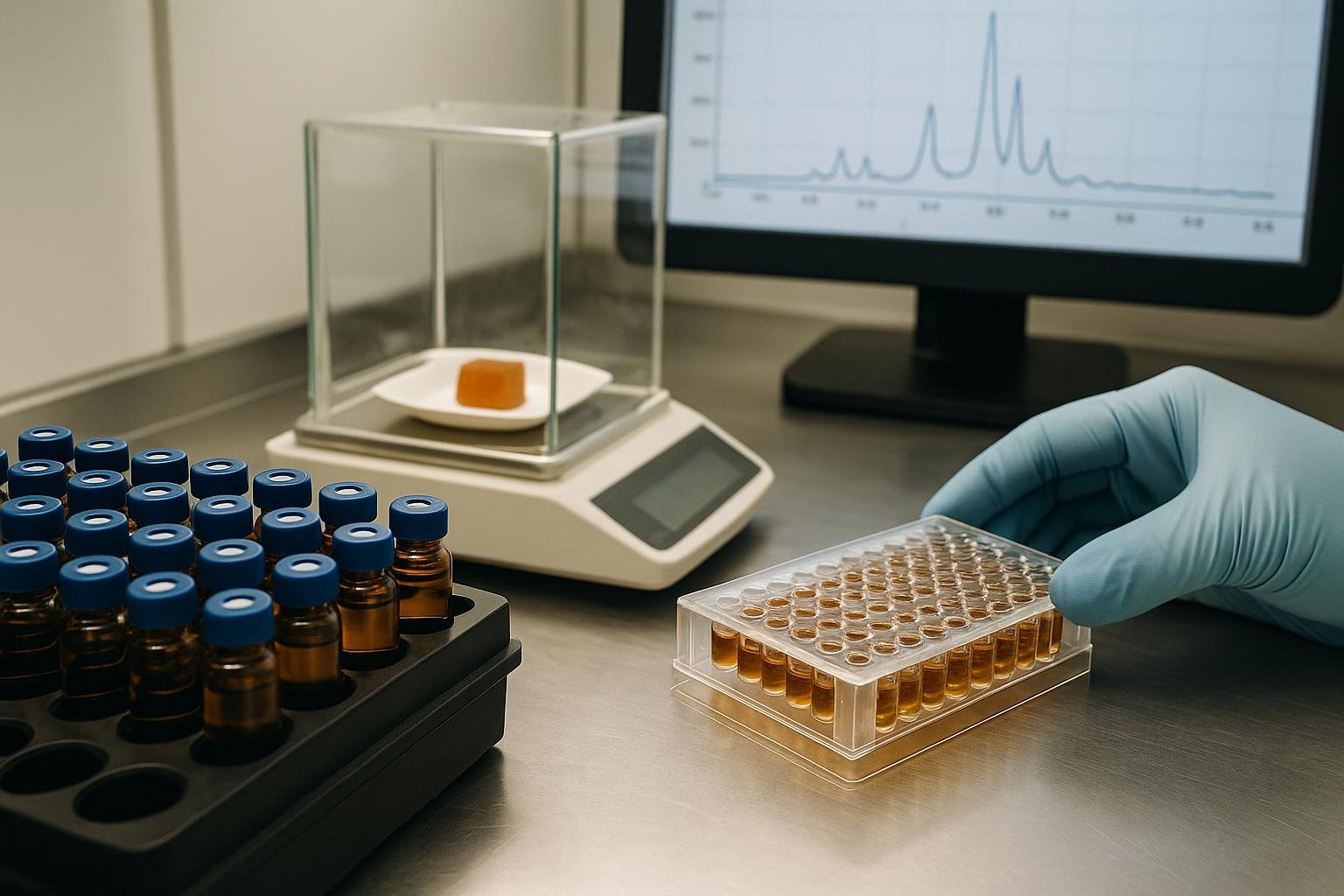
Homogeneity testing for cannabis edibles is the analytical proof that every unit in a batch carries the dose printed on the label — not just the average unit, and not just the units that happened to land near the mixing paddle. I have seen manufacturers lose entire lots because a potency result came back at twice the label claim on one gummy and half on another, with a perfectly acceptable batch average sitting in between. That average is not what the patient or consumer is dosing from. This article walks through the sampling logic, the RSD (relative standard deviation: the standard deviation expressed as a percentage of the mean) math, what New Jersey’s Cannabis Regulatory Commission actually requires in writing, and what a manufacturer can do upstream to avoid the retest call.
Whether you are a lab technician being asked to design a homogeneity protocol, a lab director writing an SOP for a new edibles client, or a manufacturer trying to understand why the lab is asking for twelve gummies instead of one — this article gives you the framework, the math, and the primary regulatory citations to work from.
Here is what this article covers:
- Why batch averages are not enough and what uneven mixing actually looks like in data
- The USP General Chapter <905> framework for dosage-unit uniformity and what it does and does not say about cannabis
- New Jersey’s specific sampling plan, RSD limit, and lot-structure requirements — the most detailed cannabis-specific homogeneity rule currently available in primary source form
- How to calculate RSD correctly and what your report should show
- What manufacturers can do before the sample arrives to improve their odds
Step 1: Understand why the batch average lies to you
Potency testing for a flower or concentrate sample is fundamentally a bulk-material question: what is the cannabinoid concentration in this matrix? Edible potency testing has a second, harder question underneath it: is that concentration distributed evenly across every unit a consumer will actually pick up?
The answer depends entirely on the manufacturing process. Cannabinoid distillate or infused oil has to be incorporated into a gummy base, a chocolate, a beverage, or a capsule fill. If the mixing step is too short, too cool, or interrupted, the active ingredient can pool. You can end up with a batch whose mean THC content is exactly 10 mg per unit and whose individual units range from 4 mg to 18 mg. A single composite sample ground from several gummies will report the mean faithfully and tell you nothing about that range.
The only way to detect uneven distribution is to test individual units or discrete increments separately and compare them.
This is not a theoretical concern. Regulators began requiring homogeneity studies precisely because early edibles markets produced products with wildly variable per-unit doses, and the problem was invisible to composite-sample potency testing. The analytical framework that pharmaceutical regulators developed for the same problem — tablets and capsules that had to deliver a consistent drug dose — is USP General Chapter <905>.
Step 2: Know what USP General Chapter <905> actually says — and what it does not
USP General Chapter <905>, titled Uniformity of Dosage Units, provides a pharmacopeial framework for evaluating dose uniformity among individual dosage units. The harmonized <905> text — aligned with the European Pharmacopoeia and Japanese Pharmacopoeia — became official in USP 2023 Issue 2 on August 1, 2023. For large-sample situations, USP General Chapter <1099>, titled Limit on Number of Large Deviations When Assessing Content Uniformity in Large Samples, provides a process for evaluating large data sets against the zero-tolerance criterion in <905> — it is not an extension of or replacement for <905>.
Note: USP <905> is a pharmaceutical pharmacopeial standard, not a cannabis-specific analytical method. The USP materials do not establish that every cannabis jurisdiction has adopted <905> for edible compliance testing. Do not substitute USP acceptance-value terminology for a state rule’s separate RSD requirement unless your applicable regulator expressly permits that approach.
<905> is the best available reference framework for the underlying science, but your state rule is the controlling document for compliance.
Where a state rule references <905> directly, follow it. Where a state rule specifies its own metric — as New Jersey does — follow the state rule and use <905> as supporting methodology documentation in your validation package. See the method validation article for how to structure that documentation.
Step 3: Apply New Jersey’s specific sampling plan and RSD limit
New Jersey provides the most explicit cannabis-specific homogeneity testing requirement I have found in primary source form. The NJ-CRC Testing Guidance addresses additional homogeneity testing for cannabis products manufactured under a new or updated master formulation record (the documented recipe and process specification for a product). Consult the current published version directly for the applicable trigger conditions, sampling plan, lot-structure requirements, and acceptance criteria, as revision dates and specific numerical thresholds should be verified against the primary source.
The general structure of a sound homogeneity study — consistent with the NJ-CRC approach — includes:
- Trigger: a new or updated master formulation record
- Lots tested: multiple lots produced under that formulation
- Samples per lot: multiple increment or serving samples, each tested individually
- Within-lot assessment: RSD calculated across the increments from that lot
- Between-lot assessment: results from tested lots compared for consistency
- RSD formula: standard deviation divided by mean, multiplied by 100
The RSD formula is worth writing out explicitly because labs occasionally report it correctly but label it wrong. If your increment results for a lot are, say, 9.2 mg, 10.1 mg, and 9.8 mg per unit, the mean is approximately 9.7 mg, the standard deviation is roughly 0.46 mg, and the RSD is (0.46 ÷ 9.7) × 100 = roughly 4.7 percent. Your report should show the individual results, the mean, the standard deviation, and the calculated RSD as a percentage. Check your state’s guidance for whether the unit basis must be expressed in milligrams per unit or whether a percentage alone satisfies the reporting requirement.
Note: Acceptance criteria for RSD are jurisdiction-specific. Do not present any single figure as a universal cannabis-industry standard, and do not apply another state’s criterion to clients in your state. Check your state regulator’s primary guidance document for the applicable criterion.
If your state has not published explicit homogeneity criteria, document your method against USP <905> principles and be prepared to justify your acceptance criterion in writing when your accreditation body asks.
For ISO 17025 accreditation context, see the ISO 17025 audit preparation article.
Step 4: Structure your report so it survives a regulatory review
A homogeneity report that passes a bench review can still fail a regulatory audit if the data trail is incomplete. A defensible report should include, at minimum:
- Formulation version identifier — which master formulation record triggered the study
- Lot identity for each tested lot
- Increment identity within each lot — which physical unit or portion was tested
- Serving basis — the unit definition used in the mg/unit calculation (a full gummy, a half-piece, a defined weight)
- Individual analyte results for each increment
- Mean, standard deviation, and RSD for each lot
- Between-lot comparison — a table or narrative showing whether the lot means and RSDs are consistent
I suggest labs take it a step further and include the potency method reference and the calibration curve summary in the same report package. A homogeneity result is only as defensible as the underlying potency assay — if the HPLC method is not validated for the matrix, the RSD you calculate is measuring method noise as much as product variability.
The report must clearly identify the unit basis for each result so that a reviewer can reconstruct the RSD calculation without ambiguity.
Note: If a product contains multiple cannabinoids with label claims — for example, a 1:1 THC:CBD gummy — applying uniformity assessment to each labeled cannabinoid individually is sound practice even where the state rule does not specify it. Document your rationale.
Step 5: What manufacturers can do upstream to pass
The lab cannot fix a mixing problem after the fact. By the time the sample arrives, the cannabinoid distribution is locked in. What a manufacturer can do is design and document the process steps that drive homogeneity before the first lot ever goes to testing.
The key process variables that affect cannabinoid distribution in gummies and similar matrices include mixing time and temperature, the viscosity of the infused ingredient relative to the base, the order of addition, and whether the infused ingredient is pre-emulsified (broken into small droplets stabilized against re-coalescence). None of those variables are analytical — they are manufacturing — but they are exactly what an investigator will ask about when a lot fails.
Practical steps manufacturers should take:
- Lock the formulation before the homogeneity study, not after. Changing the formulation after a passing study means the study no longer covers the current product.
- Collect increment samples from different physical positions in the batch — beginning, middle, and end of a depositing run, or different trays from a mold pour — so the sampling plan actually challenges the process rather than confirming it.
- Keep batch records that link lot identity to formulation version. A between-lot comparison is impossible to reconstruct if lot records do not preserve which formulation version was in effect.
- Treat a failing RSD as a process signal, not just a regulatory problem. An RSD above the acceptance criterion tells you something specific went wrong in mixing or deposition. Investigate it before the next lot.
The homogeneity study is not a paperwork exercise — it is the only analytical evidence that your manufacturing process actually delivers what the label says, unit by unit.
Note: The NJ-CRC guidance covers a range of product types — consult the current published guidance for the full scope of products subject to homogeneity requirements in New Jersey.
Quick answers
What RSD limit applies to cannabis edible homogeneity testing? No single universal cannabis-industry RSD limit exists — the applicable criterion depends entirely on your state regulator’s primary guidance document. New Jersey’s Cannabis Regulatory Commission has published explicit homogeneity criteria; check your state’s primary rule rather than assuming any one figure applies everywhere.
How many samples do I need for a cannabis edible homogeneity test? No single nationwide sampling number applies to every jurisdiction, so your state regulator’s guidance is the controlling document. New Jersey’s CRC Testing Guidance addresses this in detail; consult the current published version directly at the NJ-CRC website for the applicable sampling plan.
Does USP General Chapter <905> apply to cannabis edibles? USP General Chapter <905>, titled Uniformity of Dosage Units, provides a pharmacopeial framework for evaluating dose uniformity among individual dosage units and is a useful reference for cannabis labs. However, the USP materials do not establish that every cannabis jurisdiction has adopted <905> for edible compliance testing, and a lab should not substitute USP acceptance-value terminology for a state rule’s separate RSD requirement unless the applicable regulator expressly permits that approach.
When does a cannabis manufacturer trigger additional homogeneity testing in New Jersey? New Jersey’s CRC Testing Guidance addresses when additional homogeneity testing is required; consult the current published version at the NJ-CRC website for the specific trigger conditions and lot-structure requirements. The guidance covers a range of product types beyond gummies alone.
Can a manufacturer use gummy weight or visual appearance to prove dose uniformity? No — weight variation and visual inspection do not demonstrate cannabinoid dose uniformity. Cannabinoid distribution depends on how thoroughly the infused oil or distillate was incorporated into the matrix, and two gummies of identical weight can carry very different milligram loads if mixing was uneven. Analytical testing of individual units or increments is the only way to generate a defensible RSD figure.
What records should a manufacturer keep to support a homogeneity study? At minimum, preserve the formulation-version record that triggered the study, the lot identities and increment identities for each tested lot, the serving basis used in the RSD calculation, the individual analyte results, the calculated mean, standard deviation, and RSD for each lot, and a between-lot comparison. Your state regulator’s guidance document will specify the exact data fields required for compliance reporting in your jurisdiction.
Sources
- USP General Chapter <905> Uniformity of Dosage Units — USP–NF preview
- USP Harmonization Standards: Uniformity of Dosage Units — official date August 1, 2023
- USP General Chapter <1099> Limit on Number of Large Deviations When Assessing Content Uniformity in Large Samples — USP–NF preview
- NJ-CRC Testing Guidance — current version
FAQ
Frequently asked
- What RSD limit applies to cannabis edible homogeneity testing?
- No single universal cannabis-industry RSD limit exists — the applicable criterion depends entirely on your state regulator's primary guidance document. New Jersey's Cannabis Regulatory Commission has published explicit homogeneity criteria; check your state's primary rule rather than assuming any one figure applies everywhere.
- How many samples do I need for a cannabis edible homogeneity test?
- No single nationwide sampling number applies to every jurisdiction, so your state regulator's guidance is the controlling document. New Jersey's CRC Testing Guidance addresses this in detail; consult the current published version directly at the NJ-CRC website for the applicable sampling plan.
- Does USP General Chapter 905 apply to cannabis edibles?
- USP General Chapter <905>, titled Uniformity of Dosage Units, provides a pharmacopeial framework for evaluating dose uniformity among individual dosage units and is a useful reference for cannabis labs. However, the USP materials do not establish that every cannabis jurisdiction has adopted <905> for edible compliance testing, and a lab should not substitute USP acceptance-value terminology for a state rule's separate RSD requirement unless the applicable regulator expressly permits that approach.
- When does a cannabis manufacturer trigger additional homogeneity testing in New Jersey?
- New Jersey's CRC Testing Guidance addresses when additional homogeneity testing is required; consult the current published version at the NJ-CRC website for the specific trigger conditions and lot-structure requirements. The guidance covers ingestible, transmucosal, and dermal products, not only gummies.
- Can a manufacturer use gummy weight or visual appearance to prove dose uniformity?
- No — weight variation and visual inspection do not demonstrate cannabinoid dose uniformity. Cannabinoid distribution depends on how thoroughly the infused oil or distillate was incorporated into the matrix, and two gummies of identical weight can carry very different milligram loads if mixing was uneven. Analytical testing of individual units or increments is the only way to generate a defensible RSD figure.
- What records should a manufacturer keep to support a homogeneity study?
- At minimum, preserve the formulation-version record that triggered the study, the lot identities and increment identities for each tested lot, the serving basis used in the RSD calculation, the individual analyte results, the calculated mean, standard deviation, and RSD for each lot, and a between-lot comparison. Your state regulator's guidance document will specify the exact data fields required for compliance reporting in your jurisdiction.
Related guides
All guides- 01
Cannabis Lab 101: Cannabis Edibles Testing Cost — Why Infused Products Cost More to Test
I spent four years running potency assays on everything from flower to fudge, and infused products always took longer and cost more. Here is exactly why — matrix effects, homogeneity requirements, and the extra sample prep no one explains — plus real prices from published lab menus.
- 02
Cannabis Lab 101: Microbial Testing — Plating vs qPCR and Why Labs Disagree
I spent years running microbial panels on cannabis flower and concentrates, and the plating-vs-qPCR argument never gets old. This article breaks down total yeast and mold, Aspergillus species testing, AOAC SMPRs, state limits, and the dead-DNA problem that makes regulators and lab directors argue at every conference.
- 03
Cannabis Lab 101: Cannabis Testing Cost Per Sample — 2026 Price Ranges by Assay
I pulled published price lists from licensed labs in New Jersey, Minnesota, and Oregon, plus Utah's state fee schedule, to show you exactly what each assay costs in 2026 — and why the same test can cost twice as much in one state as another.
Need this tested?
Compare labs that run these assays and get quotes in one go — no account, no fee.