· 10 min read
Cannabis Lab 101: How to Verify a Cannabis Lab's ISO 17025 Accreditation Scope, Step by Step
I walk you through pulling a lab's live scope document from the A2LA registry, reading every column that matters, and confirming that potency, pesticides, heavy metals, and microbiology are genuinely accredited, not just claimed on a marketing page.
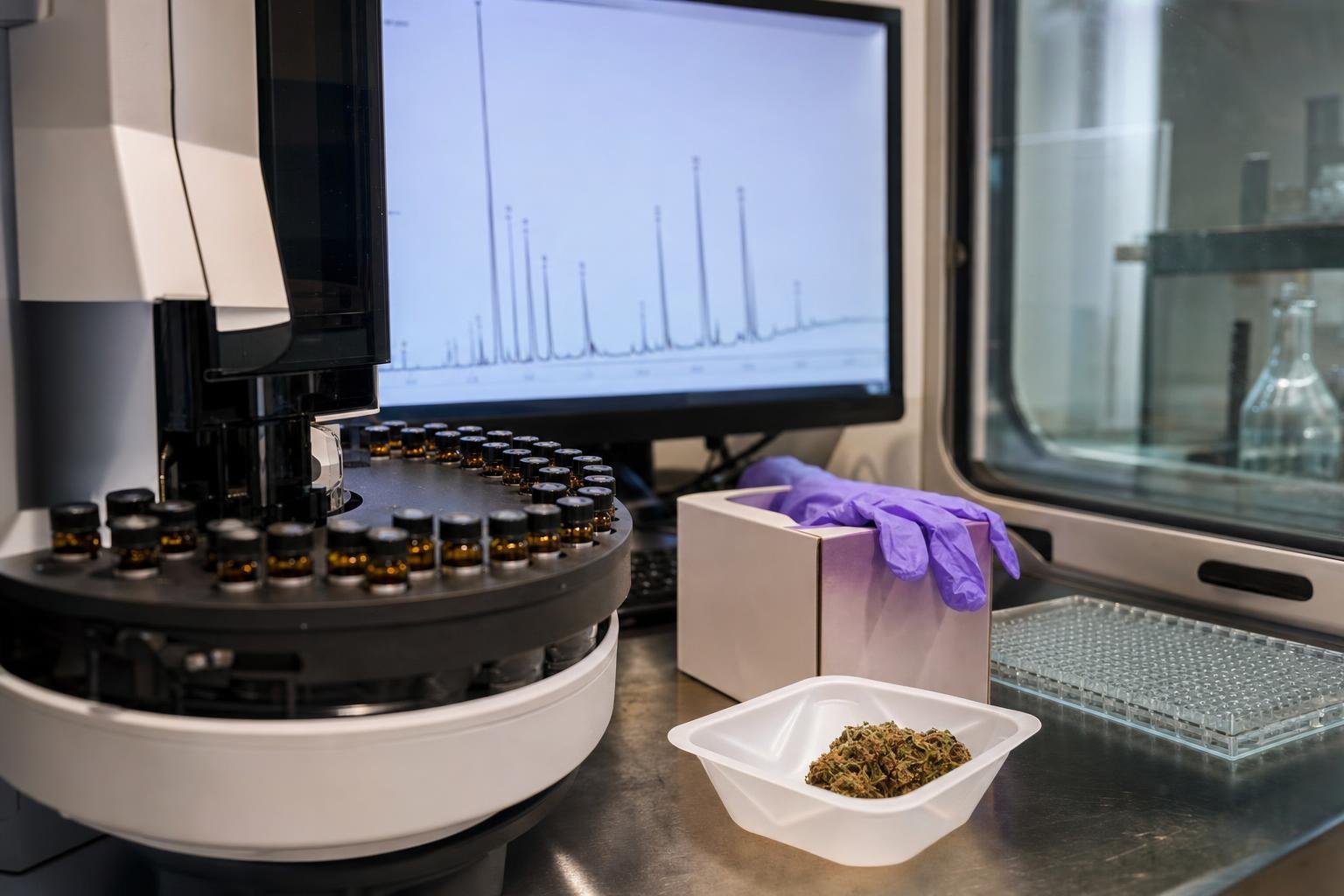
Growers, manufacturers, and compliance managers who must document their lab-vendor qualification process often stop at the certificate on the wall. That certificate tells you almost nothing. What you actually need is the scope document, a multi-page record that lists exactly which tests, matrices, methods, and analytical technologies the accreditation body has assessed and approved. This article walks you through finding that document, reading it correctly, and knowing when to push back.
Whether you are a grower qualifying a new testing vendor, a compliance manager building a supplier-approval file, or a lab director preparing for a state audit, this article gives you a step-by-step process for confirming that a cannabis lab’s ISO/IEC 17025 accreditation actually covers the analytes you need. You do not need a chemistry degree. You do need fifteen minutes and a browser.
This article covers:
- What ISO/IEC 17025 accreditation means and what it does not guarantee
- How to find a lab in the A2LA public directory
- How to read a scope document column by column
- How to identify scope limitations versus full coverage
- What the AOAC program layer adds and when to ask for it
- Red flags on certificates and marketing pages
Step 1: Understand what accreditation does and does not guarantee
ISO/IEC 17025:2017 is the international standard titled “General requirements for the competence of testing and calibration laboratories.” When an accreditation body such as A2LA assesses a laboratory against it, they are conducting an independent, third-party evaluation of that laboratory’s technical competence, not a product certification and not a state license.
The standard is described by A2LA as flexible and non-prescriptive, meaning laboratories have latitude in how they meet requirements. The areas assessed include method validation or verification, personnel and training, internal audits, and management review. That is a meaningful quality baseline. What it is not is a guarantee that every test the lab runs is covered.
The single most important thing to understand before you do anything else: accreditation does not automatically cover every test a laboratory performs. The laboratory’s scope document identifies the specific tests, technologies, matrices, and, where applicable, sampling activities that are actually covered. A lab can hold a valid ISO/IEC 17025 certificate and still run your pesticide panel entirely outside its accredited scope.
A2LA also notes that state-specific requirements are assessed when incorporated into the laboratory’s quality-management system or required by a memorandum of understanding between A2LA and a state. Whether your state’s rules are folded into the accreditation assessment depends on whether that MOU exists. Check your state regulator’s page for confirmation rather than assuming it.
For background on what compliance testing actually involves, see our introduction to cannabis compliance testing.
Step 2: Find the laboratory in the A2LA public directory
A2LA operates a dedicated Cannabis Testing Laboratory Accreditation program that covers flower, concentrates, waxes, beverages, tinctures, oils, chocolate, gummies, hard candy, and other edibles. It applies to hemp, cannabis, and cannabinoid products. That program page is your starting point.
From the A2LA accreditation directory, you can search by laboratory name, location, or accreditation number. A few things to watch for during the search:
- A2LA separately lists biological testing, chemical testing, and cannabis testing programs. A laboratory that appears under chemical testing is not automatically listed under cannabis testing. Search the cannabis-specific program, not just the general ISO/IEC 17025 directory.
- The directory returns the laboratory’s legal entity name and address. Match those against the actual facility you are contracting. A parent company may hold accreditation for one location but not a satellite lab down the street.
- Download the scope document directly from the directory. Do not accept a PDF the laboratory emails you as your primary source. The accreditor’s live directory reflects current status; a file in someone’s inbox may be months out of date.
The fact sheet notes that no authoritative source currently provides verified registry-search instructions for ANAB or Perry Johnson Laboratory Accreditation in the same level of detail available for A2LA. If your lab uses one of those bodies, go to their respective public directories and apply the same logic described in Steps 3 and 4 below. The scope document structure is similar across accreditation bodies because the underlying standard is the same.
Note: Some states require accreditation from a specific body or accept only certain accreditors for compliance purposes. Check your state cannabis regulator’s published laboratory requirements before assuming any accreditor is acceptable.
Step 3: Read the scope document column by column
This is where most buyers stop reading too early. The scope document is not a one-page certificate. It is a table, sometimes several pages long, and every column matters.
The scope document is the only document that tells you whether your specific analyte, in your specific matrix, by your specific method, is covered by the accreditation. Here is what to check in each section:
Header block. Confirm the accreditor name, the laboratory’s certificate or accreditation number, the ISO/IEC 17025 edition (it should read 17025:2017 for a current assessment), and the valid-to date. An example A2LA scope carries a “Valid To” date of December 31, 2027. If today’s date is past that date, the accreditation has lapsed and you are looking at an expired document.
Test category columns. A2LA cannabis scopes may include cannabinoid content (CBC, CBD, CBDa, CBG, CBN, THC, THCa, THCv), terpene profiling, pesticides and fungicides and plant-growth regulators, residual solvents, heavy metals, and microbiological contaminants including mold, insects, and bacteria. Locate each category you need and confirm it is present. Absence means it is not accredited.
Technology column. A scope document can list analytical technologies including fluorometry, gas chromatography, GC-MS, HPLC, ICP-MS, ICP-OES, immunoassay, LC-MS, microscopy, spectroscopy, thin-layer chromatography, UV-VIS, and wet chemistry. Seeing HPLC in the technology column does not prove that every cannabinoid is accredited. The specific analyte, matrix, method, and technology must all be matched together.
Matrix column. Matrices listed in a scope may include drugs, foods, feeds, and food additives. If you are submitting an edible gummy and the matrix column lists only flower or plant material, the accreditation may not extend to your product type.
Sampling. A2LA notes that laboratories may be accredited for sampling associated with subsequent testing, but this is not automatic. If your compliance process requires that sample collection itself be performed under an accredited scope, check for it explicitly.
For a deeper look at what potency and HPLC methods look like from the bench, see our articles on potency determination and cannabinoid separation methods.
Step 4: Distinguish a scope limitation from a full accreditation
A scope limitation is a boundary, not a deficiency. A scope limitation should be treated as a boundary on accredited work, not as evidence that the laboratory lacks all technical capability outside that boundary. A lab may run a pesticide screen every day with excellent proficiency and simply not have sought accreditation for that category yet.
What a scope limitation does mean for your documentation:
- If an analyte, matrix, method, or sampling activity is absent from the current scope, you cannot describe that work as performed under the laboratory’s ISO/IEC 17025 accreditation without written clarification from the accreditor or the laboratory.
- For potency, pesticides, heavy metals, and microbiology, locate each category in the scope and confirm the relevant matrix and method or technology before treating the result as accredited in your supplier-approval file.
- If your state or your customer requires accredited results for a specific panel, a scope limitation on that panel is a compliance gap, not a technicality.
I suggest labs and buyers take one additional step: ask the laboratory to mark on the scope document exactly which rows correspond to the tests in your certificate of analysis. That exercise surfaces mismatches faster than any other check.
For pesticide and heavy metals context from the bench, see our guides on cannabis pesticide testing and heavy metals testing.
Note: A certificate or marketing page that says only “ISO certified,” “ISO compliant,” or “ISO 17025 laboratory” is not enough to establish that the laboratory’s requested cannabis methods are within an active accredited scope. These phrases are not regulated terms. Pull the scope document.
Step 5: Check whether the AOAC program layer applies to your situation
A2LA’s AOAC Laboratory Accreditation Program applies to laboratories performing chemical and microbiological analyses of foods, dietary supplements, pharmaceuticals, and cannabis. It is a distinct layer on top of ISO/IEC 17025, not a synonym for it.
The program requires assessment against the AOAC document titled “Guidelines for Laboratories Performing Microbiological and Chemical Analyses of Food, Dietary Supplements, Pharmaceuticals, and Cannabis.” Appendix F of that document contains specific criteria for cannabis testing laboratories.
A laboratory can hold a valid ISO/IEC 17025 accreditation without also holding AOAC program accreditation, and the two are not interchangeable. A2LA distinguishes laboratories accredited only to ISO/IEC 17025 from those accredited to ISO/IEC 17025 plus AOAC program guidelines. A scope document assessed under the AOAC program will reference A2LA R204, “Specific Requirements, AOAC Laboratory Accreditation Program.” If your state or customer contract specifies AOAC program accreditation, verify that reference is present in the scope header.
When in doubt about which layer your situation requires, go to your state cannabis regulator’s published laboratory requirements and read the exact language. “Accredited to ISO/IEC 17025” and “accredited under the AOAC program” are not the same requirement.
For method validation context, see our Cannabis Lab 101 validation article and our guide on preparing for ISO 17025 audits.
Quick answers
How do I check if a cannabis lab is ISO 17025 accredited? Go to the accreditor’s public directory, such as the A2LA cannabis testing page, search by laboratory name or location, and download the current scope document directly from the registry. A certificate or marketing page that says only “ISO certified” or “ISO compliant” is not sufficient to confirm that specific cannabis methods are within an active accredited scope. You need the scope document itself, with a valid-to date that has not expired.
What is a lab accreditation scope document and why does it matter? A scope document is the official record, issued by the accreditation body, that lists the specific tests, analytical technologies, matrices, and methods covered by a laboratory’s ISO/IEC 17025 accreditation. Accreditation does not automatically cover every test a laboratory performs, so a scope document is the only way to confirm that a particular analyte, such as a pesticide panel or heavy metals by ICP-MS, is genuinely accredited. If the analyte or matrix is absent from the scope, that work cannot be described as performed under the laboratory’s accreditation.
Does ISO 17025 accreditation cover all the tests a cannabis lab runs? No. ISO/IEC 17025 accreditation covers only the tests, matrices, and methods explicitly listed in the laboratory’s current scope document. A lab may run potency by HPLC every day but hold accreditation only for pesticides and heavy metals, or vice versa. Always match your required analytes and matrices to the scope line by line before treating a result as accredited.
What is the difference between ISO 17025 accreditation and AOAC program accreditation for cannabis labs? ISO/IEC 17025 accreditation confirms a laboratory’s general technical competence against the standard’s requirements. The AOAC Laboratory Accreditation Program, offered through bodies such as A2LA, adds assessment against AOAC guidelines for food, dietary supplement, pharmaceutical, and cannabis laboratories, with Appendix F of those guidelines containing cannabis-specific criteria. A buyer who needs the AOAC program layer must verify it separately, because a laboratory can hold ISO/IEC 17025 accreditation without also holding AOAC program accreditation.
Can a cannabis lab be accredited for some tests but not others? Yes, and this is common. A scope document may list cannabinoid potency and residual solvents as accredited while omitting microbiology or a specific pesticide panel. A scope limitation means that work outside the listed boundary is not covered by the accreditation, though it does not necessarily mean the laboratory lacks the technical capability to run that test. For compliance documentation, only results from tests that appear in the current scope can be described as accredited.
Do I need to check the scope document every time I use a cannabis lab? At minimum, check the scope at initial vendor qualification and again at each annual review, or any time the laboratory notifies you of a scope change. Accreditation scopes carry a valid-to date, and a scope that was current when you qualified the lab may have been revised, suspended, or allowed to lapse since then. Pulling the document directly from the accreditor’s live directory, rather than relying on a copy the lab emailed you, is the only way to confirm current status.
Sources
- A2LA Cannabis Testing Laboratory Accreditation program page
- A2LA accreditation directory
- A2LA AOAC Laboratory Accreditation Program page
- A2LA biological testing program page
- A2LA chemical testing program page
- A2LA example cannabis scope document (accreditationPID E197F505)
- A2LA example cannabis scope document (accreditationPID E532A326)
FAQ
Frequently asked
- how do I check if a cannabis lab is ISO 17025 accredited
- Go to the accreditor's public directory, such as the A2LA cannabis testing page at a2la.org/accreditation/cannabis-testing, search by laboratory name or location, and download the current scope document directly from the registry. A certificate or marketing page that says only 'ISO certified' or 'ISO compliant' is not sufficient to confirm that specific cannabis methods are within an active accredited scope. You need the scope document itself, with a valid-to date that has not expired.
- what is a lab accreditation scope document and why does it matter
- A scope document is the official record, issued by the accreditation body, that lists the specific tests, analytical technologies, matrices, and methods that are covered by a laboratory's ISO/IEC 17025 accreditation. Accreditation does not automatically cover every test a laboratory performs, so a scope document is the only way to confirm that a particular analyte, such as a pesticide panel or heavy metals by ICP-MS, is genuinely accredited. If the analyte or matrix is absent from the scope, that work cannot be described as performed under the laboratory's accreditation.
- does ISO 17025 accreditation cover all the tests a cannabis lab runs
- No. ISO/IEC 17025 accreditation covers only the tests, matrices, and methods explicitly listed in the laboratory's current scope document. A lab may run potency by HPLC every day but hold accreditation only for pesticides and heavy metals, or vice versa. Always match your required analytes and matrices to the scope line by line before treating a result as accredited.
- what is the difference between ISO 17025 accreditation and AOAC program accreditation for cannabis labs
- ISO/IEC 17025 accreditation confirms a laboratory's general technical competence against the standard's requirements. The AOAC Laboratory Accreditation Program, offered through bodies such as A2LA, adds assessment against AOAC guidelines for food, dietary supplement, pharmaceutical, and cannabis laboratories, with Appendix F of those guidelines containing cannabis-specific criteria. A buyer who needs the AOAC program layer must verify it separately, because a laboratory can hold ISO/IEC 17025 accreditation without also holding AOAC program accreditation.
- can a cannabis lab be accredited for some tests but not others
- Yes, and this is common. A scope document may list cannabinoid potency and residual solvents as accredited while omitting microbiology or a specific pesticide panel. A scope limitation means that work outside the listed boundary is not covered by the accreditation, though it does not necessarily mean the laboratory lacks the technical capability to run that test. For compliance documentation, only results from tests that appear in the current scope can be described as accredited.
- do I need to check the scope document every time I use a cannabis lab
- At minimum, check the scope at initial vendor qualification and again at each annual review, or any time the laboratory notifies you of a scope change. Accreditation scopes carry a valid-to date, and a scope that was current when you qualified the lab may have been revised, suspended, or allowed to lapse since then. Pulling the document directly from the accreditor's live directory, rather than relying on a copy the lab emailed you, is the only way to confirm current status.
Related guides
All guides- 01
Cannabis Lab 101: Writing SOPs That Survive an Audit
I spent four years watching labs fail accreditation audits over paperwork that should have been airtight. This guide walks through the structure of a defensible SOP, version control that actually works, training records auditors accept, and the recurring findings that accreditation bodies flag most often.
- 02
Cannabis Lab 101: Pesticide Testing (LC-MS/MS vs GC-MS/MS) and Why You Need Both
I spent years running pesticide panels on cannabis flower and learned fast that no single instrument platform covers the full analyte list. This guide walks through QuEChERS extraction, matrix effects, why GC-MS/MS handles what LC-MS/MS cannot, and what California's §15719 actually requires your LOQ to be.
- 03
Cannabis Lab 101: Stability Testing, Expiry Dates, and How Labs Set a Shelf Life
I spent years running compliance panels and watched stability testing get treated as an afterthought. This article breaks down real-time vs accelerated studies, what states actually require, how THC degrades over time, and what acceptance criteria your data must hit before a regulator will approve an expiration date.
Need this tested?
Compare labs that run these assays and get quotes in one go — no account, no fee.