· 12 min read
Cannabis Lab 101: HPLC vs. GC for Cannabis Potency Testing and Why Method Choice Changes the Number on Your COA
I spent years watching cultivators panic over divergent COA numbers from different labs. The culprit is almost always method choice. This article explains exactly why HPLC and GC produce different potency values, how the 0.877 decarboxylation factor works, and what lab directors need to know before selecting or validating a potency method.
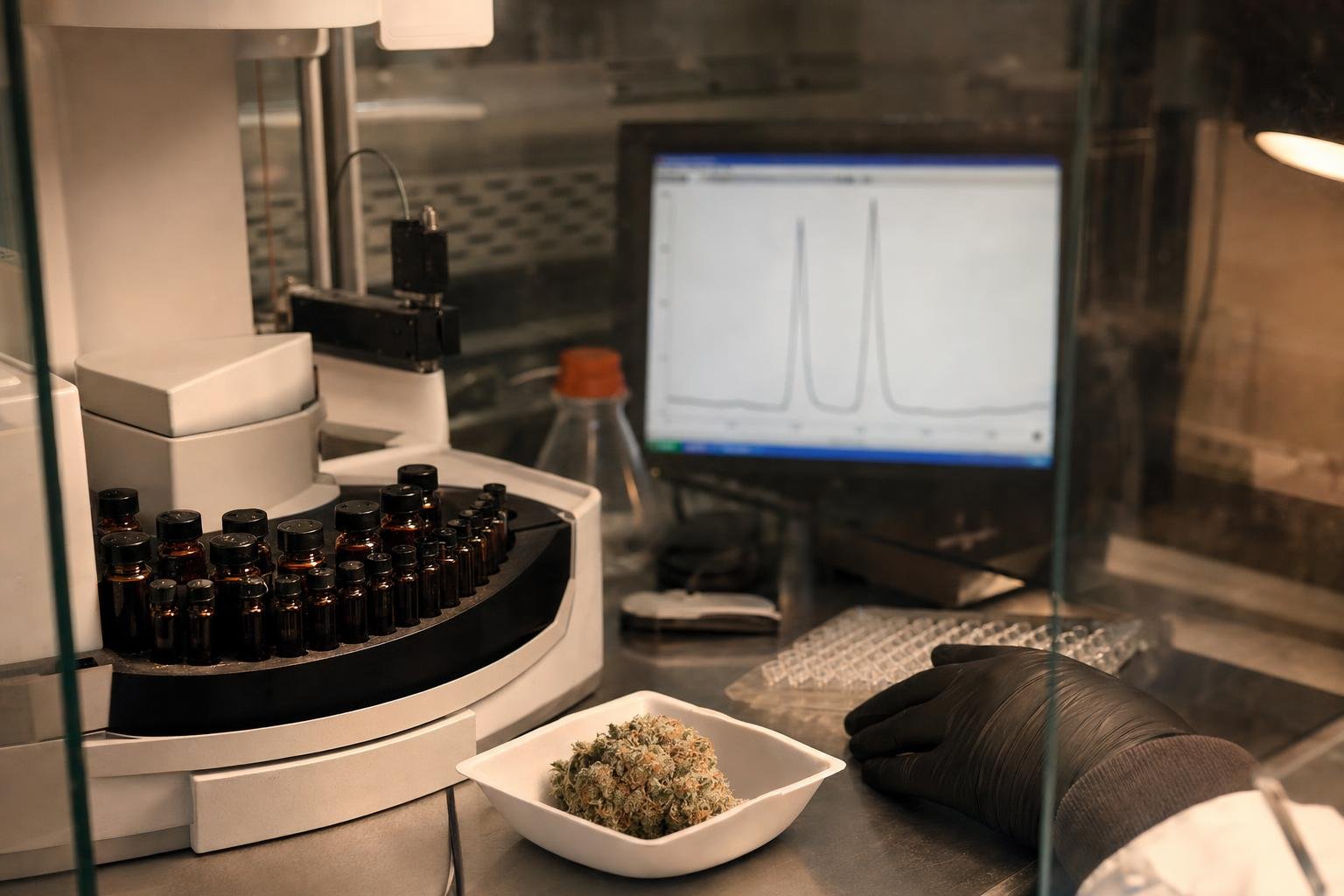
The same flower sample can produce meaningfully different potency numbers depending on whether the lab runs it on an HPLC or a GC, and that difference is not a lab error. It is chemistry. Understanding why the numbers diverge, how the 0.877 decarboxylation factor connects the two approaches, and what your state regulator actually requires will make you a better lab director, a sharper bench tech, and a more informed cultivator when two COAs land on your desk and refuse to agree.
Whether you are a lab director choosing between instrument platforms, a bench technician trying to understand why your GC and HPLC results do not match, or a cultivator staring at two COAs with different THC numbers, this article gives you the chemistry, the math, and the regulatory context to make sense of it all. You do not need a graduate degree, but you do need to be comfortable with the idea that the same molecule can look different depending on how much heat you throw at it before you measure it.
Here is what this article covers:
- The chemistry of THCA and why heat matters
- How GC converts THCA to THC during analysis and what that means for your reported number
- How HPLC keeps THCA intact and why the 0.877 factor exists
- Detector options: UV, DAD, and MS, and what each adds
- Method validation and state-specific requirements
- How to read a COA intelligently when the numbers do not match
Step 1: Understand the molecule before you choose the instrument
Most of the THC in fresh or dried cannabis flower is not actually THC. It is THCA (tetrahydrocannabinolic acid), the acidic precursor that the plant biosynthesizes before decarboxylation (the loss of a carboxyl group as carbon dioxide, driven by heat or prolonged storage) converts it to the neutral form, delta-9-THC. Illinois’s consumer-label guidance puts it plainly: heating causes THCA to convert to THC.
This is not a minor distinction. In a typical high-potency flower sample, the vast majority of total cannabinoid content sits in the THCA form, with only a small fraction as neutral THC. The ratio between the two forms is what makes method choice consequential.
The instrument you choose determines whether THCA and THC are measured as separate analytes or collapsed into a single THC peak before detection. That single decision propagates through every number on the COA.
For a broader orientation to how potency fits into the full compliance picture, see the technical overview of potency determination and the compliance testing introduction.
Step 2: See what GC heat does to your sample
Gas chromatography works by vaporizing the sample and sweeping it through a heated column with a carrier gas. The injector and column temperatures required to move cannabinoids through a GC system are high enough to decarboxylate THCA before it ever reaches the detector. As 7 C.F.R. §990.3 recognizes, GC analysis causes THCA to convert to its neutral form, THC, during the chromatographic process itself.
The practical consequence is that a GC detector, whether a flame-ionization detector (FID, a detector that measures ions produced when organic compounds burn in a hydrogen flame) or a mass spectrometer, sees only THC. It cannot distinguish between THC that was already neutral in the sample and THC that was THCA five seconds ago in the injection port. The result is a single THC peak that represents post-decarboxylation, or potential total, THC.
A National Institute of Justice-sponsored method-validation document notes that GC analysis can require derivatization (a chemical modification step that attaches a protecting group to the acidic cannabinoid) to avoid decarboxylation when you specifically want to preserve the acidic form. Without derivatization, decarboxylation is essentially guaranteed under standard GC conditions.
What GC gives you is a single number that approximates the THC a consumer would experience after full decarboxylation, but it cannot tell you how much of that number came from THCA versus pre-existing neutral THC.
For a sample with a high THCA-to-THC ratio, that GC number will be higher than the neutral THC value alone, which is exactly why a GC result and an HPLC result from the same flower can look like they came from different samples.
Step 3: See what HPLC preserves and why the 0.877 factor exists
High-performance liquid chromatography moves the sample through a column in a liquid mobile phase at or near ambient temperature. Because there is no vaporization step and no sustained high heat, THCA remains intact as it travels through the column. The detector sees two distinct peaks: one for THCA and one for neutral THC. You get two numbers.
To report a single total-THC figure comparable to what a GC would produce, or to satisfy state reporting requirements that ask for total THC, you apply the formula codified in 7 C.F.R. §990.3:
Total THC = (0.877 × THCA) + THC
The 0.877 factor is not arbitrary. It is the ratio of the molecular mass of THC to the molecular mass of THCA, reflecting the mass lost as carbon dioxide when the carboxyl group leaves during decarboxylation. 7 C.F.R. §990.3 defines it this way, and both New York’s Office of Cannabis Management testing limits and Maryland’s Technical Authority codify the same formula for their respective jurisdictions.
The 0.877 factor is the mathematical bridge between what HPLC measures and what GC approximates, and getting it wrong by even a fraction of a percent compounds across every sample in a batch.
Because the factor is less than one, multiplying THCA by 0.877 always reduces its contribution to the total relative to what a GC would report if it converted 100 percent of THCA to THC. In practice, the HPLC-derived total-THC number is often slightly lower than a GC number on the same sample, but the gap depends on how complete the GC decarboxylation actually is, which is a function of instrument conditions, not a guaranteed constant.
New York also requires that bulk flower potency be corrected for moisture content and reported on a dry-weight basis, which adds another variable when comparing COAs across labs or jurisdictions. See the New York OCM testing limits document for the full specification.
Step 4: Choose your detector, knowing what each one adds
Once you have decided on liquid chromatography as your platform, you still need to choose a detector. The three classes you will encounter in cannabis potency work are UV, DAD, and MS.
UV detection (measuring absorbance of ultraviolet light at a fixed wavelength) is the simplest and most common configuration. Cannabinoids absorb strongly in the UV range, and UV detectors are robust, inexpensive to maintain, and well-represented in the peer-reviewed literature. The Gambaro et al. 2002 paper cited by Colorado’s potency-determination page used HPLC-UV alongside GC-FID as a direct comparison.
DAD (diode-array detection, which collects a full UV-visible spectrum at every point in the chromatogram) adds spectral confirmation that the peak you are integrating is actually the cannabinoid you think it is, not a co-eluting (eluting at the same retention time) impurity. Colorado’s reference-method list explicitly includes HPLC-DAD configurations, including the De Backer et al. 2009 method and the Ambach et al. 2014 method. DAD is the most common detector class in licensed cannabis potency labs because it balances cost, robustness, and regulatory acceptance.
LC-MS (liquid chromatography coupled to a mass spectrometer, which identifies compounds by their mass-to-charge ratio) adds a layer of structural confirmation that UV and DAD cannot provide. Colorado’s reference-method list includes liquid-chromatography ion-trap mass spectrometry for cannabinoid determination. MS is particularly useful for minor cannabinoids present at low concentrations where a UV peak might be ambiguous, and it is the standard for contaminant testing. For routine potency of major cannabinoids, the additional cost and maintenance burden of MS is not always justified, but it is a defensible choice and increasingly common in labs that want a single platform for multiple assay types.
The primary sources do not establish a universal sensitivity ratio between UV/DAD and MS for cannabis potency, so I will not invent one. What I will say from bench experience is that for THC and THCA at the concentrations present in flower, a well-maintained DAD system with a validated calibration curve is entirely fit for purpose. For cannabinoid separation methods in more detail, see the cannabinoid separation methods overview.
Step 5: Validate the method against your jurisdiction’s actual requirements
Choosing HPLC over GC, or DAD over MS, does not by itself make your method compliant. Colorado’s CDPHE potency-determination page states explicitly that available potency methods had not been validated to the level of a single standard method, and that any method used must be extensively validated to meet testing requirements. The instrument class is the starting point, not the finish line.
Colorado identifies AOAC 2018.10 and AOAC 2018.11 as applicable reference methods. AOAC Official Methods are peer-reviewed, collaboratively studied, and carry regulatory weight in many jurisdictions, which is why I suggest labs treat them as the baseline for validation design even if your state does not explicitly require them.
Validation parameters you must address before a potency method goes live include: linearity of the calibration curve across the expected concentration range, accuracy (recovery from spiked matrix), precision (repeatability and intermediate precision), specificity (no interference from co-eluting cannabinoids or matrix components), limit of quantitation, and robustness. A method’s regulatory acceptability depends on validation against your jurisdiction’s requirements, not solely on whether the instrument is labeled HPLC or GC. 7 C.F.R. §990.3 and your state’s technical authority are the primary sources; your SOP is the implementation.
System suitability (a pre-run check confirming the instrument is performing within acceptable limits before sample analysis begins) must be defined in your method. The specific acceptance criteria vary by method and jurisdiction. Check your applicable AOAC method and your state’s technical authority for the criteria that apply to your validated procedure. For the full validation workflow, see the Cannabis Lab 101 method validation article and the ISO 17025 audit preparation guide.
On reporting: New York requires total THC to be reported for all final cannabis products and specifies labeled potency tolerances that vary by product category: adult-use cannabis products must fall within 85 to 115 percent of the labeled value, while medical cannabis products must fall within 90 to 110 percent of the labeled value. Illinois specifies that labeled potency must fall within 85 to 115 percent of the labeled value. Your method’s uncertainty budget must be tight enough to keep you inside that window reliably, which is an argument for investing in validation rather than treating it as a checkbox.
Step 6: Read a COA intelligently when the numbers do not agree
When a cultivator sends you two COAs from different labs and the THC numbers are meaningfully different, here is the diagnostic sequence I use.
First, look at what each report actually shows. Does it list THC and THCA as separate values, or only a single total-THC figure? A report that shows only one number cannot tell you whether the 0.877 factor was applied or whether the method was GC-based. 7 C.F.R. §990.3 is clear that the same total-THC calculation can produce different reported values if labs use different analyte definitions, thermal conditions, calibration practices, or reporting conventions.
Second, check whether the results are reported on a dry-weight basis or an as-received basis. New York’s OCM testing limits require moisture correction for bulk flower. A lab that skips moisture correction will report a lower number on the same sample.
Third, ask about calibration. Are both labs using the same certified reference standards, and are the calibration ranges appropriate for the sample concentrations? A calibration curve that does not bracket the sample concentration introduces bias that has nothing to do with instrument platform.
Before concluding that one lab is wrong, confirm that both COAs are measuring the same thing, on the same moisture basis, with the same reporting formula. Most apparent discrepancies resolve into methodological differences rather than analytical errors once you do that work.
For context on what testing costs and why, see the cost of cannabis testing article.
Quick answers
Why does my flower test higher for THC at one lab than another? The most common reason is that one lab used a GC-based method, which applies heat during analysis and converts THCA to THC before detection, while the other used HPLC, which measures THCA and THC separately and then applies the 0.877 conversion factor to calculate total THC. Differences in sample preparation, calibration standards, moisture-correction practices, and reporting conventions can compound the gap. Before treating two COA values as directly comparable, confirm whether each report lists THC and THCA individually or only a single total-THC figure.
What is the 0.877 factor in cannabis potency calculations? The 0.877 factor is the molecular-mass ratio of neutral THC to its acidic precursor THCA after the loss of carbon dioxide during decarboxylation, and it appears in the formula Total THC = (0.877 x THCA) + THC. Both New York and Maryland codify this formula in their testing requirements. When a lab reports only a single THC number without showing THCA separately, you cannot verify whether the 0.877 factor was applied correctly.
Does GC always report a higher THC number than HPLC? Not universally, but for flower with a high ratio of THCA to neutral THC, a GC method will typically report a higher THC value because the instrument’s heat converts THCA to THC before detection, collapsing both forms into one peak. HPLC measures each form separately and then applies the 0.877 conversion factor, which mathematically reduces the THCA contribution. The size of the gap depends on how much THCA is present relative to neutral THC in the sample.
Which detector is better for cannabis potency: UV, DAD, or MS? UV and DAD detectors are the workhorses of cannabis potency labs and are explicitly cited in peer-reviewed methods accepted by state regulators including Colorado. LC-MS adds mass-to-charge-based identification, which improves confidence in peak assignment and can lower detection limits for minor cannabinoids, but the fact that a method uses MS does not automatically make it more accurate for routine potency reporting. The defensible answer is that detector choice matters less than whether the method is fully validated against your jurisdiction’s requirements.
What reference methods does Colorado accept for cannabis potency? Colorado’s potency-determination page lists AOAC 2018.10 and AOAC 2018.11 as applicable reference methods, alongside several peer-reviewed HPLC-DAD and LC-MS publications. Colorado also states that available potency methods had not been validated to the level of a single standard method, and it requires any method used to be extensively validated against its testing requirements. Check the Colorado CDPHE potency-determination page directly for the current list, because it is updated as new methods are reviewed.
What potency tolerance is a lab allowed on a cannabis COA? Tolerances vary by state and, within a state, by product category. New York requires adult-use cannabis products to fall within 85 to 115 percent of the labeled value and medical cannabis products to fall within 90 to 110 percent of the labeled value. Illinois specifies that labeled potency must fall within 85 to 115 percent of the labeled value, and you must check your jurisdiction’s current testing limits document rather than assuming a single national standard applies.
Sources
FAQ
Frequently asked
- Why does my flower test higher for THC at one lab than another?
- The most common reason is that one lab used a GC-based method, which applies heat during analysis and converts THCA to THC before detection, while the other used HPLC, which measures THCA and THC separately and then applies the 0.877 conversion factor to calculate total THC. Differences in sample preparation, calibration standards, moisture-correction practices, and reporting conventions can compound the gap. Before treating two COA values as directly comparable, confirm whether each report lists THC and THCA individually or only a single total-THC figure.
- What is the 0.877 factor in cannabis potency calculations?
- The 0.877 factor is the molecular-mass ratio of neutral THC to its acidic precursor THCA after the loss of carbon dioxide during decarboxylation, and it appears in the formula Total THC = (0.877 x THCA) + THC. Both New York and Maryland codify this formula in their testing requirements. When a lab reports only a single THC number without showing THCA separately, you cannot verify whether the 0.877 factor was applied correctly.
- Does GC always report a higher THC number than HPLC?
- Not universally, but for flower with a high ratio of THCA to neutral THC, a GC method will typically report a higher THC value because the instrument's heat converts THCA to THC before detection, collapsing both forms into one peak. HPLC measures each form separately and then applies the 0.877 conversion factor, which mathematically reduces the THCA contribution. The size of the gap depends on how much THCA is present relative to neutral THC in the sample.
- Which detector is better for cannabis potency: UV, DAD, or MS?
- UV and DAD detectors are the workhorses of cannabis potency labs and are explicitly cited in peer-reviewed methods accepted by state regulators including Colorado. LC-MS adds mass-to-charge-based identification, which improves confidence in peak assignment and can lower detection limits for minor cannabinoids, but the fact that a method uses MS does not automatically make it more accurate for routine potency reporting. The defensible answer is that detector choice matters less than whether the method is fully validated against your jurisdiction's requirements.
- What reference methods does Colorado accept for cannabis potency?
- Colorado's potency-determination page lists AOAC 2018.10 and AOAC 2018.11 as applicable reference methods, alongside several peer-reviewed HPLC-DAD and LC-MS publications. Colorado also states that available potency methods had not been validated to the level of a single standard method, and it requires any method used to be extensively validated against its testing requirements. Check the Colorado CDPHE potency-determination page directly for the current list, because it is updated as new methods are reviewed.
- What potency tolerance is a lab allowed on a cannabis COA?
- Tolerances vary by state and, within a state, by product category. New York, for example, requires adult-use cannabis products to fall within 85 to 115 percent of the labeled value and medical cannabis products to fall within 90 to 110 percent of the labeled value. Illinois specifies that labeled potency must fall within 85 to 115 percent of the labeled value. You must check your jurisdiction's current testing limits document rather than assuming a single national standard applies.
Related guides
All guides- 01
Cannabis Lab 101: Cannabis Edibles Testing Cost — Why Infused Products Cost More to Test
I spent four years running potency assays on everything from flower to fudge, and infused products always took longer and cost more. Here is exactly why — matrix effects, homogeneity requirements, and the extra sample prep no one explains — plus real prices from published lab menus.
- 02
Cannabis Lab 101: Stability Testing, Expiry Dates, and How Labs Set a Shelf Life
I spent years running compliance panels and watched stability testing get treated as an afterthought. This article breaks down real-time vs accelerated studies, what states actually require, how THC degrades over time, and what acceptance criteria your data must hit before a regulator will approve an expiration date.
- 03
Cannabis Lab 101: ISO/IEC 17025 Accreditation vs. State Licensing, What Each One Requires and Why Cannabis Labs Need Both
I break down the legal and technical difference between a state cannabis testing license and an ISO/IEC 17025:2017 accreditation scope, clause by clause, so lab directors, regulators, and growers know exactly what each document authorizes and how to verify both.
Need this tested?
Compare labs that run these assays and get quotes in one go — no account, no fee.