· 6 min read
Cannabis Lab 101: THC Lab Test Explained — What a Certificate of Analysis Actually Says
I've read hundreds of COAs on the bench and watched growers squint at the numbers like they're reading a foreign language. This article walks through every section of a cannabis Certificate of Analysis — the total THC formula, LOQ, pass/fail columns, and accreditation marks — so you can actually use what you're looking at.
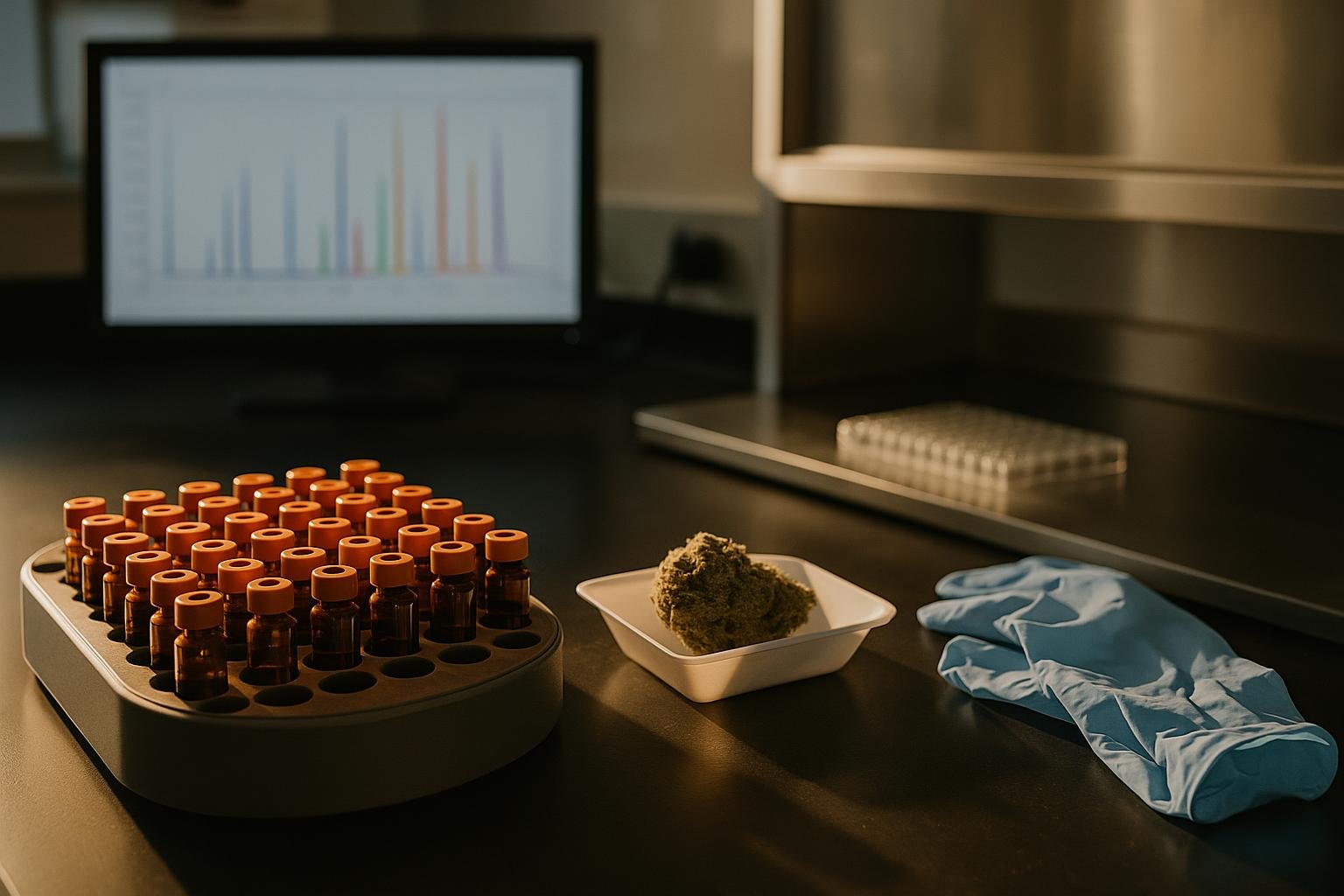
A Certificate of Analysis is the single most important document in the cannabis supply chain, and most people reading one are guessing at half of what it says. This article walks through a real (anonymised) COA section by section — the header, the potency table, the total THC formula, the LOQ flags, the pass/fail columns, and the accreditation marks — so that whether you’re a technician who just ran the assay, a lab director reviewing a batch release, or a grower trying to understand why your 25% flower failed, you leave knowing exactly what every field means and what to do about it.
Whether you are a bench technician learning to interpret your own instrument output, a lab director setting batch-release criteria, or a cultivator or manufacturer trying to decode what the lab sent back — this article is for you. Consumers looking for dispensary recommendations are not the audience here.
Here is what we are covering:
- The COA header and what the accreditation marks actually certify
- The potency table: THCA, THC, and every other cannabinoid column
- The total THC formula and the 0.877 factor explained from first principles
- The LOQ flag and why “<LOQ” is not the same as zero
- Pass/fail columns and how state programs use them
- Hemp vs. marijuana compliance thresholds on the same document
Step 1: Read the Header Before You Read a Single Number
The header of a COA is not boilerplate. It tells you whether the document is legally meaningful or just a piece of paper with numbers on it.
The first thing to check is the laboratory’s accreditation status. Look for ISO/IEC 17025:2017 accreditation — that is the international standard for testing and calibration laboratory competence. Many state regulators require accreditation by an ILAC-recognized body; Michigan, for example, requires cannabis labs to achieve ISO/IEC 17025:2017 accreditation within one year of licensure, and its rules specify an ILAC-recognized accreditation body or other agency-approved entity. Check your specific state program’s requirements to confirm what is mandated. The accreditation body’s logo, the lab’s accreditation number, and the scope of accreditation should all appear in the header. If any of those are missing, request the lab’s current scope certificate before relying on the results for compliance.
Next, check the sample ID and batch ID. These link the COA to the physical sample that was tested. In California, the licensed testing lab must upload the COA to the track-and-trace system and send a copy to the Department of Cannabis Control. The sample ID on your COA should match what is in the track-and-trace record. If it does not, you have a chain-of-custody problem, not an analytical problem.
Also check the report date and the sample receipt date. The gap between them tells you something about the lab’s turnaround. Any amended COA should carry a visible amendment date and a reason for the change — ask for it if it is not there.
Finally, confirm the matrix. A COA for flower is not interchangeable with a COA for an edible made from that flower — the sample prep, the dilution factors, and the applicable limits are all different.
Step 2: Decode the Potency Table Column by Column
The potency table is where most of the confusion lives. A typical table lists individual cannabinoids — THCA, delta-9 THC, CBDA, CBD, CBG, CBN, and sometimes eight or more others — with results expressed as a percentage by weight (for flower and concentrates) or in mg per serving or mg per unit (for edibles).
Here is what each column type means:
- Analyte name: The specific cannabinoid being reported. THCA and delta-9 THC are separate rows because they are chemically distinct compounds with different regulatory significance.
- Result: The measured concentration in the sample as received. For flower, this is typically % w/w (weight of analyte per weight of sample, expressed as a percentage).
- LOQ: The limit of quantitation (the lowest concentration the method can measure with acceptable precision). Michigan’s technical guidance requires labs to establish an LOQ of 1.0 mg/g or lower for all required cannabinoids. If a result is reported as “<LOQ” or “ND” (not detected), it means the analyte was either absent or present below that threshold — it does not mean the analyte is definitively zero.
- Pass/Fail: Some COA formats include a pass/fail column for each analyte where a regulatory limit exists. The New Jersey Cannabis Regulatory Commission publishes guidance on reading COAs that covers how pass/fail determinations are applied across safety and potency categories.
The most important thing to understand about the potency table is that THCA and THC are not additive in a simple way — you need the conversion formula to get a compliance-relevant total.
For method context: HPLC-UV and LC-MS/MS are the most common instrument platforms for potency testing, with GC-FID as an alternative for certain matrices. For a deeper look at how these separations work, see our cannabinoid separation methods guide.
Step 3: Apply the Total THC Formula — and Understand Why 0.877 Exists
The number that determines whether your product passes or fails is not the THC row — it is the calculated total THC, and if you are not running the formula yourself, you are trusting a number you cannot verify.
The total THC formula is: THCA × 0.877 + THC. Here is where 0.877 comes from.
THCA is the acidic precursor to THC. When cannabis is heated — smoked, vaped, or decarboxylated (the process of removing a carboxyl group via heat) — THCA loses a CO₂ molecule and converts to delta-9 THC. Molecular weight of THCA is 358.5 g/mol; molecular weight of THC is 314.5 g/mol. The ratio 314.5 ÷ 358.5 = approximately 0.877. That factor converts the mass of THCA in the raw sample into the equivalent mass of THC it would produce after full decarboxylation.
A worked example: suppose your COA shows THCA at 22.0% and delta-9 THC at 0.8%.
- THCA × 0.877 = 22.0 × 0.877 = 19.29%
- Plus delta-9 THC = 0.8%
- Total THC = 20.09%
This is the number that matters for most state potency labeling requirements.
Note: For hemp compliance, the stakes of this formula are even higher. Under 7 U.S.C. 1639o(1) as amended by P.L. 119-37, hemp is defined by total tetrahydrocannabinols — explicitly including THCA — at not more than 0.3 percent on a dry weight basis. The older framing of hemp as a delta-9-THC-only limit is the superseded pre-amendment language. If you are reading a hemp COA and only looking at the delta-9 THC row, you may be misreading a compliant or non-compliant sample. USDA also requires hemp results to be reported on a dry weight basis, which may differ from how some marijuana COAs express results.
For a deeper dive into how potency is determined instrumentally, see our technical overview of potency determination.
Step 4: Interpret the LOQ Flag and the Pass/Fail Column Correctly
Two fields on a COA cause more misreading than any others: the LOQ flag and the pass/fail column. Getting these wrong has real consequences — either releasing a non-compliant batch or quarantining a perfectly good one.
“<LOQ” is not the same as zero, and “PASS” in one column does not mean the batch passed all required testing.
When a result is flagged as “<LOQ,” it means the instrument detected a signal — or did not — but the concentration is below the threshold the method can reliably quantify with acceptable precision. Michigan requires labs to establish an LOQ of 1.0 mg/g or lower for cannabinoids. A result of <1.0 mg/g for a minor cannabinoid like CBN is not alarming — it just means CBN is present at a trace level the method cannot pin down precisely. For a pesticide or a mycotoxin, however, a <LOQ result near the action limit deserves more scrutiny: ask the lab what the LOQ is for that specific analyte and compare it to the state’s action limit.
The pass/fail column is batch-level, not analyte-level. A COA may show PASS for potency and still show FAIL for microbials if the batch was tested for both. Read every category row, not just the potency section.
I suggest labs take it a step further and include the applicable action limit in the pass/fail column — not just the word PASS — so that a grower or manufacturer can see how much margin exists between the result and the limit. Some state programs require this; others do not. If your COA does not show the limit, ask for it.
Note: For concentrates and edibles, the same batch may carry multiple COAs — one for the input material and one for the finished product. The relevant compliance document for sale is always the finished-product COA. See our compliance testing overview for how batch sampling works across product types.
Step 5: Check the Method and Sampling Footnotes
The bottom of a COA — the section most people never read — contains the method references, sampling information, and QC summary. This is where a technically literate reader can assess whether the numbers in the table are trustworthy.
The method footnote should name a published, peer-reviewed or standards-body method, not just a proprietary internal procedure with no external reference.
Michigan’s technical guidance requires analytical methodologies to be based on published peer-reviewed methods and internally verified according to AOAC Official Methods of Analysis Appendix J or K. If the COA cites a recognised standards-body method — such as an AOAC Official Method or an ASTM standard — you have a traceable method reference. If it cites only “in-house method,” ask for the validation summary.
Also check the sample weight. Michigan requires a minimum 0.5 gram representative sample for cannabinoid profile testing. If the sample weight is not stated, or if it is suspiciously small, the representativeness of the result is questionable — especially for heterogeneous matrices like whole flower.
For method validation context — what R-squared, recovery, and precision criteria a method should meet before it is used for compliance — see our method validation guide.
Note: Portable and handheld devices (near-infrared, FT-IR) exist for rapid in-field potency screening. However, no state program I am aware of accepts a handheld device result as the compliance COA — these are screening tools, not release documents. The compliance COA must come from an accredited laboratory.
Quick answers
What is the total THC formula on a cannabis COA? Total THC is calculated as THCA × 0.877 + THC, where 0.877 is the molecular-weight conversion factor that accounts for the CO₂ lost when THCA decarboxylates into THC. This means a flower with 20% THCA and 1% THC would report a total THC of about 18.54%. The formula matters because raw flower is mostly THCA, so the THC number alone dramatically understates potency.
What does LOQ mean on a cannabis lab report? LOQ stands for limit of quantitation — the lowest concentration the lab can measure with acceptable precision and accuracy, not just detect. Michigan’s technical guidance requires labs to establish an LOQ of 1.0 mg/g or lower for all required cannabinoids. Any result reported as less-than-LOQ means the analyte was either absent or present below the threshold the method can reliably quantify.
How much does a cannabis potency test cost? Published lab price lists show potency panels running roughly $75–$85 per sample for a multi-cannabinoid profile. The underlying instrument cost per run is much lower than the compliance price, but overhead, staff, QC samples, and accreditation costs make up the rest of what you pay.
Can a lab change a COA after it has been issued? Most state programs have amendment rules requiring labs to document any change to a COA after issuance, and California requires the lab to upload the COA to the track-and-trace system and send a copy to the Department of Cannabis Control. If you receive a corrected COA, ask the lab for the amendment authorization documentation. Check your state regulator’s page for the specific amendment procedure that applies.
What accreditation mark should I look for on a cannabis COA? Look for ISO/IEC 17025:2017 accreditation — that is the international standard for testing laboratory competence. Many state regulators, including Michigan, require accreditation by an ILAC-recognized body, but check your specific state program’s requirements. The accreditation body’s logo and scope number should appear on the COA header; if they are missing, ask the lab for its current scope of accreditation.
Does a cannabis COA apply to hemp the same way it applies to marijuana? The document format is similar, but the compliance threshold is different. Under 7 U.S.C. 1639o(1) as amended by P.L. 119-37, hemp is defined by total tetrahydrocannabinols — including THCA — at not more than 0.3 percent on a dry weight basis, so the total THC formula is the operative number for hemp compliance, not delta-9 THC alone. USDA also requires hemp test results to be reported on a dry weight basis, which may differ from how some marijuana COAs express results.
Sources
- California Department of Cannabis Control — Testing Laboratories
- New Jersey Cannabis Regulatory Commission — How to Read a COA (PDF)
- New Jersey Cannabis Regulatory Commission — Third-Party Testing Requirement
- New York Cannabis Control Board — CHIP Academy: How to Read a COA (PDF)
- Washington State Liquor and Cannabis Board — Providing Certificates of Analysis on Request
- Washington State LCB — Cannabinoid Science Work Group Recommendations (PDF)
- Michigan Cannabis Regulatory Agency — Sampling and Testing Technical Guidance (PDF)
- Michigan Administrative Code R 420.305
- USDA Agricultural Marketing Service — Hemp Laboratory Testing Guidelines
- 7 U.S.C. 1639o — Hemp Definition (Cornell LII)
- Congressional Research Service — IF13136: Hemp and the 0.877 Conversion Factor (PDF)
- Vermont Agency of Agriculture — Cannabis Quality Control Plan (PDF)
- Adams Independent Testing / Hemp Inspection — Pricing
- Cannabiz Labs — Pricing
- Conflabs — Pricing
- PubChem — delta9-Tetrahydrocannabinolic acid (THCA)
- PubChem — Tetrahydrocannabinol (THC)
- PMC — Decarboxylation of THCA to THC
- Shimadzu — Cannabis Lab Start-Up Guide (PDF)
- Lab Overflow — Cannabis Testing Market 2026
FAQ
Frequently asked
- what is the total THC formula on a cannabis COA
- Total THC is calculated as THCA × 0.877 + THC, where 0.877 is the molecular-weight conversion factor that accounts for the CO₂ lost when THCA decarboxylates into THC. This means a flower with 20% THCA and 1% THC would report a total THC of about 18.54%. The formula matters because raw flower is mostly THCA, so the THC number alone dramatically understates potency.
- what does LOQ mean on a cannabis lab report
- LOQ stands for limit of quantitation — the lowest concentration the lab can measure with acceptable precision and accuracy, not just detect. Michigan's technical guidance requires labs to establish an LOQ of 1.0 mg/g or lower for all required cannabinoids. Any result reported as less-than-LOQ means the analyte was either absent or present below the threshold the method can reliably quantify.
- how much does a cannabis potency test cost
- Published lab price lists show potency panels running roughly $75–$85 per sample for a multi-cannabinoid profile. The underlying instrument cost per run is much lower than the compliance price, but overhead, staff, QC samples, and accreditation costs make up the rest of what you pay.
- can a lab change a COA after it has been issued
- Most state programs have amendment rules requiring labs to document any change to a COA after issuance, and California requires the lab to upload the COA to the track-and-trace system and send a copy to the Department of Cannabis Control. If you receive a corrected COA, ask the lab for the amendment authorization documentation. Check your state regulator's page for the specific amendment procedure that applies.
- what accreditation mark should I look for on a cannabis COA
- Look for ISO/IEC 17025:2017 accreditation — that is the international standard for testing laboratory competence. Many state regulators, including Michigan, require accreditation by an ILAC-recognized body, but check your specific state program's requirements. The accreditation body's logo and scope number should appear on the COA header; if they are missing, ask the lab for its current scope of accreditation.
- does a cannabis COA apply to hemp the same way it applies to marijuana
- The document format is similar, but the compliance threshold is different. Under 7 U.S.C. 1639o(1) as amended by P.L. 119-37, hemp is defined by total tetrahydrocannabinols — including THCA — at not more than 0.3 percent on a dry weight basis, so the total THC formula is the operative number for hemp compliance, not delta-9 THC alone. USDA also requires hemp test results to be reported on a dry weight basis, which may differ from how some marijuana COAs express results.
Related guides
All guides- 01
Cannabis Lab 101: Cannabis Edibles Testing Cost — Why Infused Products Cost More to Test
I spent four years running potency assays on everything from flower to fudge, and infused products always took longer and cost more. Here is exactly why — matrix effects, homogeneity requirements, and the extra sample prep no one explains — plus real prices from published lab menus.
- 02
Cannabis Lab 101: How Many Cannabis Testing Labs Are There in the US? A State-by-State Count
I spent time digging through state regulator license lists so you don't have to. This piece explains why there is no single national count, walks through what the official state-by-state lists actually show, and tells you exactly how to verify whether any lab you work with holds a current license and ISO/IEC 17025 accreditation.
- 03
Cannabis Lab 101: Non-Laboratory Cannabis Testing — What Handheld and Benchtop Devices Can and Cannot Tell You
I spent four years running potency assays on a benchtop HPLC, and I still get asked whether a handheld NIR or a TLC spot kit can replace a lab result. Here is an honest breakdown of what each device class actually measures, where the published accuracy data land, and why none of them count as compliance tests.
Need this tested?
Compare labs that run these assays and get quotes in one go — no account, no fee.