· 9 min read
Cannabis Lab 101: Water Activity and Moisture Content — The Two Numbers That Decide Shelf Life
I spent years watching growers argue with fail results they didn't understand. This article explains what water activity and moisture content actually measure, where the 0.65 aw limit comes from, what instrument the lab uses, and exactly how flower ends up failing — so you can prevent it.
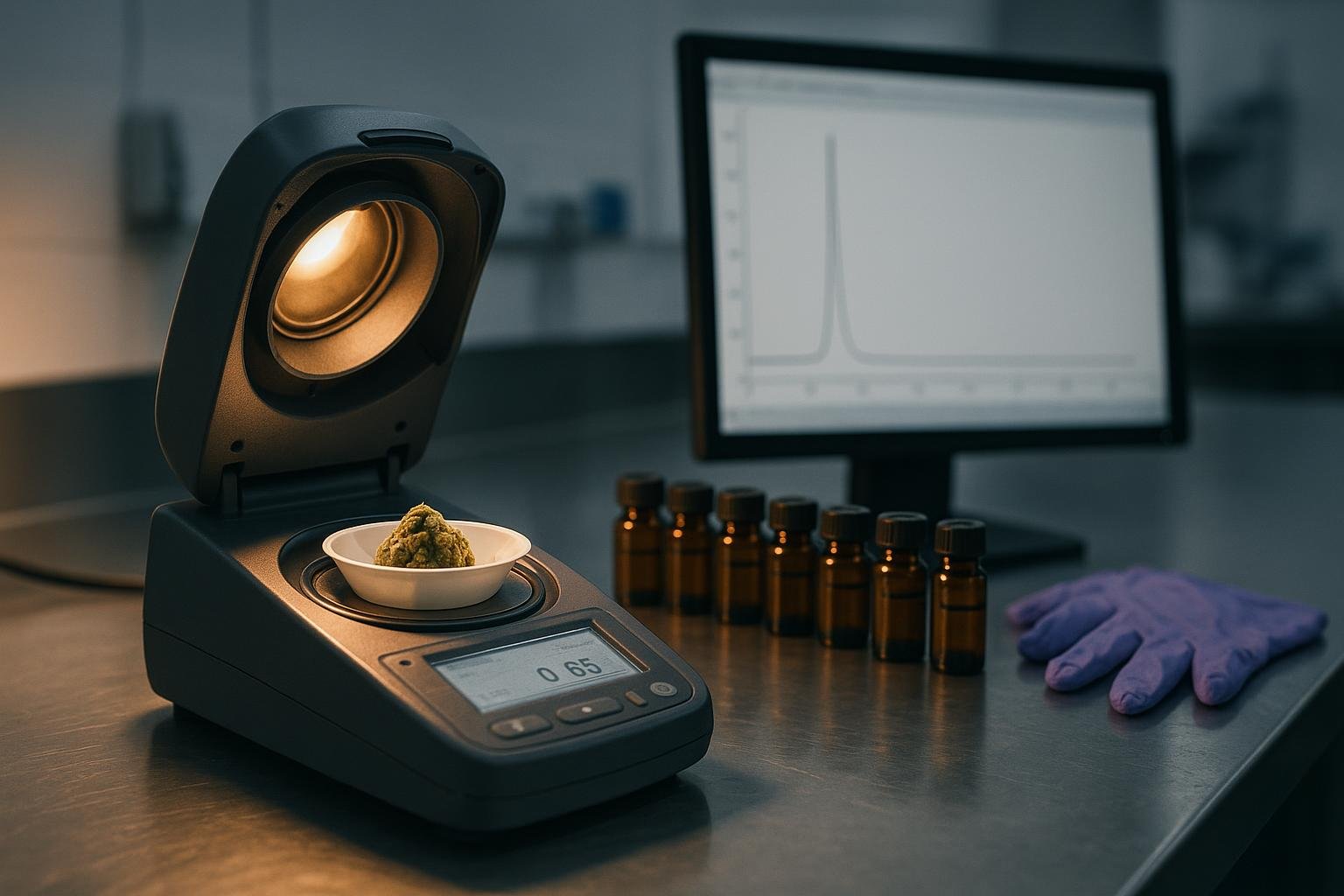
Water activity and moisture content sound like they measure the same thing. They do not — and confusing them is one of the most common reasons a grower’s flower fails compliance testing and cannot be released for retail sale. This article explains what each measurement actually captures, where the 0.65 a_w limit comes from and which regulations enforce it, what instrument the lab puts your sample into, and what you can do before the sample ever leaves the farm to avoid a fail.
Whether you are a grower trying to understand why your cure matters to the lab, a technician setting up a water-activity method for the first time, or a lab director writing an SOP against a specific regulatory citation — this article gives you the numbers, the instrument specs, and the regulation clauses you need. Consumers looking for dispensary recommendations and investors looking for market data will not find either here.
What is coming:
- The conceptual difference between a_w and moisture content, and why regulators care about one more than the other
- Where the 0.65 threshold comes from — ASTM standard and state regulation citations
- Product-specific limits (flower vs. edibles) and how they differ by jurisdiction
- The instrument class, calibration requirements, and method standard the lab uses
- How growers fail — and what ASTM says to do about it
Step 1: Understand what water activity and moisture content actually measure
Moisture content is a quantity measurement. You weigh a sample, drive off the water — by heat, by desiccant, or by another gravimetric method — and report what percentage of the original mass was water. It answers the question: how much water is in here?
Water activity, written as a_w, is an availability measurement. It compares the vapor pressure of water in your sample to the vapor pressure of pure water at the same temperature; pure water has an a_w of 1.00 under that definition, and bone-dry silica gel approaches 0.00. Cured cannabis flower in good condition sits somewhere in between. It answers the question: how free is that water to move, evaporate, and support biological activity?
The practical consequence: a moisture-content result does not by itself establish how much water is available to support microbial growth. Two samples with identical moisture percentages can have meaningfully different a_w values depending on how tightly the water is bound to sugars, cell walls, and other matrix components. Water activity is the measurement regulators use to assess mold risk because it directly predicts whether microorganisms can grow — moisture percentage alone does not.
Do not equate the two numbers. Oregon’s OAR 333-007-0420 treats water activity and moisture content as separate reported measurements with separate consequences, and a sample can fail water activity independently of its moisture content result. California’s 4 CCR § 15717 requires reporting both water activity and percentage moisture content for dried flower, with a water-activity pass criterion expressly stated in the rule. For more on how compliance testing is structured, see our introduction to cannabis compliance testing.
Step 2: Trace the 0.65 threshold to its actual sources
The 0.65 a_w limit is not a single federal rule — it is a value that appears in multiple state regulations and in an ASTM storage specification, each for its own stated reason.
Here is where it actually lives:
California — 4 CCR § 15717 requires licensed labs to test dried flower and pre-rolls for water activity and sets the pass criterion at a_w not exceeding 0.65. A batch that fails water-activity testing may not be released for retail sale.
Oregon — OAR 333-007-0420 requires usable marijuana to be tested for both water activity and moisture content. Water activity above 0.65 a_w fails the sample. Moisture content above 15 percent is reported to the licensee but does not cause the sample to fail under the current rule. The two measurements carry separate consequences.
ASTM D8197-22 — This storage specification defines an acceptable a_w range of 0.55 to 0.65 for dry cannabis flower intended for human or animal use. It gives the reasoning explicitly: a_w below 0.65 helps prevent undesirable microbial growth including mold; a_w above 0.55 helps prevent physical damage such as breakage during handling and storage. The standard is not a regulation, but it is the technical backbone that informed several state rules.
Note: The 0.65 value is not universal. Some jurisdictions use different limits or apply product-specific rules. Always check the codified regulation in your state — not a summary document — before writing your SOP. No single national limit applies in every U.S. jurisdiction.
Note: Product category changes the limit. California sets 0.85 a_w for solid edible cannabis products under the same 4 CCR § 15717. If your lab handles edibles and concentrates alongside flower, you need the correct limit for each product type.
Step 3: Set up the instrument correctly
The instrument class for direct water-activity measurement is a calibrated water-activity meter — sometimes called an a_w measurement system. ASTM D8196-22 is the standard that covers the recommended procedure for determining water activity in cannabis flower. It specifies instrument requirements including resolution, accuracy, temperature performance, and calibration — consult the full standard for those figures, as the published sample does not reproduce them in full.
Calibration: ASTM D8196-22 requires use of a calibrated a_w meter. The 0.65 pass/fail threshold sits in the middle of the typical cannabis a_w range, which is exactly why bracketing calibration points on either side of that value matter — do not rely on a single-point check and call it calibrated.
Sample handling: ASTM D8196-22 specifies that freshly sampled cannabis flower should be tested with a calibrated water-activity meter. Exposure time between sampling and measurement matters — water equilibrates with ambient air, so a sample left open on the bench before loading will give you a reading that reflects your lab’s humidity, not the product’s actual condition.
Method acceptance: If your state has not specified a method, ASTM D8196-22 is the defensible default — it is the only cannabis-specific water-activity standard with a published instrument specification.
Moisture content is a separate measurement with a separate instrument. The primary sources do not establish a single universally required method across jurisdictions, so check your state rule for whether it specifies gravimetric loss-on-drying, Karl Fischer titration (a coulometric or volumetric method that reacts water with a reagent to quantify it), or another approach. For method validation considerations that apply to both measurements, see our method validation guide.
Note: The ASTM news article on cannabis standards describes D8196 and D8197 as a paired system — one covers measurement procedure, the other covers storage specification. A lab running compliance testing needs D8196. A grower or manufacturer trying to maintain product within spec during storage should also read D8197.
Step 4: Understand how growers fail — and what ASTM says to do about it
Most water-activity failures I have seen come from one of three places: inadequate cure time, poor environmental control during cure or storage, or packaging that traps residual moisture. The instrument does not lie — if the flower went into the jar too wet, the meter will find it.
The two failure modes per ASTM D8197-22:
ASTM D8197 identifies two distinct problems at opposite ends of the scale. Flower above 0.65 a_w risks undesirable microbial growth including mold. Flower below 0.55 a_w risks physical damage — brittleness and breakage during handling and storage. The acceptable window is narrow: 0.55 to 0.65 a_w.
What to do if you are above 0.68 a_w: ASTM D8197 states that flower above 0.68 a_w requires further drying to bring the material into the 0.55–0.65 range. Co-storage with humidity-control sachets is not sufficient at that level — you need active drying first.
What to do if you are between 0.65 and 0.68 a_w: ASTM D8197 provides that flower below 0.68 a_w can be brought into the specified range through co-storage with appropriately designed salt-based humidity-control sachets (packets containing a saturated salt solution that equilibrate the headspace to a target relative humidity). This is a common grower practice, but the sachets need to be matched to the target a_w, not just grabbed off a shelf.
The moisture-content trap: Do not assume that hitting 15 percent moisture means your a_w will be fine. Oregon’s rule sets separate consequences for the two measurements — water activity above 0.65 fails the sample, while moisture content above 15 percent is reported to the licensee without causing a fail under the current rule. There is no reliable universal conversion between a moisture percentage and a specific a_w value across all cultivars, particle sizes, and curing conditions. Measure both, report both, and treat them as separate numbers.
For growers trying to understand why the lab’s result matters to the microbiology panel, our mycotoxins article explains what grows when water activity is too high and why it matters for human health. For the cost side of compliance testing, see our cost-per-sample breakdown.
Quick answers
What is the water activity limit for cannabis flower? In California and Oregon, dried cannabis flower fails if water activity exceeds 0.65 a_w — that limit appears in California Code of Regulations Title 4 § 15717 and Oregon Administrative Rule OAR 333-007-0420. The 0.65 value is not a universal national standard; check your own state’s codified rules for the applicable limit.
What is the difference between water activity and moisture content in cannabis? Moisture content reports how much water is in the sample as a mass-over-mass percentage, while water activity (a_w) measures how available that water is — specifically its vapor pressure relative to pure water, where pure water has an a_w of 1.00. Two samples can have identical moisture percentages but different water-activity values depending on how tightly the water is bound to the plant matrix. Regulations use water activity to assess microbial risk because it is the measurement that directly predicts whether mold can grow.
What instrument does a cannabis lab use to measure water activity? Labs use a calibrated water-activity meter, sometimes called an a_w measurement system. ASTM D8196-22 is the standard practice for determining water activity in cannabis flower and specifies the instrument requirements; consult the full standard for the applicable resolution, accuracy, and calibration requirements. The standard is the defensible baseline for any compliance lab setting up this measurement.
Can cannabis flower fail water activity testing even if it looks and smells dry? Yes — flower can appear visually dry and still carry enough available moisture to support mold growth if a_w exceeds 0.65. Water activity is not detectable by sight or smell; only a calibrated meter gives you the number. This is exactly why regulators require instrument-based testing rather than a grower’s visual assessment.
Is the water activity limit the same for edibles as for flower? No. California sets a 0.65 a_w limit for dried flower and pre-rolls but allows solid edible cannabis products up to 0.85 a_w under 4 CCR § 15717. Product-category limits vary by jurisdiction, so always confirm the limit that applies to your specific product type in your state’s codified rules.
Does a 15 percent moisture content mean cannabis will pass water activity testing? Not necessarily. Oregon’s OAR 333-007-0420 treats moisture content and water activity as separate reported measurements with separate consequences — water activity above 0.65 fails the sample, while moisture content above 15 percent is reported to the licensee without causing a fail under the current rule. There is no universal conversion between a given moisture percentage and a specific a_w value across all cultivars, particle sizes, and curing conditions, so a 15 percent moisture reading does not guarantee a passing a_w result.
Sources
- ASTM D8196-22 sample — ASTM standard for water activity in cannabis flower
- ASTM D8197-22 — ASTM standard for cannabis flower storage specification
- ASTM news: Two cannabis standards you should know about
- California Code of Regulations, Title 4, § 15717 — water activity and moisture content requirements
- Oregon Administrative Rules, OAR 333-007-0420 — usable marijuana testing requirements
- NJ-CRC webpage noting guidance rescission (March 4, 2025)
FAQ
Frequently asked
- what is the water activity limit for cannabis flower
- In California and Oregon, dried cannabis flower fails if water activity exceeds 0.65 aw — that limit appears in California Code of Regulations Title 4 § 15717 and Oregon Administrative Rule OAR 333-007-0420. The 0.65 value is not a universal national standard; check your own state's codified rules for the applicable limit.
- what is the difference between water activity and moisture content in cannabis
- Moisture content reports how much water is in the sample as a mass-over-mass percentage, while water activity (aw) measures how available that water is — specifically its vapor pressure relative to pure water, where pure water has an aw of 1.00. Two samples can have identical moisture percentages but different water-activity values depending on how tightly the water is bound to the plant matrix. Regulations use water activity to assess microbial risk because it is the measurement that directly predicts whether mold can grow.
- what instrument does a cannabis lab use to measure water activity
- Labs use a calibrated water-activity meter, sometimes called an aw measurement system. ASTM D8196-22 is the standard practice for determining water activity in cannabis flower and specifies the instrument requirements; consult the full standard for the applicable resolution, accuracy, and calibration requirements. The standard is the defensible baseline for any compliance lab setting up this measurement.
- can cannabis flower fail water activity testing even if it looks and smells dry
- Yes — flower can appear visually dry and still carry enough available moisture to support mold growth if aw exceeds 0.65. Water activity is not detectable by sight or smell; only a calibrated meter gives you the number. This is exactly why regulators require instrument-based testing rather than a grower's visual assessment.
- is the water activity limit the same for edibles as for flower
- No. California sets a 0.65 aw limit for dried flower and pre-rolls but allows solid edible cannabis products up to 0.85 aw under 4 CCR § 15717. Product-category limits vary by jurisdiction, so always confirm the limit that applies to your specific product type in your state's codified rules.
- does a 15 percent moisture content mean cannabis will pass water activity testing
- Not necessarily. Oregon's OAR 333-007-0420 treats moisture content and water activity as separate reported measurements with separate consequences — flower can fail water activity independently of its moisture content result. There is no universal conversion between a given moisture percentage and a specific aw value across all cultivars, particle sizes, and curing conditions, so a 15 percent moisture reading does not guarantee a passing aw result.
Related guides
All guides- 01
An Introduction to Cannabis Compliance Testing
There is an increased demand for quality of Cannabis testing as the legalization of Cannabis storms through most to all of the United States and Canada. Unfortunately, as the rise in popularity of cannabis products continues over the years, the regulatory landscape has become substantially more difficult to navigate in the US.
- 02
Cannabis Lab 101: Cannabis Edibles Testing Cost — Why Infused Products Cost More to Test
I spent four years running potency assays on everything from flower to fudge, and infused products always took longer and cost more. Here is exactly why — matrix effects, homogeneity requirements, and the extra sample prep no one explains — plus real prices from published lab menus.
- 03
Cannabis Lab 101: Cannabis Lab Technician Salary by State and Role
I pulled every sourced number I could find from ZipRecruiter, Indeed, and Salary.com to build a real salary table by role — from sample-prep tech to lab manager. Here is what the data actually says, what drives the spread, and how to negotiate your next offer.
Need this tested?
Compare labs that run these assays and get quotes in one go — no account, no fee.