· 12 min read
Cannabis Lab 101: How to Spot a Fake Cannabis COA (Field-by-Field Verification Checklist)
I spent four-plus years on the bench watching COAs get altered, recycled, and outright fabricated. This checklist walks you through every required field on a cannabis certificate of analysis so you can tell a genuine lab report from a fraudulent one before a product moves another inch.
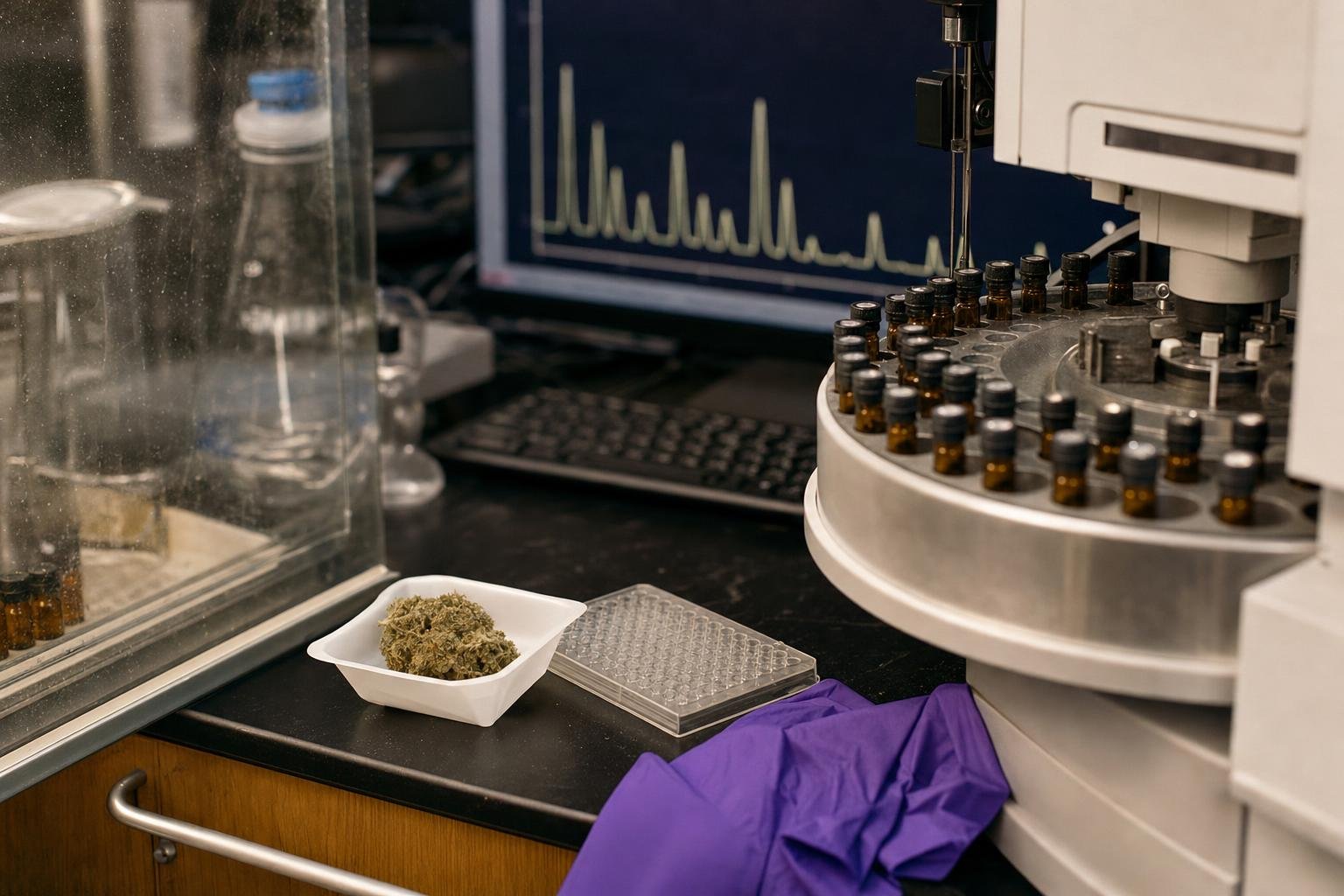
A cannabis certificate of analysis is only as trustworthy as the process that produced it. Fabricated COAs, recycled results from a different batch, and documents altered after the fact are real problems in licensed markets, and the consequences range from a failed regulatory audit to a product recall to criminal charges. This checklist walks you through every required field so you can tell a genuine lab report from a fraudulent one before a product moves another inch.
Whether you are a dispensary buyer receiving a new vendor’s product, a compliance officer auditing your supply chain, a grower trying to understand what your lab just sent you, or a regulator reviewing submitted documentation, this article gives you a field-by-field verification workflow you can run right now. It assumes you have the COA in front of you and access to a browser.
Here is what this article covers:
- Laboratory identity: license number and state registry lookup
- Accreditation number and scope: why the ISO logo alone is not enough
- Sample identifiers and track-and-trace cross-check
- Date chain: collection, receipt, and analysis dates
- Results, units, and pass/fail reporting
- LOQ values and what their absence signals
- Analyst approval fields
- QR code and portal verification
- Red flags that most commonly indicate a fraudulent or altered document
Step 1: Verify the Laboratory’s License and Accreditation Scope
The first thing you check is not the numbers. It is whether the laboratory that signed the document is legally allowed to produce it.
Pull the laboratory name from the COA and look it up in the state regulator’s licensed-laboratory registry. Every licensed state maintains one. If the name does not appear, or if the license number on the COA does not match the registry entry, stop there. A document from an unlicensed laboratory is not a compliant COA regardless of how professional it looks.
Next, find the accreditation number. Nevada’s Cannabis Compliance Board Regulation 11 requires each independent cannabis testing laboratory to achieve ISO/IEC 17025 accreditation within one year of licensure, and that accreditation must cover all analytes required under Regulation 11.050. Nevada is a useful benchmark because its rule makes explicit what many states imply: the accreditation number must be real, and the scope must match what the laboratory is reporting.
The critical step most people skip is checking the scope document, not just the certificate. ANAB is explicit that accreditation covers only the tests, matrices, and methods listed in a laboratory’s scope. A COA that displays an ISO/IEC 17025 logo for potency testing in flower is not automatically valid for pesticide screening in an infused edible. Go to the accreditor’s public directory, pull the laboratory’s scope document, and confirm that the specific analyte category and product matrix on the COA appear there. If they do not, the result is outside the laboratory’s validated and accredited capability, which is a material problem even if the number looks plausible.
For more on what ISO/IEC 17025 requires of a cannabis laboratory, see our ISO 17025 audit preparation guide.
Step 2: Check the Sample Identifier Chain
A genuine COA is tied to a specific physical sample. Fabricated or recycled COAs often break down here because the identifiers do not match what is in the regulator’s track-and-trace system.
Locate the sample ID, batch or lot number, and product description on the COA. Then do the following:
- Compare those identifiers with the package label in front of you. Every character should match.
- If the jurisdiction uses a track-and-trace system (California uses Metrc, and California’s DCC regulations at §15726 require the laboratory to upload the COA to that system within one business day of completing all analyses), look up the batch in the system and confirm the COA is attached to that record.
- Michigan requires laboratories to report pass/fail results in Metrc and on the COA itself, per Michigan’s Sampling and Testing Technical Guidance. If the COA shows only numerical results without a pass/fail determination where the jurisdiction requires one, that is a red flag.
A COA that cannot be located in the track-and-trace system for its claimed batch is unverified, full stop.
Also check the product type. A COA issued for flower should not be used to clear a concentrate, even if the strain name matches. The matrix matters because the analytical method, the action limits, and the accreditation scope are all matrix-specific. See our compliance testing overview for how matrix differences affect which tests are required.
Note: For hemp products, the applicable track-and-trace system and COA upload requirements vary by state program. Texas hemp rules require the COA to include the sample received date and analysis dates with corresponding results, per the Texas DSHS rule attachment. Check the specific state program rather than assuming cannabis-market rules apply.
Step 3: Audit the Date Chain and Method References
Dates are where altered COAs most often slip up. The logic is simple: a sample cannot be received before it was collected, and it cannot be analyzed before it was received.
California §15726 requires the COA to include the collection date, laboratory receipt date, analysis dates, and corresponding results. Texas DSHS rules require the same elements. Check each date in sequence:
- Collection date is on or before receipt date.
- Receipt date is on or before the earliest analysis date.
- Analysis dates are consistent with the laboratory’s stated turnaround time. A COA showing a receipt date on a Friday and an analysis date on the same Friday for a full panel that includes microbiology (which typically requires incubation) deserves scrutiny.
- The COA issue date follows all analysis dates.
Next, look at the method references. Michigan’s technical guidance requires methods to be based on published peer-reviewed procedures, independently validated for cannabis testing, and internally verified by the laboratory. A method reference on a legitimate COA should be specific enough to connect the result to a validated procedure. A COA that lists no method reference, or lists only a generic description like “in-house method” with no further detail, is not necessarily fraudulent, but it is a gap worth questioning. Ask the laboratory for the method SOP number and confirm it appears in their accreditation scope.
If any date is missing or the sequence is impossible, do not accept the document.
For context on what method validation actually involves, see our method validation article.
Step 4: Read the Results Table Critically
This is where I see the most creative alteration. Someone changes a failing pesticide result to “ND” (non-detect), adjusts a potency number upward, or copies results from a passing batch onto a different product’s COA.
Here is what to check in the results table:
- Every analyte should have a unit. Potency results are typically reported as percent by weight or milligrams per gram. Pesticide and residual solvent results are typically in micrograms per gram (ug/g) or parts per million. A result with no unit is uninterpretable.
- Non-detect results should reference a limit of quantitation (LOQ). The LOQ (the lowest concentration a method can reliably measure and report as a number) tells you what “not detected” actually means. A COA that reports “ND” for every pesticide with no LOQ values listed does not tell you whether the method was sensitive enough to matter. The absence of LOQ values is not proof of fraud, but it is a verification gap, particularly for pesticide and heavy metals panels. See our pesticide testing guide and heavy metals article for what those panels should look like.
- Pass/fail determinations should appear where the jurisdiction requires them. Michigan requires pass/fail on the COA. A document showing only favorable-looking numbers with no pass/fail column, in a jurisdiction that mandates one, is inconsistent with the reporting requirement.
- Results outside plausible ranges deserve a call to the lab. I am not going to give you a universal “too high” number because action limits and typical ranges vary by analyte, matrix, and state. What I will say is that a potency result that differs dramatically from the same cultivar’s historical results, or a heavy metals result that is exactly at the action limit for every analyte, is worth questioning.
Bold the one thing you take from this section: a result without a unit, a method, and a pass/fail determination where required is an incomplete result, not a verified one.
Note: New York’s Cannabis Laboratory Quality System Standard requires full traceability of cannabis laboratory activities from sample receipt through disposal, including intermediary steps such as accessioning, processing, testing, and reporting. That traceability obligation means a legitimate New York laboratory can produce documentation for every step between receipt and the reported result. If a laboratory cannot produce that chain on request, the COA’s results are unsupported.
Step 5: Scan the QR Code and Verify the Portal Record
This is the fastest single check and the one most people skip.
Washington State Register WSR 26-20-094 is a proposed rule that would require product labels for medical-grade cannabis products to include an internet link, web address, or QR code providing the product’s required COA. Texas DSHS rules require the product label to include a conspicuously marked URL linking to the required COA, and the COA itself must carry a QR code that verifies the authenticity of testing conducted at an accredited laboratory.
When you scan the code:
- Note where it resolves. It should go to the laboratory’s secure portal, the state regulator’s system, or an authorized verification service. A URL that resolves to a generic file-hosting service or a static PDF with no authentication layer is not a verification portal.
- Compare every identifier in the portal record with the paper document: sample ID, batch number, product name, collection date, receipt date, analysis dates, and every numerical result. Any discrepancy between the portal record and the paper document means one of them has been altered.
- If the QR code is missing, dead, or leads to a page with different identifiers than the paper COA, treat the document as unverified and contact the laboratory directly before the product moves.
A QR code that does not reproduce the same identifiers and results as the paper document is a failed verification, regardless of how the rest of the COA looks.
For a broader picture of what the lab is doing before that COA is ever generated, see our compliance testing overview and cost-per-sample breakdown.
Step 6: Escalate When Verification Fails
Verification is not a binary pass/fail you handle alone. When a COA fails one or more of the checks above, here is the escalation path:
- Call the laboratory directly and ask them to pull the sample record by the sample ID on the document. A legitimate laboratory can do this in minutes. If they cannot locate the record, or if the record they pull does not match the document, the COA is not theirs.
- Contact the state regulator. Every licensed cannabis market has a regulatory body that handles COA complaints. In California that is the Department of Cannabis Control. In Nevada it is the Cannabis Compliance Board. In Oklahoma the OMMA Quality Assurance Laboratory uses proficiency testing to verify that licensed laboratories use accurate and consistent methods, and it is the appropriate contact for suspected result manipulation.
- Quarantine the product until the COA is verified or replaced with a new test from a licensed, in-scope laboratory.
- Document everything. Screenshot the QR code destination, note the date and time of your verification attempt, and keep the original document. If this becomes a regulatory matter, your records are your defense.
The COA is a legal document in every licensed cannabis market, and treating an unverified one as valid is a compliance failure that belongs to whoever accepted it.
A 2025 peer-reviewed proposal published in PMC describes a Peer-review Blinded Assay Test (P-BAT) framework in which laboratories analyze portions of the same product without knowing the originating laboratory, then compare results against the original COA. I mention it here because it illustrates the principle underlying all COA verification: results that cannot be reproduced by an independent laboratory under controlled conditions are results that deserve scrutiny. Proficiency testing programs, which Nevada requires within six months of licensure, operate on the same logic.
Quick answers
How can I tell if a cannabis COA is fake? Start by scanning the QR code or visiting the portal URL on the document and confirming that the record it returns matches every identifier on the paper: sample ID, batch number, product name, collection date, and results. Then look up the laboratory’s license on the state regulator’s website and cross-check the accreditation number against the accreditor’s public certificate database. A COA that fails either check should be treated as unverified until the laboratory can explain the discrepancy.
What fields are required on a cannabis certificate of analysis? Required fields vary by state, but California’s regulations at Title 4 CCR §15726 require at minimum the collection date, laboratory receipt date, analysis dates, and corresponding results. Most licensed-state programs also require the laboratory name and license number, accreditation number and scope, sample identifiers, analyte results with units, and pass/fail determinations. Check the specific rule in the jurisdiction where the product was tested, because no single national COA template applies everywhere.
Does an ISO 17025 logo on a COA mean the results are valid? Not automatically. ISO/IEC 17025 accreditation covers only the analytes, matrices, and methods listed in that laboratory’s accreditation scope, not everything the lab chooses to run. You must confirm that the specific test reported on the COA falls within the laboratory’s documented scope by checking the accreditor’s certificate directly.
What does a broken or mismatched QR code on a COA mean? A QR code that leads to a static PDF, a dead page, or a record with different identifiers than the paper document fails the verification purpose that regulators in Washington and Texas have written into their rules. It does not automatically prove fraud, but it is a material red flag that requires a direct call to the laboratory and, if unresolved, escalation to the state regulator.
Can a lab run a test outside its accreditation scope and still issue a COA? A laboratory can generate a document, but a result reported for an analyte or matrix outside its accreditation scope is not a compliant COA under programs that require scope-matched accreditation, including Nevada’s Cannabis Compliance Board Regulation 11. The practical risk is that the result has not been validated under the controls that accreditation requires, so its reliability is unknown.
What is the P-BAT framework and why does it matter for COA verification? The Peer-review Blinded Assay Test, described in a 2025 peer-reviewed proposal, is a framework in which laboratories analyze portions of the same product without knowing which lab produced the original COA, then compare results across labs. It matters because systematic divergence between a COA’s reported values and blinded interlaboratory results is one of the few controlled ways to detect result inflation or fabrication at scale.
Sources
- Nevada Cannabis Compliance Board Regulation 11
- Washington State Register WSR 26-20-094
- ANAB ISO/IEC 17025 Cannabis Testing Laboratory Accreditation Program
- California DCC Regulations, Title 4 CCR §15726
- P-BAT: Peer-review Blinded Assay Test framework (PMC)
- Michigan Sampling and Testing Technical Guidance for Marijuana Products
- Oklahoma Medical Marijuana Authority Quality Assurance Laboratory
- New York Cannabis Laboratory Quality System Standard
- Texas DSHS Consumable Hemp Products Rule Attachment
FAQ
Frequently asked
- how can I tell if a cannabis COA is fake
- Start by scanning the QR code or visiting the portal URL on the document and confirming that the record it returns matches every identifier on the paper: sample ID, batch number, product name, collection date, and results. Then look up the laboratory's license on the state regulator's website and cross-check the accreditation number against the accreditor's public certificate database. A COA that fails either check should be treated as unverified until the laboratory can explain the discrepancy.
- what fields are required on a cannabis certificate of analysis
- Required fields vary by state, but California's regulations at Title 4 CCR §15726 require at minimum the collection date, laboratory receipt date, analysis dates, and corresponding results. Most licensed-state programs also require the laboratory name and license number, accreditation number and scope, sample identifiers, analyte results with units, and pass/fail determinations. Check the specific rule in the jurisdiction where the product was tested, because no single national COA template applies everywhere.
- does an ISO 17025 logo on a COA mean the results are valid
- Not automatically. ISO/IEC 17025 accreditation covers only the analytes, matrices, and methods listed in that laboratory's accreditation scope, not everything the lab chooses to run. You must confirm that the specific test reported on the COA, such as pesticide screening in an edible matrix, falls within the laboratory's documented scope by checking the accreditor's certificate directly.
- what does a broken or mismatched QR code on a COA mean
- A QR code that leads to a static PDF, a dead page, or a record with different identifiers than the paper document fails the verification purpose that regulators in Washington and Texas have written into their rules. It does not automatically prove fraud, but it is a material red flag that requires a direct call to the laboratory and, if unresolved, escalation to the state regulator.
- can a lab run a test that is outside its accreditation scope and still issue a COA
- A laboratory can generate a document, but a result reported for an analyte or matrix outside its accreditation scope is not a compliant COA under programs that require scope-matched accreditation, including Nevada's Cannabis Compliance Board Regulation 11. The practical risk is that the result has not been validated under the controls that accreditation requires, so its reliability is unknown.
- what is the P-BAT framework and why does it matter for COA verification
- The Peer-review Blinded Assay Test, described in a 2025 peer-reviewed proposal, is a framework in which laboratories analyze portions of the same product without knowing which lab produced the original COA, then compare results across labs. It matters because systematic divergence between a COA's reported values and blinded interlaboratory results is one of the few controlled ways to detect result inflation or fabrication at scale.
Related guides
All guides- 01
Cannabis Lab 101: What Happens When a Cannabis Batch Fails Testing (Remediation, Retest, and Destruction Rules)
I spent years reporting failing results to clients and watching the same confused calls follow every time. This article walks cultivators, manufacturers, and QA managers through the three legal outcomes after a cannabis batch fails: remediation, retesting, and mandatory destruction, with the actual rules from California and Oklahoma.
- 02
Cannabis Lab 101: Cannabis Edibles Testing Cost — Why Infused Products Cost More to Test
I spent four years running potency assays on everything from flower to fudge, and infused products always took longer and cost more. Here is exactly why — matrix effects, homogeneity requirements, and the extra sample prep no one explains — plus real prices from published lab menus.
- 03
Cannabis Lab 101: Cannabis Lab Record Retention (What to Keep, How Long, and What Auditors Actually Inspect)
I break down which laboratory records a cannabis testing lab must retain, for how long, and in what format to survive a state regulatory audit or an ISO/IEC 17025 surveillance assessment, covering raw data, chromatograms, COAs, chain-of-custody forms, training files, and corrective action records.
Need this tested?
Compare labs that run these assays and get quotes in one go — no account, no fee.