· 11 min read
Cannabis Lab 101: Terpene Testing by GC (Method, Reference Standards, and Reporting)
I spent years running terpene panels on a GC and watching growers compare results between labs that were measuring completely different compound lists. This article covers headspace vs. liquid injection, FID vs. MS detection, how to read a reference standard certificate, and why two labs can hand you different total-terpene numbers from the same flower.
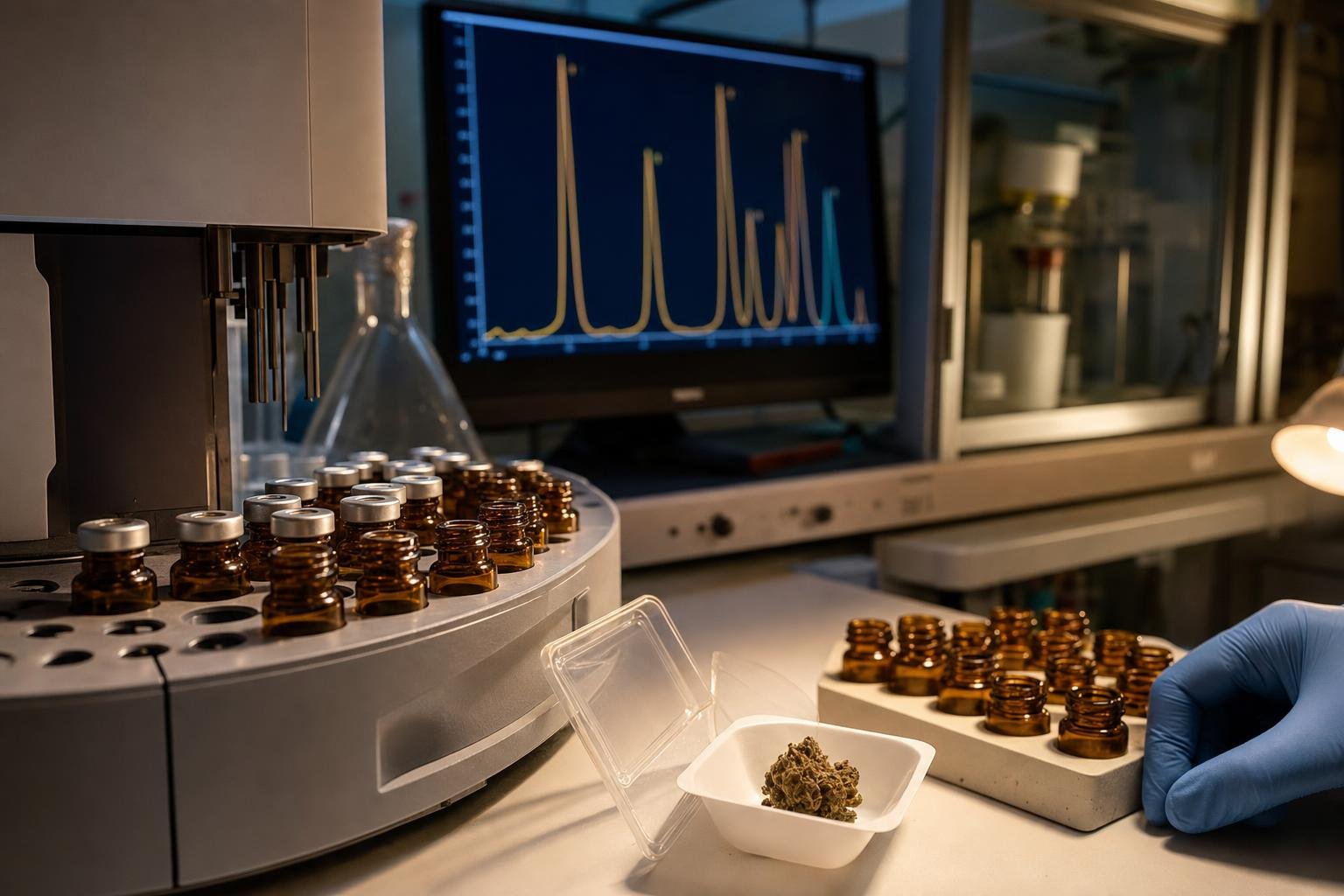
Terpene testing by GC sounds straightforward until you notice that two licensed labs can hand a grower completely different total-terpene numbers from splits of the same flower. The reason is almost never instrument error. It is usually a difference in which compounds each lab is measuring, how the sample was prepared, and what rule the lab uses to sum and report the result. This article goes one level deeper than the simple terpene explainer and gives you the bench-level detail: headspace versus liquid injection, FID versus MS detection, how to read a reference standard certificate, and how to explain interlaboratory variation to a grower without losing their trust.
Whether you are a bench technician setting up a terpene method for the first time, a lab director evaluating a new reference standard vendor, or a cultivator trying to understand why Lab A and Lab B disagree, this article gives you the vocabulary and the decision framework to work through the problem.
What follows covers:
- How static headspace sampling works and why it is preferred over direct injection for flower matrices
- When GC-FID is sufficient and when GC-MS or GC-MS/MS adds necessary value
- What commercial reference standard panels actually contain and what they cost
- Why “total terpenes” is a method-dependent number, not a universal fact
- What one state’s regulatory guidance requires as a concrete example
Step 1: Choose your sample-introduction approach
The first decision in any GC terpene method is how the sample gets onto the column. The two main options in cannabis labs are static headspace sampling and direct liquid injection of a prepared extract.
Static headspace sampling (introducing the gas phase above a heated, sealed sample into the GC rather than the bulk matrix itself) keeps the column clean. Cannabis flower contains waxes, chlorophylls, and other high-molecular-weight compounds that will foul a capillary column quickly if injected directly. In a static headspace method, the sample is weighed into a sealed vial, the vial is heated to a set temperature, terpenes volatilize and equilibrate into the gas phase above the sample, and an aliquot of that gas is swept onto the column. A 2019 Analytical Chemistry paper by Shapira and colleagues used exactly this approach, specifically the full-evaporation technique with a static headspace sampler, to quantify 93 terpenoids in air-dried cannabis inflorescences and extracts.
Direct liquid injection of a solvent extract is faster to set up and does not require a headspace autosampler, but it demands rigorous sample cleanup and a robust column-maintenance schedule. It is more common in labs that run terpenes as part of a broader extract panel.
The critical point is that headspace results and liquid-injection results are not directly interchangeable. The two approaches introduce different sample fractions into the GC, and you should not assume your method gives the same numbers as a competitor’s without running a method-comparison study. See the method validation article for how to structure that comparison.
Note: For cannabis concentrates (wax, shatter, distillate), the matrix is already a semi-liquid and the headspace equilibration behavior differs from flower. Validate your method against the specific matrix class you intend to report.
Step 2: Select your detector, FID or MS
Once the analyte is on the column, you need to detect it. The two detectors you will encounter in cannabis terpene work are the flame-ionization detector (FID) and the mass-spectrometry detector (MS or MS/MS).
A GC-FID (a detector that burns eluting organic compounds in a hydrogen-air flame and measures the resulting ion current) is a reliable, linear, and relatively inexpensive quantitative tool. Its limitation is that it gives you no structural information. You identify a peak by its retention time alone, which means a co-eluting impurity can inflate your result without any warning signal. FID response factors also vary between compound classes, so you need a reference standard for each analyte you want to quantify accurately. Vendors including Ibis Scientific explicitly list their CAN-TERP reference mixtures as compatible with GC-FID as well as GC-MS.
A GC-MS (a detector that fragments eluting compounds with an electron beam and records the resulting mass spectrum) adds a second dimension of identification confidence. You can compare the observed spectrum against a library and flag a peak that does not match the expected fragmentation pattern. GC-MS/MS (tandem mass spectrometry, where a precursor ion is selected and fragmented a second time) adds further selectivity and is the platform used in the 93-terpenoid method referenced above.
I suggest labs running compliance terpene panels use at minimum GC-MS, not GC-FID alone, because the identification confidence justifies the instrument cost when a disputed result goes to a regulator. If your lab already runs GC-MS for residual solvents, the same platform can often be configured for terpenes with a different column and method file, which reduces capital cost.
Note: Some jurisdictions accept GC-FID for terpene reporting. The New Jersey Cannabis Regulatory Commission testing guidance permits methods from the American Herbal Pharmacopoeia cannabis inflorescence monograph or AOAC-certified, USP-validated, ASTM, FDA, or EPA methods when available, without mandating a specific detector type. Check your own state’s primary source.
Step 3: Build your calibration from reference standards
A terpene GC method is only as good as the reference standards behind it. This is where a lot of labs cut corners and then wonder why their results drift.
Commercial cannabis terpene reference standards come in two broad formats: multi-component mixes and single-compound neat standards. For routine calibration, a multi-component mix is practical. Here is what the current market looks like based on listed catalog prices:
- AccuStandard ASTM-P-0151-01: 21-component terpenoid mix at 2,500 micrograms per milliliter in isopropanol, 1-milliliter unit, listed at 210 U.S. dollars.
- AccuStandard ASTM-P-0151-01-IS: single-component internal standard at 1,000 micrograms per milliliter in isopropanol, listed at 115 U.S. dollars per milliliter.
- Ibis Scientific CAN-TERP Mix 1: 100 micrograms per milliliter in methanol, 1-milliliter unit, listed at 218 U.S. dollars.
- Ibis Scientific CAN-TERP Kit: listed at 390 U.S. dollars; a high-level 1,000-microgram-per-milliliter version is listed at 455 U.S. dollars.
- Restek Canna Standard No. 1 via Ibis Scientific: 19-component, 1-milliliter unit, listed at 266 U.S. dollars.
- Restek Canna Terpenes Standard No. 2 via Ibis Scientific: two-component, 1-milliliter unit, listed at 50 U.S. dollars.
- Ibis Scientific TP Mix 2: 21-component mix at 1,000 micrograms per milliliter in methanol, listed at 247 U.S. dollars.
The analyte list on the certificate of analysis is the most important document you will receive with any reference standard. Read it before you order. A 21-component mix covers a commercially practical panel; a published research method such as the 93-terpenoid ACS method requires substantially more standards and instrument time. Neither panel size is universally required: no single national standard mandates a specific terpene count for cannabis compliance testing.
For method validation, the Planta Medica 2019 method targeting ten terpenes (alpha-pinene, beta-pinene, beta-myrcene, limonene, terpinolene, linalool, alpha-terpineol, beta-caryophyllene, alpha-humulene, and caryophyllene oxide) was validated against AOAC guidelines and reported limits of detection of 0.25 micrograms per milliliter and limits of quantitation of 0.75 micrograms per milliliter. Those figures give you a defensible benchmark when you are writing your own validation acceptance criteria for a similar analyte set.
Step 4: Understand why total-terpene numbers vary between labs
This is the section growers ask about most, and it is the one labs are least transparent about.
The “total terpenes” number on a certificate of analysis is a method-dependent sum, not a universal measurement of everything in the sample.
Three sources of variation account for most interlaboratory disagreement:
Analyte list differences. A lab running a 10-analyte panel will almost always report a lower total than a lab running a 21-analyte panel on the same sample, because the second lab is summing more compounds. The Planta Medica 10-analyte method, the 21-component commercial standards from AccuStandard and Ibis Scientific, and the 93-terpenoid ACS method are not evidence for one universal panel. They are evidence that the field has not converged on one.
Sample-introduction differences. Static headspace sampling and direct liquid injection of an extract capture different fractions of the terpene profile. A compound that is abundant in a solvent extract may be underrepresented in a headspace injection if its vapor pressure is low at the equilibration temperature. Results from the two approaches should not be assumed comparable without method-comparison data.
Reporting convention differences. Some labs report terpenes as a percentage of the as-received sample weight. Others apply a moisture correction. Some sum only compounds above the limit of quantitation; others include estimated values between the LOD and LOQ. None of these conventions is universally wrong, but they produce different numbers from the same raw data.
When you receive a terpene COA, ask for the analyte list, the sample-preparation approach, and the reporting rule before you compare it to another lab’s result. A grower who understands this will stop treating terpene totals as a simple ranking metric, which is a conversation worth having early.
Note: New Jersey is one example of a state that has moved toward specifying which terpenes must be reported. The NJ-CRC testing guidance names beta-myrcene, d-limonene, ocimene, and terpinolene among required analytes and sets a 10-percent-by-volume terpene limit for inhalable concentrates. That limit and that analyte list apply in New Jersey. Other states have different or no equivalent requirements; check your state regulator’s current guidance directly.
Step 5: Report results in a way that survives scrutiny
A terpene report that cannot be reproduced or defended is a liability. Here is what a defensible report includes beyond the numbers themselves.
First, list every analyte that was targeted, not just the ones that were detected above the LOQ. A grower or a regulator should be able to see that you looked for beta-caryophyllene and it was below your reporting threshold, rather than wondering whether you measured it at all.
Second, state the sample-preparation approach. Headspace or liquid injection, solvent used, dilution factor, and equilibration conditions are all method-defining parameters. Without them, a result cannot be reproduced.
Third, identify the calibration standard by lot number and the internal standard used. This is standard practice in any accredited lab under ISO 17025 and it is the fastest way to resolve a dispute when a client questions a result.
Fourth, state the reporting basis. Is the result reported on an as-received weight basis, a dry-weight basis, or a volume basis for liquids? For concentrates subject to a regulatory terpene limit, the reporting basis is not a formatting detail. It is the number the regulator will use to determine compliance.
A report that answers all four of those questions is one that holds up when a grower calls to dispute the result or a regulator asks for your raw data.
For labs building out a full compliance testing program, terpene reporting sits alongside potency, pesticides, heavy metals, and mycotoxins as one of several panels that together define a product’s release status. The compliance testing overview and the cost-per-sample breakdown give context for where terpenes fit in the broader workflow.
Quick answers
Why do two labs report different total terpene percentages for the same cannabis sample? The most common reason is that the two labs are measuring different analyte lists: one lab might target 10 terpenes while another targets 21 or more, so the sums cannot be directly compared. Sample preparation also matters, because headspace sampling captures a different fraction of volatiles than a direct liquid injection of an extract. Always ask the lab for its full analyte list before comparing results.
What is the difference between GC-FID and GC-MS for terpene analysis? GC-FID measures how much carbon is burned as each compound elutes, giving a quantitative signal without structural information. GC-MS fragments each eluting compound and records a mass spectrum, which allows positive identification of an analyte by library matching in addition to quantitation. Most compliance labs use GC-MS or GC-MS/MS for terpenes because the identification confidence is higher, though FID remains a valid quantitative tool when retention times are well established.
What does static headspace sampling mean in a GC terpene method? Static headspace sampling means the cannabis sample is sealed in a vial and heated until volatile terpenes partition into the gas phase above the sample; that gas phase, not the bulk matrix, is then injected onto the GC column. This keeps plant waxes, chlorophyll, and other heavy matrix components out of the instrument, which extends column life and reduces carryover. The trade-off is that only sufficiently volatile compounds reach the detector, so very high-boiling sesquiterpenes may be underrepresented compared to a solvent-extraction method.
How many terpenes does a typical commercial reference standard cover? Commercial cannabis terpene reference standards commonly contain roughly 19 to 21 components: AccuStandard’s ASTM-P-0151-01 lists 21 components, and Restek’s Canna Standard No. 1 distributed by Ibis Scientific lists 19 components. Published research methods can target far larger panels, such as the 93-terpenoid GC-MS/MS method reported in Analytical Chemistry in 2019. The number your lab measures is ultimately constrained by which reference standards you purchase and validate against.
Does New Jersey require terpene testing, and is there a terpene concentration limit? Yes. The New Jersey Cannabis Regulatory Commission testing guidance requires terpene profiling and lists specific analytes including beta-myrcene, d-limonene, ocimene, and terpinolene. For cannabis concentrate intended for inhalation or vaporization, the guidance sets a limit of no more than 10 percent terpenes by volume. This limit applies in New Jersey only; check your own state regulator’s current guidance for applicable requirements.
How much does a cannabis terpene reference standard cost? A 1-milliliter, 21-component terpene mix from AccuStandard (ASTM-P-0151-01) lists at 210 U.S. dollars, and a comparable 21-component mix from Ibis Scientific lists at 247 U.S. dollars. Ibis Scientific’s CAN-TERP Mix 1 (100 micrograms per milliliter in methanol) lists at 218 U.S. dollars, and its full CAN-TERP Kit lists at 390 U.S. dollars. These are per-unit list prices for reference standards only and do not include the internal standard, solvent, or consumables a validated method also requires.
Sources
- Analytical Chemistry 2019, static-headspace GC-MS/MS, 93 terpenoids
- Planta Medica 2019, GC-MS, 10-analyte cannabis terpene method
- New Jersey Cannabis Regulatory Commission Testing Guidance
- Ibis Scientific CAN-TERP Mix 1 product page
- Ibis Scientific reference standards catalog
- AccuStandard cannabis terpene standards catalog
FAQ
Frequently asked
- Why do two labs report different total terpene percentages for the same cannabis sample?
- The most common reason is that the two labs are measuring different analyte lists: one lab might target 10 terpenes while another targets 21 or more, so the sums cannot be directly compared. Sample preparation also matters, because headspace sampling captures a different fraction of volatiles than a direct liquid injection of an extract. Always ask the lab for its full analyte list before comparing results.
- What is the difference between GC-FID and GC-MS for terpene analysis?
- GC-FID (flame-ionization detection) measures how much carbon is burned as each compound elutes, giving a quantitative signal without structural information. GC-MS (mass-spectrometry detection) fragments each eluting compound and records a mass spectrum, which allows positive identification of an analyte by library matching in addition to quantitation. Most compliance labs use GC-MS or GC-MS/MS for terpenes because the identification confidence is higher, though FID remains a valid quantitative tool when retention times are well established.
- What does static headspace sampling mean in a GC terpene method?
- Static headspace sampling means the cannabis sample is sealed in a vial and heated until volatile terpenes partition into the gas phase above the sample; that gas phase, not the bulk matrix, is then injected onto the GC column. This keeps plant waxes, chlorophyll, and other heavy matrix components out of the instrument, which extends column life and reduces carryover. The trade-off is that only sufficiently volatile compounds reach the detector, so very high-boiling sesquiterpenes may be underrepresented compared to a solvent-extraction method.
- How many terpenes does a typical commercial reference standard cover?
- Commercial cannabis terpene reference standards commonly contain roughly 19 to 21 components: AccuStandard's ASTM-P-0151-01 lists 21 components, and Restek's Canna Standard No. 1 distributed by Ibis Scientific lists 19 components. Published research methods can target far larger panels, such as the 93-terpenoid GC-MS/MS method reported in Analytical Chemistry in 2019. The number your lab measures is ultimately constrained by which reference standards you purchase and validate against.
- Does New Jersey require terpene testing, and is there a terpene concentration limit?
- Yes. The New Jersey Cannabis Regulatory Commission testing guidance requires terpene profiling and lists specific analytes including beta-myrcene, d-limonene, ocimene, and terpinolene. For cannabis concentrate intended for inhalation or vaporization, the guidance sets a limit of no more than 10 percent terpenes by volume. This limit applies in New Jersey only; check your own state regulator's current guidance for applicable requirements.
- How much does a cannabis terpene reference standard cost?
- A 1-milliliter, 21-component terpene mix from AccuStandard (ASTM-P-0151-01) lists at 210 U.S. dollars, and a comparable 21-component mix from Ibis Scientific lists at 247 U.S. dollars. Ibis Scientific's CAN-TERP Mix 1 (100 micrograms per milliliter in methanol) lists at 218 U.S. dollars, and its full CAN-TERP Kit lists at 390 U.S. dollars. These are per-unit list prices for reference standards only and do not include the internal standard, solvent, or consumables a validated method also requires.
Related guides
All guides- 01
Cannabis Lab 101: Microbial Testing — Plating vs qPCR and Why Labs Disagree
I spent years running microbial panels on cannabis flower and concentrates, and the plating-vs-qPCR argument never gets old. This article breaks down total yeast and mold, Aspergillus species testing, AOAC SMPRs, state limits, and the dead-DNA problem that makes regulators and lab directors argue at every conference.
- 02
Cannabis Lab 101: Cannabis Testing Cost Per Sample — 2026 Price Ranges by Assay
I pulled published price lists from licensed labs in New Jersey, Minnesota, and Oregon, plus Utah's state fee schedule, to show you exactly what each assay costs in 2026 — and why the same test can cost twice as much in one state as another.
- 03
Cannabis Lab 101: The Cannabis Testing Market in 2026 — Who Tests What, and What It Costs
I spent four years on the bench watching growers squint at invoices and ask why a flower panel costs $600. This article breaks down who is licensed to test cannabis, what analytes every compliance panel must cover, what real labs charge per test, and why a single national market-size number is harder to find than it looks.
Need this tested?
Compare labs that run these assays and get quotes in one go — no account, no fee.