· 12 min read
Cannabis Lab 101: Choosing a Testing Lab (12 Questions to Ask Before You Send a Sample)
I spent four years on the bench watching producers send samples to the wrong lab and pay for it twice. This checklist covers the 12 questions every grower, manufacturer, or lab director should ask before committing to a testing partner: accreditation scope, PT history, LOQs, pricing transparency, and data integrity.
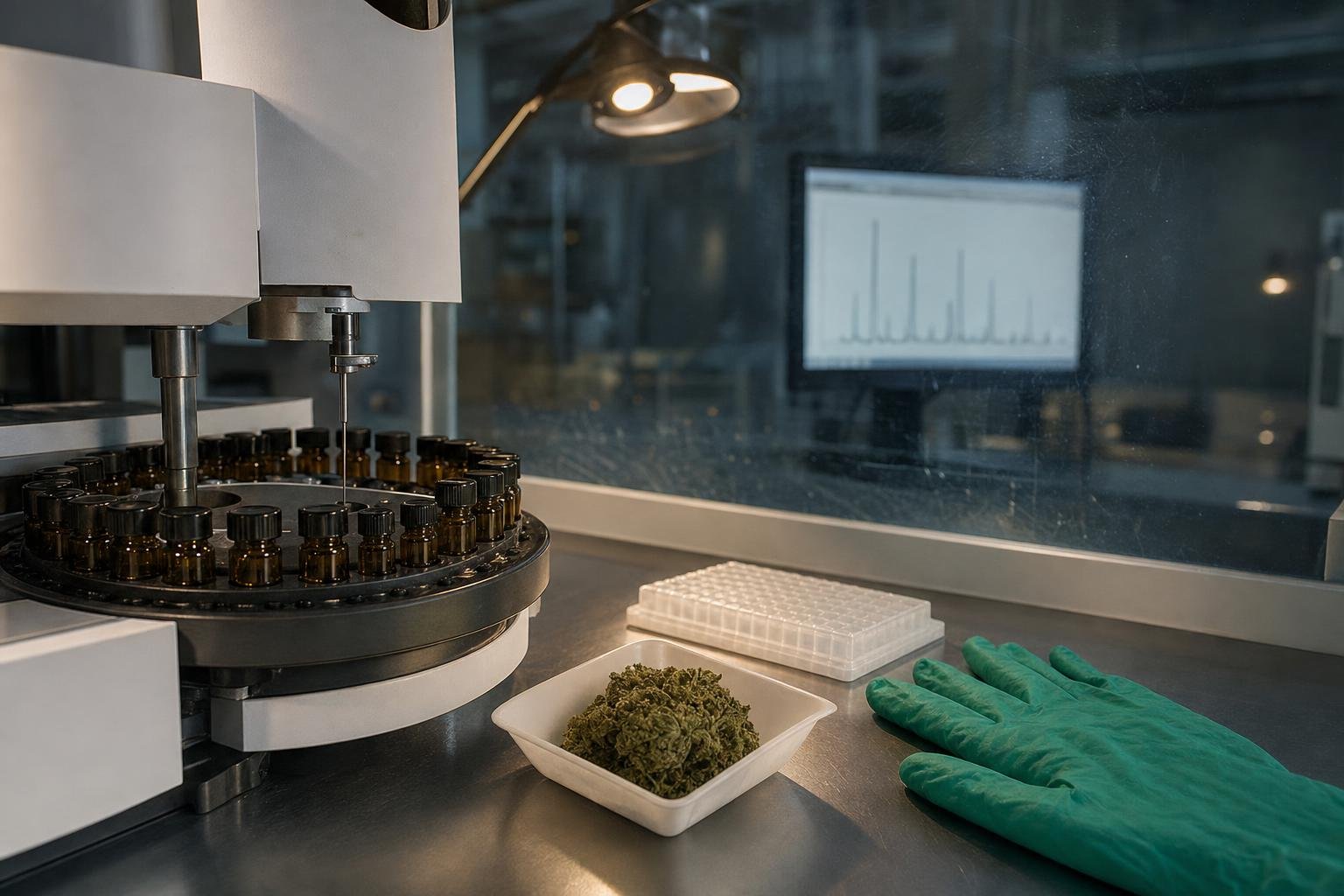
Choosing a cannabis testing lab feels straightforward until you get a certificate of analysis back that your state regulator rejects, or a pesticide result that your distributor questions, or an invoice with line items you never agreed to. I have been on both sides of that conversation, and the problems almost always trace back to questions the producer never asked before dropping off the first sample. This checklist gives you the 12 questions to ask, the regulation clauses to cite, and the answers that should make you comfortable before you commit.
Whether you are a grower shopping for a compliance lab, a manufacturer vetting a new testing partner after a regulatory audit, or a lab director benchmarking your own program against what buyers actually want, this article gives you a concrete framework. You will leave with specific questions, the regulatory citations behind them, and the red-flag answers that should send you elsewhere.
The questions fall into four clusters:
- Accreditation and licensing (Questions 1 through 4)
- Method quality and LOQs (Questions 5 through 7)
- Proficiency testing and data integrity (Questions 8 through 10)
- Pricing, turnaround, and communication (Questions 11 through 12)
Step 1: Verify the lab’s license and accreditation status independently
Do not take the lab’s word for its own license. Every state with a cannabis-testing program maintains a public license database or a searchable list of permitted labs. Pull it up yourself.
Once you have confirmed the license exists and is active, ask for the lab’s current ISO/IEC 17025 accreditation certificate. ISO/IEC 17025 is the international standard for testing and calibration laboratories; it requires documented procedures, equipment calibration, staff competency records, and regular internal audits. A certificate alone is not enough: you want the scope of accreditation, which is the attached document listing every analyte, matrix, and method the lab is authorized to report under that accreditation.
Why does the scope matter so much? Nevada’s Regulation 11 expressly requires a cannabis independent testing laboratory’s ISO/IEC 17025 scope to cover all analytes required by state rules. A lab can be genuinely ISO-accredited for cannabinoids and genuinely unaccredited for pesticides. If you send a full compliance panel to that lab, the pesticide result is not covered by the accreditation, and a regulator who checks will notice.
California’s regulations at title 4, section 15701 require licensed laboratories to maintain ISO/IEC 17025 accreditation for cannabinoids, heavy metals, microbial impurities, mycotoxins, residual pesticides, and residual solvents and processing chemicals. California also allows an interim license while a lab pursues accreditation, so a California lab you are evaluating might be operating under an interim license. That is not automatically disqualifying, but you should know which categories are and are not yet accredited.
Note: Hemp is a partial exception. USDA strongly encourages ISO 17025 for hemp-testing labs but does not require it under its domestic hemp-testing guidance. If you are testing hemp, check your state’s specific rules rather than assuming federal guidance is the ceiling.
The single most important document you can request from any prospective lab is its current accreditation scope, not its certificate.
Step 2: Confirm the lab holds the right state permit for your product type
Accreditation and licensure are separate things, and both have to be right.
California identifies its cannabis testing license as a Type 8 license and requires labs to obtain and maintain ISO/IEC 17025 accreditation as a condition of that license. Virginia’s Administrative Code, title 3, agency 10, chapter 60 requires covered cannabis-testing laboratories to hold a controlled-substances registration certificate authorizing cannabis-product testing, and separately requires the lab to be independent from other cannabis-industry participants. New York’s 9 NYCRR Part 130 requires a cannabis laboratory permit before a lab can issue required medical or adult-use cannabis reports.
The practical check: ask the lab for its license number, look it up in the state regulator’s public database, and confirm the license type covers your product category. A lab licensed for adult-use flower may or may not be permitted to test medical-use concentrates, depending on how your state structures its license categories. If you are a manufacturer, also confirm the lab is permitted to receive your matrix: edibles, tinctures, and topicals sometimes require separate method validation or a separate license endorsement.
Note: Virginia also requires the responsible laboratory-testing supervisor to hold either a relevant master’s degree plus two years of post-degree laboratory experience, or a relevant bachelor’s degree plus four years of post-degree laboratory experience, under the same chapter 60 rules. Asking who signs your COA and what their credentials are is a reasonable question, not an intrusive one.
A lab that is accredited but not licensed, or licensed but not accredited for your analyte panel, cannot issue a compliant result.
Step 3: Ask about method validation and LOQs for your specific matrix
This is where buyers leave the most money on the table, because they assume all labs running the same analytes are equivalent. They are not.
A limit of quantitation (LOQ, the lowest concentration a method can reliably measure and report with acceptable precision and accuracy) is specific to the analyte, the matrix, the instrument, and the method. An LOQ for delta-9 THC in flower is not the same as an LOQ for delta-9 THC in a chocolate edible, because the matrix suppresses or enhances the signal differently. The cited sources do not establish a universal cannabis laboratory LOQ, because none exists: request the lab’s analyte-specific LOQ table and its validation summary for your matrix.
California requires a licensed laboratory to generate a validation report for each test method, under California Code of Regulations section 15713, and to submit a new validation report to the Department within five business days of adopting a new or altered method. That means a California lab should have a validation report you can ask to see. If a lab cannot produce a validation report for the method it will use on your sample, that is a red flag regardless of what state you are in.
For a deeper look at what a validation report should contain, see our Cannabis Lab 101: Method Validation article.
Ask for the LOQ table and the validation summary for your specific matrix before you submit your first sample, not after you get a result you cannot explain.
Step 4: Review the lab’s proficiency-testing history
Proficiency testing (PT, a program in which an external provider sends blind samples to a lab and grades its results against a known value) is the closest thing the industry has to an independent performance check. A lab can have a pristine accreditation certificate and still be producing systematically biased results if no one is checking the output against a known standard.
New York’s 9 NYCRR Part 130 requires participating laboratories to pass two of the three most recent proficiency tests when an ISO/IEC 17043-approved provider offers the applicable test. Nevada’s Regulation 11 requires labs to demonstrate proficiency for all required analytes within six months of receiving a license. California requires participation in a proficiency-testing program as a condition of licensure.
Ask the lab: which PT provider do you use, how often do you participate, and can you share your most recent PT summary? A reputable lab will share this without hesitation. The answers you are looking for are a named ISO/IEC 17043-accredited provider, participation at least annually (and ideally more frequently), and a pass record. A lab that hedges, says PT results are proprietary, or cannot name its provider should not get your samples.
For context on what compliance testing programs look like from the inside, see An Introduction to Cannabis Compliance Testing.
PT history is the one quality indicator that cannot be faked in the moment, because the records either exist or they do not.
Step 5: Scrutinize the pricing structure before you sign anything
Published price lists in this industry vary enormously in what they include, and the quoted price per panel is rarely the full cost.
To give you a concrete anchor: Utah’s Department of Agriculture and Food publishes a government fee schedule for medical cannabis laboratory testing. As of the current schedule, cannabinoid testing runs $77 (high-volume) to $138 (low-volume), pesticide testing is $176, heavy metals are $121, mycotoxins are $143, microbial testing is $99 without PCR or $132 with PCR (polymerase chain reaction, a molecular method for detecting microbial DNA), residual solvents are $121, and terpenes are $121. These are government rates for a specific state program and are not a national benchmark, but they illustrate the range of line items you should be asking about.
On the private-lab side, Confidence Analytics publishes its expedite fees as $100 for Tier 1 and $50 for Tier 2 rush service, on top of panel prices.
The questions to ask any lab:
- Does the quoted price include sample collection or only receipt at the lab?
- Are all required analytes for my state panel included, or are some add-ons?
- What is the rush fee, and what turnaround does it guarantee?
- Is the certificate of analysis delivery included, or is there a portal fee?
- What happens if a sample fails and needs to be re-tested: who pays?
For a broader breakdown of testing economics, see The Cost of Testing Cannabis for Small, Medium, and Large Labs.
Get the full fee schedule in writing, not a verbal quote, before you submit your first sample.
Step 6: Evaluate data integrity practices and audit readiness
Data integrity (the assurance that analytical results have not been altered, selectively reported, or back-calculated after the fact) is the issue that ends labs. It is also the hardest thing to evaluate from the outside, but there are concrete questions that reveal a lot.
Ask the lab:
- Does your LIMS (laboratory information management system) produce an unbroken audit trail from sample login to final report?
- Are raw instrument files stored separately from processed results, and are they available to the client or regulator on request?
- How do you handle out-of-specification QC results: do you re-run, investigate, or report?
- When did you last have an internal audit, and what were the findings?
California requires a licensed laboratory to conduct an internal audit at least annually, or more frequently if required by its accreditation body, under California Code of Regulations section 15735. New York requires a laboratory regulatory audit every two years during normal business hours under 9 NYCRR Part 130. A lab that cannot tell you when its last internal audit was, or that has never been through a regulatory audit, has not been stress-tested.
I suggest labs take it a step further and ask whether the lab has ever had a corrective action request from its accreditation body and, if so, how it was resolved. That question separates labs that treat quality as a checkbox from labs that treat it as a system.
For more on what ISO 17025 audits actually look like from the inside, see Cannabis Testing Lab Certification: How to Prepare for ISO 17025 Audits.
A lab with a clean audit trail and a documented corrective-action history is more trustworthy than one that claims it has never had a finding.
Step 7: Check turnaround time, communication, and what happens when something goes wrong
Turnaround time is not regulated at the national level, and no authoritative national average exists. What matters is whether the lab’s standard turnaround fits your production schedule, whether rush service is available and priced transparently (see Step 5), and whether the lab communicates proactively when something delays a result.
The questions that reveal communication quality:
- Who is my point of contact, and what is their typical response time?
- How will you notify me if a sample is flagged for a QC issue before the COA is issued?
- If a result is at or near an action limit, do you call before issuing the COA?
- What is your policy on sample retention, and how long do you keep my samples after reporting?
A lab that calls you when a potency result looks anomalous before issuing the certificate is a lab that understands its role in your supply chain. A lab that issues a failing COA without warning and then goes quiet is one that sees you as a transaction.
For producers who want to understand what the lab is actually doing to their sample at each stage, see An Introduction to Cannabis Compliance Testing and the individual assay explainers for pesticides, heavy metals, mycotoxins, and terpenes.
The lab you choose is not just a vendor: it is the entity whose name and accreditation number appear on every certificate that stands between your product and the shelf, and that relationship deserves the same due diligence you would apply to any critical supplier.
Turnaround time is the most visible metric, but communication quality during a problem is the one that actually protects your business.
Quick answers
Does a cannabis testing lab have to be ISO 17025 accredited? In most licensed cannabis states, yes. California requires ISO/IEC 17025 accreditation for every test category a lab performs, under California Code of Regulations title 4, section 15701. Nevada requires labs to achieve accreditation within one year of licensure under Regulation 11, and New York requires ISO/IEC 17025 accreditation or an equivalent approved by the Office of Cannabis Management under 9 NYCRR Part 130. Hemp is a partial exception: USDA strongly encourages ISO 17025 for hemp-testing labs but does not require it under its domestic hemp-testing guidance.
How much does cannabis testing cost per sample? Prices vary by state, matrix, and panel, so no single national average applies. Utah’s published government fee schedule lists cannabinoid testing at $77 to $138, pesticide testing at $176, heavy metals at $121, mycotoxins at $143, and residual solvents at $121 per sample. Always ask whether a quoted price covers sampling, the full analyte panel, repeat analyses, rush fees, and certificate-of-analysis delivery, because labs itemize these differently.
What is an accreditation scope and why does it matter? An ISO/IEC 17025 accreditation scope is the document that lists exactly which analytes, matrices, and methods a lab is authorized to report under its accreditation. Nevada’s Regulation 11 expressly requires the scope to cover all analytes mandated by state rules, so a lab accredited only for cannabinoids cannot issue a compliant pesticide result even if it runs the assay. Always request the current scope certificate and compare it line by line against the panel you need.
How do I check whether a cannabis lab has passed its proficiency tests? Ask the lab directly for its most recent proficiency-testing results and the name of the PT provider. New York’s 9 NYCRR Part 130 requires labs to pass two of the three most recent proficiency tests for each analyte category when an ISO/IEC 17043-approved provider offers the test. A lab that cannot or will not share PT results is a red flag.
What qualifications does a cannabis lab supervisor need? Virginia’s Administrative Code, title 3, agency 10, chapter 60 requires a responsible laboratory-testing supervisor to hold either a relevant master’s degree plus two years of post-degree laboratory experience, or a relevant bachelor’s degree plus four years of post-degree laboratory experience. Requirements vary by state, so ask any prospective lab for the credentials of the person signing your certificates of analysis and check your own state’s rules.
Can a cannabis testing lab charge extra for rush turnaround? Yes, and published pricing confirms it. Confidence Analytics lists a $100 Tier 1 expedite fee and a $50 Tier 2 expedite fee on its public pricing page. Rush fees are not regulated in most states, so always ask for the full fee schedule in writing before submitting time-sensitive samples.
Sources
- California Code of Regulations, title 4, section 15701 (DCC regulations text)
- California DCC: Type 8 testing laboratory license types
- California DCC: Testing laboratories licensee page
- Utah Department of Agriculture and Food fee schedule
- Virginia Administrative Code, title 3, agency 10, chapter 60
- Nevada Cannabis Compliance Board Regulation 11
- New York 9 NYCRR Part 130, OCM cannabis laboratory testing regulation
- Confidence Analytics: Test Packages and Pricing
- California DCC: Notifications and Requests Regarding Testing Laboratories (sections 15713, 15735)
- USDA AMS: Laboratory Testing Guidelines, U.S. Domestic Hemp Production
FAQ
Frequently asked
- Does a cannabis testing lab have to be ISO 17025 accredited?
- In most licensed cannabis states, yes. California requires ISO/IEC 17025 accreditation for every test category a lab performs, under California Code of Regulations title 4, section 15701. Nevada requires labs to achieve accreditation within one year of licensure under Regulation 11, and New York requires ISO/IEC 17025 accreditation or an equivalent approved by the Office of Cannabis Management under 9 NYCRR Part 130. Hemp is a partial exception: USDA strongly encourages ISO 17025 for hemp-testing labs but does not require it under its domestic hemp-testing guidance.
- How much does cannabis testing cost per sample?
- Prices vary by state, matrix, and panel, so no single national average applies. Utah's published government fee schedule lists cannabinoid testing at $77 to $138, pesticide testing at $176, heavy metals at $121, mycotoxins at $143, and residual solvents at $121 per sample. Always ask whether a quoted price covers sampling, the full analyte panel, repeat analyses, rush fees, and certificate-of-analysis delivery, because labs itemize these differently.
- What is an accreditation scope and why does it matter?
- An ISO/IEC 17025 accreditation scope is the document that lists exactly which analytes, matrices, and methods a lab is authorized to report under its accreditation. Nevada's Regulation 11 expressly requires the scope to cover all analytes mandated by state rules, so a lab accredited only for cannabinoids cannot issue a compliant pesticide result even if it runs the assay. Always request the current scope certificate and compare it line by line against the panel you need.
- How do I check whether a cannabis lab has passed its proficiency tests?
- Ask the lab directly for its most recent proficiency-testing results and the name of the PT provider. New York's 9 NYCRR Part 130 requires labs to pass two of the three most recent proficiency tests for each analyte category when an ISO/IEC 17043-approved provider offers the test. A lab that cannot or will not share PT results is a red flag.
- What qualifications does a cannabis lab supervisor need?
- Virginia's Administrative Code, title 3, agency 10, chapter 60 requires a responsible laboratory-testing supervisor to hold either a relevant master's degree plus two years of post-degree laboratory experience, or a relevant bachelor's degree plus four years of post-degree laboratory experience. Requirements vary by state, so ask any prospective lab for the credentials of the person signing your certificates of analysis and check your own state's rules.
- Can a cannabis testing lab charge extra for rush turnaround?
- Yes, and published pricing confirms it. Confidence Analytics lists a $100 Tier 1 expedite fee and a $50 Tier 2 expedite fee on its public pricing page. Rush fees are not regulated in most states, so always ask for the full fee schedule in writing before submitting time-sensitive samples.
Related guides
All guides- 01
Cannabis Lab 101: Cannabis Edibles Testing Cost — Why Infused Products Cost More to Test
I spent four years running potency assays on everything from flower to fudge, and infused products always took longer and cost more. Here is exactly why — matrix effects, homogeneity requirements, and the extra sample prep no one explains — plus real prices from published lab menus.
- 02
Cannabis Lab 101: Cannabis Lab Technician Salary by State and Role
I pulled every sourced number I could find from ZipRecruiter, Indeed, and Salary.com to build a real salary table by role — from sample-prep tech to lab manager. Here is what the data actually says, what drives the spread, and how to negotiate your next offer.
- 03
Cannabis Lab 101: Proficiency Testing — How Labs Prove They Get the Right Answer
I spent years running compliance assays and watching labs treat proficiency testing as a paperwork box to check. It is not. PT is the only external proof that your numbers mean something — and regulators in every licensed state are watching the scores.
Need this tested?
Compare labs that run these assays and get quotes in one go — no account, no fee.